Years before I knew anything about horse welfare science, I was running an agency experiment on humans. I just didn’t know that’s what it was.
The last line of defense
The first four years or so of my career at a major telecom, I worked in a network test center. We were the last tier. By the time a customer reached us, they had already been bounced through every layer of customer support that came before. They had explained their problem four times. They had been transferred. They had been put on hold. They had been told things that turned out not to be true. They had been told nothing at all.
By the time they got to me, they were frothy. Not difficult — frothy. Stripped down to their last nerve. And my job was either to fix it, or to explain — with enough credibility to land — exactly why what looked like a problem was actually the system working as designed.
I only worked in the test center for those early years, but what I learned there carried me through the rest of a twenty-six-year career. The thing that worked, almost every time, was not the fix.
It was the menu.
What I actually said
Once I understood the situation, I would stop trying to push a single resolution. I would lay out what was actually possible. Something like:
- I can add this to your line.
- I can remove this from your line.
- I can fix this so it works the way you want it to.
- I can explain how this is supposed to work, so you can decide whether it’s worth keeping.
That was it. Not unlimited choices. Not everything they wanted. Sometimes the menu was three things, sometimes two. Sometimes one of the items was a frank explanation of why the thing they were asking for wasn’t going to happen. The menu was bounded by what was actually within my power to do.
And almost every time, the customer’s tone shifted before they even picked an option. The frothy edge dropped out of their voice. They moved from fighting me to thinking with me. Sometimes they picked the option I would have picked for them anyway. Sometimes they picked the “explain it to me” option and we ended the call without changing a single thing on the account, and they thanked me.
I thought, for a long time, that this was a customer service trick. A way of de-escalating a hard call. It was actually neuroscience. I just didn’t have the vocabulary for it yet.
The vocabulary I was missing
Animal welfare scientists have a name for what I was doing. They call it agency — the ability of an individual to act on their own will, to engage with their environment in a way that serves their own goals, to gather information and make a real choice about what happens to them. Researchers in the field talk about three Cs of agency: choice, control, and challenge. The ability to choose between options. The ability to actually affect the outcome. The ability to do something that takes some skill or attention to figure out.
Agency is not a luxury. It’s a welfare input.
Strip it from a system — any system with a nervous system on the receiving end — and the system gets sicker, more reactive, harder to work with, and over time, quieter in a way that looks like compliance but isn’t.
Restore it — even imperfectly, even partially, even with two options instead of ten — and the system starts to self-regulate again.
The customer on the line was a frothy horse. The frothy horse is the customer who has been told “no” five times in a row and has stopped trying. The mechanism is the same. And that is not a metaphor. It is research.
Three studies. One pattern.
Last week’s issue of The Receipts, our Tuesday research newsletter, walked through three studies on horses and choice. I want to put them back on the table here, because together they make a single argument that holds up against any rigor you want to apply to it. This is the long version, with the full citations and the welfare science underneath.
Receipt 01 · Hydration: flavored water doesn’t replace plain water. It drives more of both.
A 2021 Washington State University study tested 40 hospitalized horses over 72 hours. Every horse had access to two buckets of water. The control group got two buckets of plain water. The three test groups got one bucket of plain water plus one bucket of flavored water (sweet feed, peppermint, or apple-electrolyte).
The headline result: horses given a sweet-feed-flavored option alongside their plain water drank significantly more total water than the controls who only had plain water available. For an average 1,100-pound horse, that worked out to roughly 3.5 additional gallons of water per day — with the study’s confidence range running from about 1.9 to 5.1 extra gallons depending on the horse (P = 0.0001, which is about as statistically strong as veterinary intake studies get). Not a rounding error. Not a vague trend. Three and a half gallons, every day, from adding one flavored bucket beside the plain one.
Here’s what I see in my own herd that explains it. The horses go back and forth between the two buckets. They drink some flavored water, then drink some plain water, then go back to the flavored. It’s not an either-or. They don’t drink the flavored bucket dry while ignoring the plain — they drink more of both. Plain water gets used like a palate cleanser between sips of flavor. Like reaching for a glass of milk between bites of a cookie. The variety is what keeps them coming back to the buckets, and what they come back to is everything in the stall, plain water included.
The flavored bucket isn’t competing with the plain bucket. It’s making the plain bucket more interesting too.
A note from the founder
The strong result in this study came from sweet-feed-flavored water — basically, water with a scoop of sweet feed mixed in. Some commercial mashes work the same way: a high-sugar, high-calorie feed product gets dunked into water and the horse drinks more. That works. The science here is real.
The science is also incomplete in a way I want to name out loud, because it matters.
The study tested sweet feed water. It did not test no-added-sugar, low-calorie, whole-food flavored water against sweet feed water side by side. I cannot give you a head-to-head number that says Improve Equine’s flavors drive total intake equally well, because that study has not been run yet. I would love to see it, and one day I would like to fund it.
What I can tell you is what the broader research shows. The Goodwin study you’ll see in Receipt 02 ranked the top eight flavors horses preferred when given a real choice. Fenugreek, an herb, came in first. Rosemary, cumin, peppermint, and oregano — all herbs and spices, none of them sugar — also placed in the top eight. The horses’ preferences are not driven by sugar alone. They are driven by flavor variety as a real choice alongside plain water, and many of the preferred flavors are herbs and spices that don’t carry a sugar load at all.
The Improve Equine flavors are built on that finding. Whole food, whole herbs and spices. No added sugar, no added salt, no electrolytes, under 35 calories per serving, safe for metabolic and Cushing’s horses.
What we are trying to do is innovate on giving horses a healthy choice. Horses get offered a lot of choices that are less than healthy — treats, sweet mashes, bribes to get them to take medicine, sugary additives in their water to get them to drink. Each one gets rationalized on its own. It’s just this once. It’s just for an event. It’s just to get her to drink. It doesn’t happen that often. The cumulative load adds up over a year.
The premise of this company is that the welfare benefit of choice doesn’t have to come with a sugar payload, a calorie load, or a feed dump in the bucket. You can give your horse the agency the science is talking about in a format that doesn’t compound a different problem.
— Sara
Citation: Van Diest TJ, Kogan CJ, Kopper JJ. (2021). The effect of water flavor on voluntary water intake in hospitalized horses. Journal of Equine Veterinary Science, 98:103361. DOI 10.1016/j.jevs.2020.103361
Receipt 02 · Variety isn’t a preference. It’s biology.
Horses are patch-foragers. They evolved to move across landscapes, sampling different plants based on visual cues, odor, taste, texture, and — critically — variety itself. That last part isn’t a luxury. It’s how a free-roaming horse self-medicates, balances nutrients, and adapts to whatever the landscape is offering that month.
Goodwin and colleagues offered stabled horses a battery of fifteen different flavors layered into otherwise-identical concentrate diets. The horses showed clear, consistent preferences (fenugreek and banana topped the list) and used flavor variety to drive feed acceptance. The takeaway: when the same horse gets the same hay, the same grain, and the same plain water for months, we are asking a patch-forager to thrive in a monoculture. The picky eater turning up their nose at a bucket they have eaten from for ninety days is not being difficult. They are following biology.
You can’t redesign a system to violate its own architecture and call the user broken when it fails. Engineering knows this. Welfare science knows this.
Citation: Goodwin D, Davidson HPB, Harris P. (2005). Selection and acceptance of flavours in concentrate diets for stabled horses. Applied Animal Behaviour Science, 95(3-4):223-232. DOI 10.1016/j.applanim.2005.04.007
Receipt 03 · Lack of choice is itself a stressor
This is where the research gets harder to look at. Hall and colleagues laid out the case in 2008 that horses living in environments where their behavior cannot affect outcomes — where their actions don’t change anything — show measurable signs of learned helplessness: passivity, behavioral despair, reduced ability to learn new tasks. The same condition that was first documented in dogs in the 1960s, the same mechanism that shows up in chronically stressed humans, applies to horses too.
The chronic stress markers tell a complementary story, and an interesting one. A 2021 four-season hair cortisol study by Mazzola and colleagues didn’t find that “stables make horses sick.” What it found was more useful than that: horses who had the option to come into the stable at night showed lower chronic stress markers than horses whose stable access was decided for them, in either direction. The variable wasn’t the building. The variable was whether the horse got to choose.
And in April of this year, a single-author review article from Cornell’s Department of Animal Science synthesized the entire research domain under the title that says everything: Opportunities for agency in domestic horses. The author, Dr. Lindsay Goodale, is the one who introduced the three-Cs framework I used above — choice, control, challenge — and her review is open access if you want to go read it yourself. I recommend you do.
It does not have to be the perfect choice. It does not have to be the choice you would have made for them. But it has to be a choice, and the horse has to be the one making it.
Citations: Hall C, Goodwin D, Heleski C, Randle H, Waran N. (2008). Is there evidence of learned helplessness in horses? Journal of Applied Animal Welfare Science, 11(3):249-266. DOI 10.1080/10888700802101130 · Mazzola SM, et al. (2021). Do You Think I Am Living Well? A Four-Season Hair Cortisol Analysis on Leisure Horses in Different Housing and Management Conditions. Animals, 11(7):2141. DOI 10.3390/ani11072141 · Goodale L. (2026). Opportunities for agency in domestic horses: Applying the behavioural domain to increase equine welfare. Animal Welfare, 35:e26. DOI 10.1017/awf.2026.10085
The line that holds it all together
Horses don’t need predictability of options. They need predictability of access to options.
That distinction is the whole game. Horse care has historically tried to deliver welfare by standardizing everything — same feed, same water, same routine, same everything — on the assumption that consistency itself is calming. Some of that is true. Predictability of access matters. Knowing the food shows up at six and the water bucket gets refilled at four matters. Horses are creatures of routine and there is real welfare value in that.
But predictability-of-access has been confused with predictability-of-options, and they are not the same thing. A horse who knows that fresh water will be there twice a day, and that a few different flavor choices will sometimes be in those buckets, and that the choice of which to drink belongs to them — that horse has both. Predictable access. Real choice within that access.
That horse is not stressed by variety. That horse is fed by it.
What this looks like in your stall
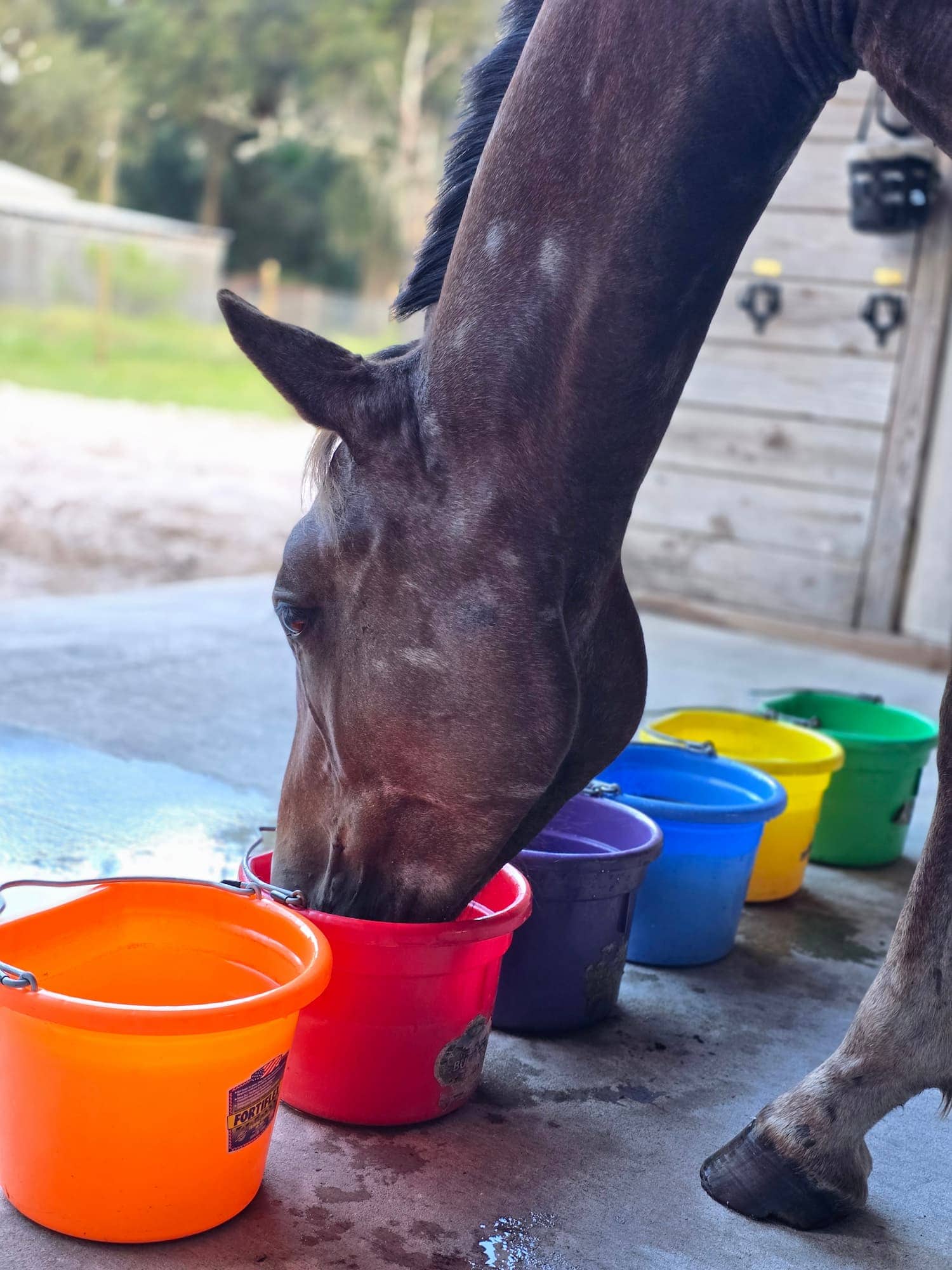
The Water Buffet method is the equine version of the menu I was offering frothy customers a quarter-century ago. Three to five buckets out, different flavors, plus plain water always available. The horse picks. The horse changes their mind. You watch which buckets empty fastest and you get better data on your horse’s preferences than any forced-thirst electrolyte protocol could ever give you. Here is the full method.
You don’t need a full buffet to start.
A “mini buffet” is enough. Plain water in one bucket. A second choice in another — even just a different temperature, a different location, a different bucket. That is still a choice. The act of gathering information and making the choice itself is what gives the horse agency. It does not have to be unlimited. It does not have to be perfect. It has to belong to the horse.
If you want to try it with our flavors, you can browse the twelve options here, or grab a sampler if you want to test a few without committing to a full pouch. If your horse is metabolic or has Cushing’s, the products are formulated with no added sugar and we have a dedicated guide for that.
Frequently asked, with the welfare answer
How many buckets do I need to start a Water Buffet?
Two. That’s it. One bucket of plain water and one bucket of anything else — a different flavor, a different temperature, a different location, a different bucket entirely. The minimum effective version of choice is one option plus an alternative. The act of choosing is the agency, not the size of the menu.
My horse only drinks one flavor. Am I doing it wrong?
No. That’s the whole point. Your horse is exercising agency — gathering information, making a preference, sticking with it. Watch which buckets empty fastest. That’s data, not failure. The Water Buffet works because the horse is choosing, not because the horse is sampling everything.
Doesn’t giving horses too many choices stress them out?
This is the most common pushback, and the research speaks directly to it. What stresses horses isn’t variety. It’s unpredictability of access — not knowing whether food and water will be there at all. Predictability of options is different from predictability of access, and conflating the two has cost a generation of horses real welfare. Knowing the buckets will be there at the same time every day is the structure. What’s in those buckets, and which one the horse picks, is the agency.
What if my horse refuses everything new?
This one is interesting. The R&D research from the pet food industry has a recurring finding: people think they know what their animals will accept, and when researchers run blind trials, the animals often don’t respond the way the owners predicted. Horses are no different. My mare Lorilei refused the flavors entirely for the first month or two. I didn’t push her. I just let her watch the other horses drink from them, kept the buckets out, and gave her time. Eventually she tried them on her own terms. Exposure without pressure is itself a form of choice — the choice to investigate, on her timeline, with no consequence for opting out. That is agency too.
How is this different from electrolytes?
Electrolytes have a real and legitimate use. When a horse has actually depleted minerals through hard work, heat, or illness, electrolytes rebalance what’s been lost. In emergency dehydration, electrolytes give you an osmotic lever to pull water into the body faster than plain hydration can. Those uses are real and important.
But somewhere along the way, the industry started using electrolytes as a daily hydration tool — dosing horses with salt to make them thirsty so they would drink more. That’s legacy thinking, and it conflates two completely different jobs. Recovery from a mineral deficit is one job. Day-to-day hydration is another. We’ve been using the recovery tool to do the hydration job, and that’s why so many horses end up on rotating electrolyte protocols their bodies don’t actually need.
The Water Buffet decouples the two. Hydration is the everyday concern — horses need to drink, and they drink more when they have a real choice. Electrolytes stay in their proper lane: a tool for actual depletion or genuine emergency, deployed when they’re actually called for. Modernizing hydration means understanding the difference, and not asking one tool to do two jobs.
My horse is metabolic or has Cushing’s. Is the Water Buffet safe?
Our products are formulated with no added sugar, no added salt, no electrolytes, and no copper, with under 35 calories per serving. They are safe for metabolic horses, Cushing’s horses, and the rest of the farmily. Full guide on safe hydration for metabolic horses here. Always loop your vet in for any horse with active metabolic disease — that’s their lane, not mine.
I’m a busy boarder. What’s the minimum effective version?
Two buckets. Done. Plain water always available. One alternative beside it — even a second bucket of plain water in a different spot in the stall. That is still a choice. You are not coddling your horse. You are handing the system back its self-correction loop.
Back to the test center
The reason the frothy customers calmed down was never that I always fixed the problem. Sometimes the right answer was “I can’t change this, and here is why it’s designed this way.” Sometimes the right answer was a partial fix that wasn’t the one they originally wanted. Sometimes the right answer was the one they would have arrived at on their own if anyone had given them five quiet minutes and a real menu.
The mechanism wasn’t the resolution. It was the respect for their agency in arriving at one.
Horses deserve no less. The science says so. Our farm runs on it. And if you want to try the smallest possible version of it — one extra bucket, one extra choice — that is enough to start.