The front yard
I’d taken lessons for years when my mom did the most loving thing a parent can do for a horse-crazy ten-year-old: she gave me a horse for my birthday — Windy, a sixteen-hand Thoroughbred-Appaloosa mare, that we brought home and put in our front yard.
Picture it, because it really is as “what were you thinking?” as it sounds. A six-foot privacy fence, and over the top of it, a horse’s ears. A tiny yard in a neighborhood, by herself with no shelter but the trees. This was the Tizwhiz and Red Cell era and we fed her straight alfalfa — I couldn’t tell you how much — and coffee cans of sweet, molasses-soaked grain. She’d nicker when we came out and we mistook it for hunger, and fed her more. I can still see her in that yard, shaking, wound so tight on sugar with nowhere to burn it off, and none of us had a clue that we were the cause.
We moved her to a neighbor’s barn a couple of months later but the part that matters is this: nobody was intentionally careless. Not my mom, not me.
I had done the thing you’re supposed to do — I’d taken the riding lessons to learn about horses… and none of it taught me how to properly take care of a horse on our own.
I knew how to ride. I had no idea how about horse care.
The day at Walnut Creek
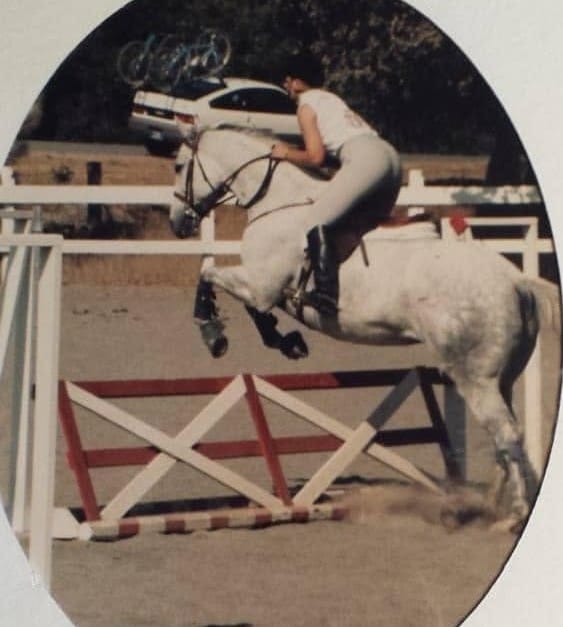
The last phase was stadium, always Chickie’s best. Square, tight knees, a handy little mare. We came in for our courtesy circle, I saluted, and I remember what went through my head: we’re gonna go show you some good shit. I wasn’t thinking about a ribbon; I was feeling myself. I knew we were good at this, and it didn’t matter to me who was watching. We put together that smooth round where every distance came out of stride, every lead change was balanced and right on time; it felt like water pouring out of a pitcher over the jumps. A perfect, joyful ride on a horse I loved.
I left the ring, went back to the trailer, untacked her, watered and fed her, and I was rubbing her down when my trainer came over and asked why I hadn’t come back for the awards. I told her, “I had to take care of my horse.” She said, “You won.”
Something rearranged itself in me that day. Not we won — that part was nice. What stuck was that I’d ridden an incredible round and in needing to take care of my mare, the placing never once crossing my mind. Standing at that trailer, I had an epiphany: it doesn’t matter to me whether I can win against you. There were horses at that show worth more than the house I lived in. That isn’t a contest; it never was. The only question that ever lit me up was how far this horse and I could go together. Not compared to everyone else. Just within our partnership.
Showing may be in my future again one day… I’m looking at you, baby Tae… but it hits differently now.
There was never one right answer
In all my years I have never met two people who do horsemanship identically — not even two riders in the same program, under the same trainer, on the same farm. As hard as this world pushes for one right way, it can’t even manufacture uniformity among people straining to comply. The horse who is an outlier on care. The horse who needs the opposite of what the book prescribes. The routine that works beautifully for your barnmate’s gelding and does nothing for yours. There is a lot of room to be effective beneath the umbrella of that might work.
So much of what keeps people uneasy is the suspicion that ONE correct version exists and they’re falling short of it. It doesn’t exist.
There’s your horse, there’s you, and there’s the work of finding what’s true between the two of you.
It’s not that I can’t. It’s that I don’t.
I started a non-riding horsemanship program, and some people assume that means I can’t ride my horses.
It’s not that I can’t ride them. It’s that I don’t.
Wick, my Mustang, is green broke, and I’ve ridden him plenty. He also loves to buck, I’ve broken my tailbone coming off him, and there’s real apprehension there for me now. Working through it isn’t a priority for us at the moment, so we don’t. That’s a choice. I still love our daily relationship and our growth together hasn’t stopped just because the saddle gets dusty.
Lorilei is on a ten year plan from feral to safe-ish. If she’s not there in ten years, well, we will be on a twenty year plan. And Tae, while giant, is only two years old and won’t be backed until he is four or five… or six.
Reacher survived a septic tendon injury and his recovery has been called a miracle by two vets. He’s out in the pasture running and playing and looking sound, and my vet thinks I probably could ride him…a lot of other people probably would… but when I trim his feet, he struggles to hold weight on that leg for long so I won’t add mine to it. Nobody handed me that as a rule. It’s a judgment made by listening to the horse I know in front of me instead of the horse everyone else sees tearing around the pasture like a maniac with his boys.
And that is the thing the lessons never taught me, and the thing I most want to teach now: not how to steer a horse around an arena, but how to read the one in front of you and trust what you see enough to act on it.
The door I built
A riding program was never truly on the table for me — and rather than a problem, that became a useful thought experiment. What does this look like if the saddle was never the point? What if loving them were reason enough to be here?
Consider the two primary doors a horse-loving kid actually gets. One: take lessons and climb. Two: buy your own horse and work it out (possibly) alone. What if we offered a third door, the one that simply says: come learn to be with them. Come learn to care for them, to read them, to keep them well. You don’t have to own one, and you don’t have to ride.
That third door is the program I built. And I built it, I think, for the little horse-infatuated girl I used to be.
In practice it looks like this. We cover behavior, first aid, aspects of nutrition, trimming, the early and subtle signs that something is wrong… but more than any curriculum, it’s the posture. My student arrived looking for constant instruction, the way we’re all trained to. Now when she gets here, I ask one question: what do you want to work on today?
In her journey down this road she found a passion in equine bodywork. She learns from several other trainers, the same way I do, and when she comes back with “I learned this, I want to try it,” I don’t shut it down to guard my authority — I tell her the truth, usually some version of “I’ve wanted to take that course for ages and never found the time, so teach me.” Her knowing things I don’t doesn’t threaten me. I’m keenly aware that I don’t know everything, and the best thing I can give her is good judgment and an environment that welcomes as much information as she can gather — including from people who aren’t me.
There’s a moment from recently I keep returning to. Her husband was visiting, she was showing him around and introducing him to the horses. I was about to leave on a work trip with her minding the farm. She was confirming the details, making sure she wasn’t forgetting anything, and I said what I often say, “Nothing is that big of a deal.”
She stopped and smiled, and told me that everywhere else in her life she carries a constant fear of getting things wrong — the same fear she’d walked into my barn with on the first day. “But not here,” she said. “I worry about doing things wrong everywhere else — everywhere but the barn. Because here, I know it’s okay.” Here, she’d learned that everything self-corrects. You try something; if you don’t like how it goes, you adjust and do it differently next time. That isn’t a lowering of the bar.
It’s how we develop the knowledge and good judgement that she’ll need when she has a horse and is on her own one day. It’s what trust and autonomy feel like from the inside.
Being with horses — truly learning to listen to them and care for them well — is a deep, lifelong, endlessly rewarding discipline. It takes years to get good at. It asks for no saddle and no ribbon. When we stop micromanaging the human and stop scoring the performance, the barn stops being a place you can fail and becomes what it was always meant to be: a place where you’re allowed to feel safe simply loving them.
Frequently Asked Questions
What is non-riding horsemanship?
It’s what it sounds like — learning to be with horses and care for them well, without the saddle as the goal. Behavior, first aid, nutrition, trimming, reading the subtle early signs that something is wrong, and building the judgment to act on what you see. Riding is one skill a horse person can have. It was never the whole of horsemanship, and for a lot of people it isn’t even the part that matters most.
Do I have to own a horse to learn this?
No — and that’s part of the point. The traditional options are take riding lessons, or buy your own horse and figure it out alone. A non-riding program is a third door: a way to learn how to be around horses and care for them, before you ever own one, or whether or not you ever do.
Can you really learn horsemanship without ever riding?
Yes, and I’d argue it’s the half most of us skipped. I rode for years before I could keep a horse healthy in my own yard. Riding taught me to ride. It didn’t teach me to care for one. Those are two different educations, and only one of them prepares you to be alone with your horse on your own land.
Why don’t you ride your own horses?
It’s not that I can’t — it’s that I don’t, and each one is a specific decision. Wick is green broke and loves to buck; I’ve broken my tailbone off him, and working through that isn’t a priority right now. Lorilei is years into going from feral to safe. Tae is two and won’t be backed for years. Reacher came through a septic tendon injury and looks sound, but he tells me at his feet that he’s still not comfortable carrying his own weight, so I won’t add mine. Riding isn’t the measure of the relationship I have with any of them.
Isn’t riding the point of having horses?
For some people, in some seasons, absolutely. But the point is different for every person and every horse — I’ve never met two who do this identically. If the only door into horses is the one marked “learn to ride,” a lot of people who would have made extraordinary horse people never get in at all. I’d rather widen the doorway.