Foundations cover what a horse needs. Optimization is what happens when you decide to do better than the floor — and the only way to do that is to control your levers independently.
For the past two weeks, we’ve been working through the foundations. The Cost of “Free” Water spoke to how important hydration is in our horses and why it’s necessary to prioritize and plan it in our horse’s daily lives because of how many systems it affects. This week, we’ve discussed the nutritional foundation and how between forage, a ration balancer, and one to two tablespoons of iodized table salt, a horse’s basic needs, including trace minerals, are all covered.
Now here’s where the fun starts. Optimization. When we have a solid base to build off of, all of our supplements have the greatest opportunity to succeed when applied correctly.
Reading what’s in the bottle
Walk through any supplement aisle and you’ll see products built around synergy — a pharmacological term for when two or more ingredients elevate each other’s effects, producing a result greater than what each one would deliver alone. That’s a genuinely useful design principle when the combined ingredients are matched to the outcome you’re after. The question every owner should be asking is whether the multiple inputs in a given product actually match the need they’re trying to address. The bottle promises one thing. The chemistry inside is doing several things at once. Understanding what those things are — and whether they fit your specific horse’s situation — is the difference between a tool that’s working for you and a tool that’s overcorrecting in a direction you didn’t intend.
Joint supplements are a quick example of why this matters, and one I’m thinking through for my own horses right now. There are really two distinct situations under that one shelf label. The first is a young or sound horse where I’m trying to support healthy joints and prevent damage going forward. The second is a horse who already has joint damage, where I’m trying to support healthy remodeling, prevent further degeneration, and reduce inflammation and discomfort. The ingredients in a joint supplement may help one situation, the other, or both. They are not the same outcome, and they aren’t always served by the same combination. The question — am I spending money on the right product for the outcome I’m actually trying to achieve? — is the question every supplement purchase deserves.
Which brings us to one of the most common combinations in the horse world, and one of the most worth understanding clearly — electrolytes and water.
The coupled lever
In the case of hydration, we have always leaned into the idea that either my horse drinks plain water just fine, or my horse isn’t drinking enough and so I need to give them extra salt and electrolytes to make them thirsty so they will.
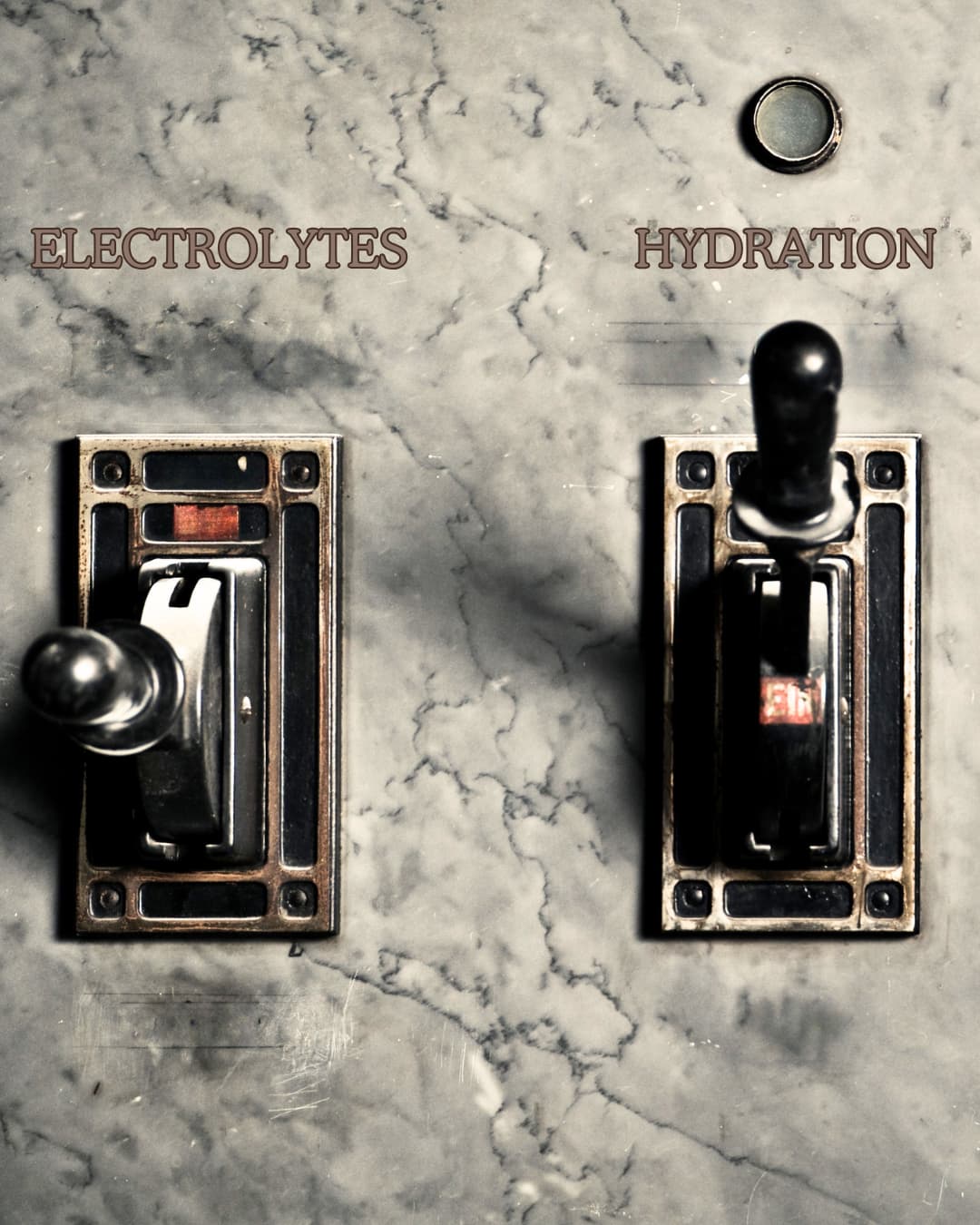
That’s coupling two inputs to generate one result. The industry has handed us electrolytes and water as one solution for decades. Add electrolytes, the horse gets thirsty, and (hopefully) the bucket empties… biochemistry is assumed to be balanced. But in this situation you can’t dial up water intake without also dialing up sodium. You can’t address an electrolyte deficit without also driving thirst. Whatever the right answer was for either question individually, you’re now hitting one compromise number somewhere in the middle.
Decouple them and you can optimize for both.
Hydration as its own problem
Sometimes a horse simply needs water, and you can move them toward it faster by giving them something they want to drink. Peer-reviewed research bears this out: when horses have access to a drink they find desirable, they will voluntarily take in up to three and a half gallons more per day (Van Diest et al., 2021, Journal of Equine Veterinary Science).
Three and a half gallons a day is reserve. It’s resilience to travel stressors. It’s a buffer for water that suddenly smells different at a new venue, for the bucket they don’t like, for the cold snap that drops trough temperature thirty degrees overnight. In the most literal sense, it’s a margin of safety for everything else you’re going to ask of that horse.
No sodium load is required to produce that result. The horse drinks because the water tastes like something they want. The mechanism is behavioral, not osmotic — and the tool stays dedicated to one job.
Electrolytes as their own problem
Look at it seasonally. In winter, if a horse is getting one to two tablespoons of iodized salt and a ration balancer, the electrolyte side is already handled. They just need water. The foundation is doing its job.
Summer changes the picture. So does any horse working at performance levels. The trace mineral profile that needs to be replaced for a horse standing out in the Florida sun grazing all day is different from a horse competing in a fifty-mile endurance race. Slow, steady, low-volume sweat losses across months of heat are not the same physiological problem as acute, massive losses concentrated into a single endurance event.
Once the two levers are separate, you get to choose the exact mineral profile that matches the situation your horse is actually in. You’re not picking one product and hoping it works for everything. You’re matching the tool to the job.
How you deliver also matters as much as what you pick
This is where the research has something specific to say.
Add electrolytes to a horse’s drinking water and you have to make sure they actually drink the entire amount of that water to get the full dose — and many won’t, because heavily mineral-laced water often tastes off enough that voluntary intake drops. The horse drinks less, takes in fewer minerals than intended, and the protocol won’t work as designed.
The other common method is paste, dosed orally by syringe. This is standard practice for endurance riders during competition, and it’s where the research gets specific. Holbrook et al. (2005), published in the Equine Veterinary Journal, ran a randomized, blinded, crossover trial on fourteen horses given concentrated electrolyte paste orally once per hour for eight hours — simulating typical endurance competition practice. The result: a statistically significant increase in both the number (P = 0.0174) and severity (P = 0.0006) of gastric ulcers in the squamous gastric region. The authors concluded that this schedule of supplementation, commonly used in endurance horses, may be harmful to the gastric mucosa.
That’s a real finding. It doesn’t mean electrolytes themselves are the villain. It means hypertonic paste, delivered to an empty stomach repeatedly across a competition day, has a measurable physiological cost. A follow-up by Alshut et al. (2023) in the Journal of Veterinary Internal Medicine tested whether sodium chloride pellets fed with meals twice daily produced the same gastric damage. They did not. The fed-with-food approach neither caused nor exacerbated lesions over the study period.
Read those two papers together and the pattern is clear: it’s not the minerals causing the problem. It’s the delivery — concentrated, repeated, on an empty stomach, into the part of the stomach least equipped to handle a hypertonic insult. When the same minerals go in with feed, forage and saliva buffer the gastric environment, the horse absorbs the dose gradually, and compliance with the full intended amount is much higher. Same chemistry. Completely different outcome.
So instead of a single lever pulled whenever we suspect dehydration, we’re building a system — components that can be dialed in independently to give the horse what they need, in the form they tolerate best, for the situation they’re actually in.
What this looks like in practice
The argument falls apart without worked examples. Here are three real situations, each calling for a different combination of the same two levers.
Situation: Winter cold snap, pasture horse at maintenance.
Protocol: Foundation already covers the mineral side — forage, ration balancer, one to two tablespoons of iodized salt daily. The risk is water intake. When the temperature drops thirty degrees and the trough goes from comfortable to ice-rimmed, voluntary water consumption plummets, and impaction colic risk climbs. Three days before the forecasted cold snap, put a water buffet out in the pasture — plain water alongside palatability-enhanced options the horse already likes. Build reserve before they need it. The mineral lever stays where it is. Only the intake lever moves, intentionally, in advance.
Situation: Traveling to and competing in a fifty-mile endurance event.
Protocol: Foundation is still the floor — forage, ration balancer, iodized salt. The optimization play has multiple moving parts, each pulled separately. Start the water buffet days before the event so the horse arrives at the venue with reserve in the tank. During conditioning, supplement with a mineral profile appropriate to current training volume, fed with meals so the dose is absorbed gradually and the gastric environment stays buffered. During travel and at the venue, bring their preferred palatable flavors with you, offered side-by-side with plain water at the new location, so unfamiliar water doesn’t tank intake when you need it most. During and immediately after the event itself, switch to a profile specifically calibrated to endurance-level sweat losses — not the conditioning-day product — delivered in a form that respects the Holbrook findings. If paste is the right tool at that moment, pair it with a small forage meal first. The same logic applies to barrel racing, racing, three-day eventing — anywhere the work creates a specific physiological demand.
Situation: Critical dehydration. Emergency veterinary care.
Protocol: This is the situation where coupling electrolytes and water is exactly the right tool. A vet administers IV saline — electrolytes dissolved in water — because the osmotic mechanics are doing therapeutic work. The dissolved electrolytes help pull fluid into the cells faster than plain water could on its own. It’s the clinical, lifesaving use of the coupled lever, and it works because the situation requires both forces moving in the same direction at once. The reason we build a decoupled kit at home is so we don’t end up here. Optimization at the maintenance and performance levels is what keeps the IV bag in the vet’s truck instead of in your horse’s vein.
“But how do I know what my horse actually likes?”
You put options in front of them and watch which ones they pick. A water buffet — three to five buckets, different flavors plus plain water — is how you find out. The horse votes with the bucket. You watch which ones empty faster and you have better data on your horse’s preferences than any general protocol could give you. Even within intake-as-its-own-problem, the right answer is horse-specific. Let them tell you.
Above the floor, the questions get specific
The baseline diet is deliberately broad because its job is to cover the published requirement for any normal horse doing any normal thing. Above that, the questions get specific, and specific questions deserve specific tools. The Florida pasture gelding, the Tevis endurance horse, the show jumper schooling at home, the broodmare in late lactation — they’re all asking different questions, and the right answer for each one looks different.
That precision is only available to you if you have independent levers. Once water and minerals are decoupled, both can be tuned — and the work you put into tuning them at the maintenance and performance levels is the work that keeps you from needing the emergency intervention later.
References
- Van Diest, T., Kogan, C., & Kopper, J. (2021). The Effect of Water Flavor on Voluntary Water Intake in Hospitalized Horses. Journal of Equine Veterinary Science.
- Holbrook, T.C., Simmons, R.D., Payton, M.E., & MacAllister, C.G. (2005). Effect of repeated oral administration of hypertonic electrolyte solution on equine gastric mucosa. Equine Veterinary Journal, 37(6): 501–504.
- Alshut, M., Bachmann, M., Venner, M., et al. (2023). The effects of feeding sodium chloride pellets on the gastric mucosa, acid-base, and mineral status in exercising horses. Journal of Veterinary Internal Medicine.