There’s the moment you decide to do something better — and then there’s actually doing it, again and again, until it’s just how you do things. These are the areas of friction that prevent me from taking the actions.
The seed
For me, a change almost always starts the same way: I notice that the way I’m doing something isn’t getting me the result I want — the response, the reaction, the consequence— and I decide I want to do it differently; or I see something, or learn something, and I think: that’s better. I’d like to make that part of how I work.
That moment is the seed. It gets planted, and it’s a fruitful direction — a lovely idea I’d like to grow.
But between the seed and the practice there’s a bridge, and sometimes, instead of walking across it, I sit right where I am and admire it. The idea stays a thought, an aspiration. I don’t take the actions — consistently — that would grow that start into something rooted. Into “just how I do things.”
So the question I’ve been sitting with is this: what’s stopping me from growing the seeds I’ve planted?
The halter
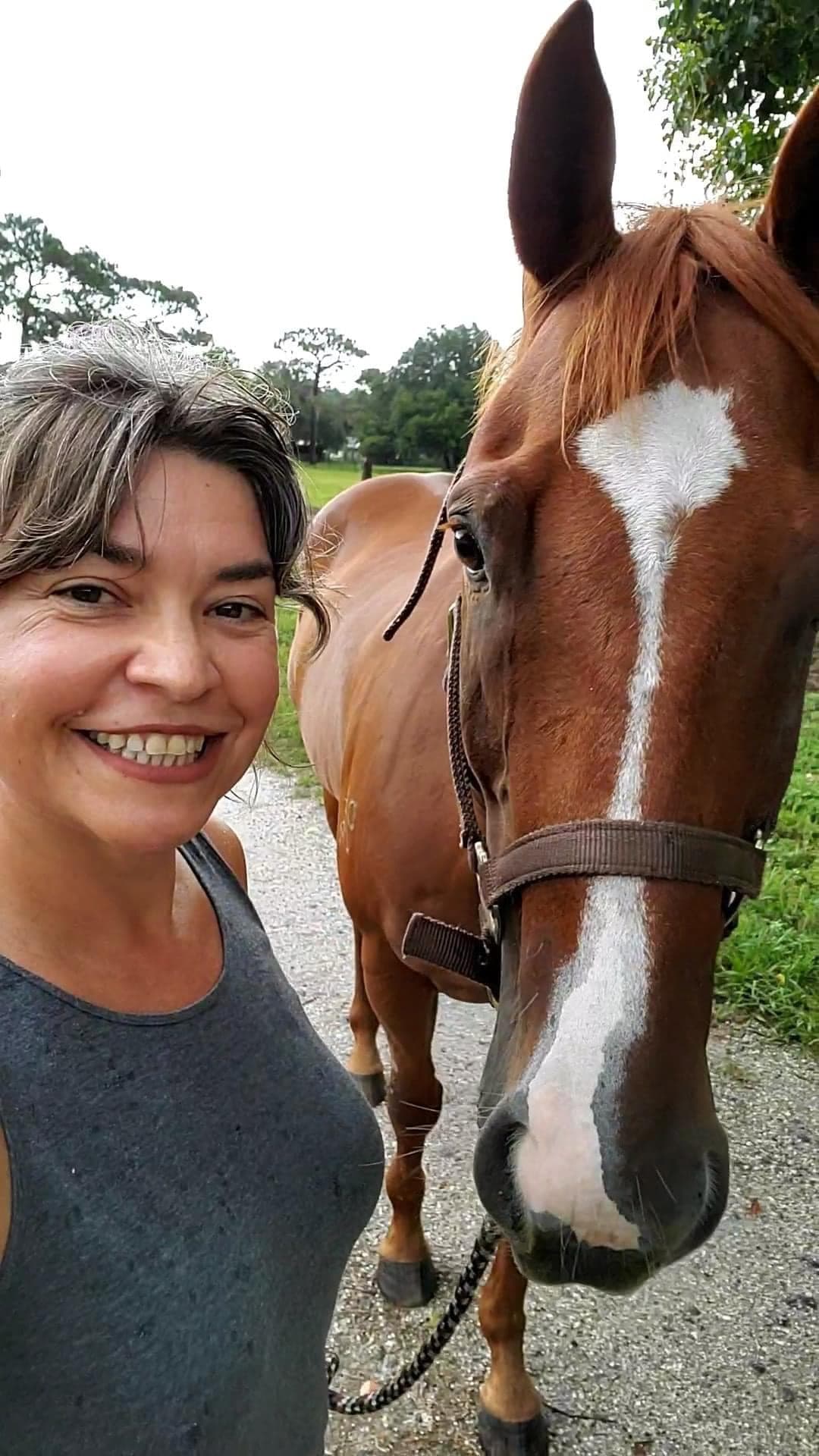
A clear example I can share is around how I put a halter on. I’ve had horses who are sensitive but begrudgingly tolerant about their ears and their faces being touched — and then there’s Reacher, who is hyperaware of every inch of his whole body; his skin doesn’t miss much. With a horse like that, something that would normally be neither here nor there suddenly matters. This picture is from our early days and I can see the tenting over his eye that brought my normal practices under scrutiny. For him it became a question worth answering: how do we slow this down, how do we do it gentler, how do we do it in a way that’s actually kinder?
I’ve haltered horses by unbuckling the cheekpiece and sliding the whole thing over their ears. I’ve done it the way where you hook the nose and whip the crownpiece over the top — where it lands with a slap on the side of the face. And then I learned to line the halter up, reach my hand over their neck to take hold of the crownpiece, and lift it gently onto their face and lay it over, so nothing ever hits them in the face, or the head, or the neck.
Once I observed that last way, the respect for the horse’s experience stayed with me. Their ears weren’t squished and pulled on. There was no bracing for or, worse, surprise when the crownpiece lands on their face or neck. Such a simple attention to detail… this was now how I wanted to do it. And then I noticed something: I wasn’t growing it. I wasn’t doing it consistently. That’s when I really started to look at it — okay, why am I not doing the thing I know is better?
For me, it comes down to three things.
The first is hurry
Hurry is the voice that says: I don’t have time to do this the kinder, gentler, different way because we just need to get this done.
Sometimes that’s true because I haven’t made the space to practice the better way — so it never becomes the way I reach for. And sometimes it’s just adherence to the clock: we’re on a tight schedule, and the way I already know is the most direct route there.
That’s not what I want most of the time, and I have more control over that than I admit, but it will be the reality in some cases and I’m going to leave some room for it. I’m going to leave some grace— because I’m human, and I’m not perfect.
The second is habit
If I’ve always done something one way, that way is my fallback — and doing it differently takes intention, over and over again, until the new way is the one that lives in my hands. When I trained in mixed martial arts, my sifu often reminded us:
Practice makes habit.
It’s the thing you do over and over that lays down a new pathway, a new muscle memory, until it becomes what you reach for without thinking. That’s really what growing the seed is — repetition, until the new way takes root. It matters because under pressure, with a new horse or a horse in an excited state, I don’t rise to my intentions, I fall back to my habits… and I want that to be the most regulated, gentlest practice in my toolkit.
The last is judgment
I’ve been in barns where I did something a little differently than everyone else — honestly, I’ve done a lot of things differently than everyone else. *laughing at self*
Sometimes people ask, “Why do you do it that way?” and I love that. It’s curiosity, even if it comes with a little edge. What I like less is the version that travels down the barn aisle and sounds like: “Did you see what Sara’s doing?”
But what someone else thinks of me is genuinely none of my business.
The judgment was definitely a ‘me’ problem when I was younger. I let it land. I wanted to fit in, and I didn’t yet have the confidence in my own experience, my own intuition, my own competence to simply stand there and say: This is how I do things, and I’m okay with that. If it’s not for you, it’s not for you.
The phrase I reach for now is, “We feel differently about that.” If someone tells me flat out, “You should be doing it this way,” that’s my whole answer — well, we feel differently about that.
But the other half of it is that I think it’s a ‘we’ problem too. As a community, when we see something new or outside of our comfort zone, we could lean in with an open mind instead: I’d love to see how it turns out when you do it that way — what are your results, what led you there? I believe everybody genuinely has a good reason for what they do. It might be experience and it might be education — information they have that I don’t, or information they have that I can add to. That’s how we actually make each other better.
So — what have you planted?
Hurry, habit, judgment — those are my three areas of friction that can extinguish a fragile new sprout. Naming them is how I catch myself doing it.
So here’s my question for you: what’s a seed you’ve planted — something you’ve been meaning to grow into a practice? And what’s stopping you from tending it?