We all agree our horses need a hydration strategy. The question is what you can do with what you have, in the time you’ve got — and why doing some of it always beats waiting until you can do all of it.
Why “water in a bucket” isn’t a strategy
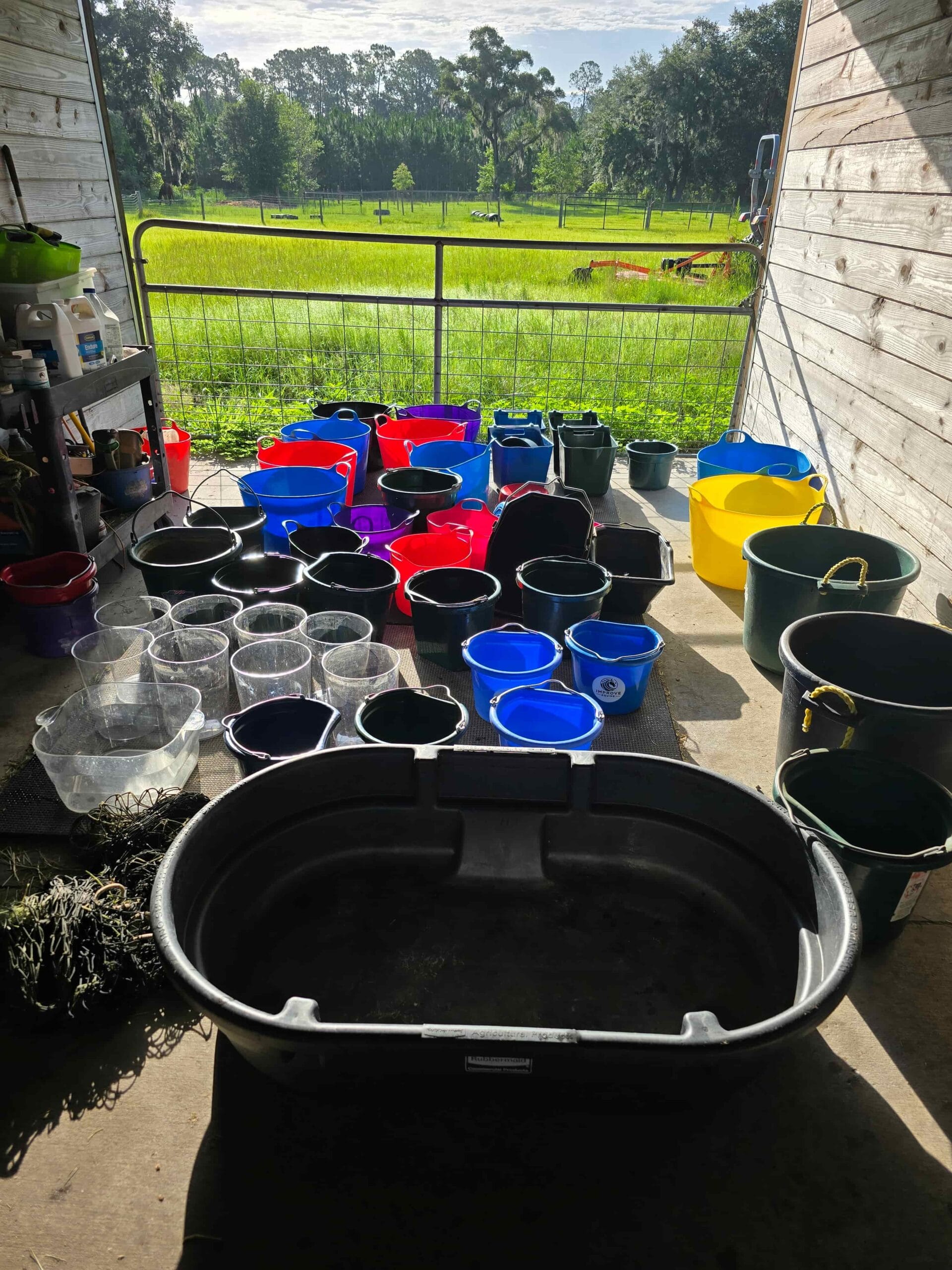
Summer is officially here. We’re at that take-your-breath-away, humid, heat-index-and-real-feel-over-a-hundred, rinsing-our-horses-off-every-day time of year. Hydration isn’t just a nice-to-have anymore. It isn’t even just on the list of priorities — it’s at the top of the list.
In average temperatures, a horse drinks somewhere between five and ten gallons of water a day just to run its basic body functions. Turn up the summer heat, add humidity or a training session, and that requirement climbs toward twenty gallons a day or more… and they aren’t only losing water. A horse working hard in the heat can sweat up to four gallons an hour, and equine sweat is hypertonic — meaning it carries more concentrated salts than the blood does. So they’re pouring out sodium, chloride, and potassium right along with the fluid (Kerr & Snow, 1983, American Journal of Veterinary Research).
Dehydration, impaction colic, and heat stress aren’t hypotheticals — horses die from the heat, which is exactly why we all agree we need a plan.
Here’s where a lot of us start and stop: put clean water out… and that’s it.
But a bucket in the corner doesn’t guarantee your horse is drinking, and it doesn’t ensure they’re drinking enough to do more than scrape the bare minimum. A hydration strategy is the difference between water being available and your horse actively drinking adequate amounts.
The toolkit is a menu, not a mandate
Everything below is a real, legitimate element of a hydration strategy. None of it is a standard you have to meet all at once… this isn’t an opportunity to beat ourselves up. Read it like a menu, and pick what fits your horse, your setup, your budget, and your day.
Keep the water worth drinking. Scrub the tubs. Drop in copper rods to suppress organic growth. Run a bubbler to oxygenate and agitate the water so algae never gets a foothold. And mind the temperature — horses have a preferred drinking temperature, and they’ll drink less when the water’s off. In summer, float ice cubes, refill from a cold source instead of letting it bake in the sun all day, and shade the tank under a shelter or a stand of trees. In winter, the same lever runs the other way: bucket warmers, or water carried out warm from inside.
Put water where the horse already is. Break out of the field-versus-stall box. A station in the arena, in the grooming stall, in the aisleway as you walk by — water stations around the farm give a horse the chance to say I’ll stop and take a sip right here. Low stakes, easy yes, all day long.
Make it taste like something they want. This one has the research behind it. When horses are offered a drink they find desirable, they will voluntarily take in up to three and a half gallons more per day (Van Diest et al., 2021, Journal of Equine Veterinary Science). People get there all kinds of ways — a splash of juice, molasses, a handful of sweet feed stirred into a bucket to make a “tea,” sweeteners like dextrose or stevia to cover the bitterness of electrolytes, even Gatorade. Whatever works for what you know about your horse and for your budget. No-sugar-added, healthy options exist too (we maaaaaaay make those). More choices is just… more choices.
Salt and electrolytes — with one real caveat. These do two jobs: they replace the sodium and trace minerals lost in that hypertonic sweat (above what a balanced diet fed at the recommended rate already provides), and they elicit thirst so the horse drinks.. but this one comes with a caution. If you load salt into a horse and then they don’t drink, you’ve pushed them further toward dehydration, not away from it. Match the profile to the horse and the work, and make sure water is actually going down.
Use the eating–drinking loop. When a horse eats, it pulls in minerals that shift its body chemistry and nudge it toward the trough. It runs the other way too: getting a horse that’s off its feed to take a drink can shift the chemistry back toward eating. Adding water to the feed is another easy way to get fluid in. Note: Horses tend to self-regulate their bucket drinking to adjust for water in their feed.
Pre-hydrate before you need it. If you can see it coming — a forecasted heat wave, a trailer ride, a show — start three days out. Build the reserve before they need it. Those additional gallons onboard are your margin of safety for everything else you’re about to ask of that horse.
Reach for enrichment. Freeze a hydration mix into treats they’ll eat right out of your hand. Freeze it into little four-inch bundts that drop into a Likit toy, or toss into the pan to melt and wet down feed while slowing down a fast eater. Freeze a big block in a bundt pan and tie it up in the stall as something cool and lickable. Hydration and boredom-busting in the same move.
You don’t have to do all the things
… but I would encourage you to pick what you can do and implement it. Half-assing hydration is better than no-assing it.
Every one of these is a legit, important way to support your horse. If you can do all of it, all the time — that’s wonderful, and your horse will benefit from it — but you don’t have to. Pick the options that work for you, your horse, and your setup right now, and do those. If what works changes tomorrow — a different forecast, a different day, less time on your hands — then do something different tomorrow. The plan is allowed to move with your life.
What this looks like in practice
At home, last night. It was still scorching hot when I brought the horses in. I filled their stall buckets with fresh, cool water. They each got a tablespoon of plain salt and a tablespoon of KER Summer Games electrolytes mixed in their feed with their preferred amount of water. Then I made up a couple of Improve Equine flavors, set them in front of each horse, and let them pick the one they wanted — that became their second bucket for choice. Whatever they didn’t finish, I set out in the pasture, full water buffet style, right next to their fresh water with the bubblers and the copper rods. This is what worked for me with the time and supplies I have.
At a boarding barn. You may not be able to hang four buckets for a buffet or build a shade cover for someone else’s setup. So ask the smaller, better question: what can you influence? Soak some of their evening hay before you leave, and you’ve put a couple of gallons straight into the gut. Offer a bucket of flavored water on the cross-ties and let them drink it down while you groom.
Every item on that menu moves the needle from a horse just getting by to a horse actually thriving through the heat, but you do not have to check every box to be a good horse owner.
If the tool you prefer to reach for is a healthy, no-sugar-added flavor:
That’s what we make. Our eleven flavors of hydration mixes are built to make water taste like something your horse wants, without the sugar load. One option among many — use whatever fits your situation.
Your turn
Every horse and every barn is different, and the best ideas in this community need to be shared. What’s in your hydration strategy? What flavors, hacks, and routines keep your horses drinking when the heat hits? Reply and tell me, or send it to info@improveequine.com.
You don’t have to do it perfectly to do right by your horse. Half-assing it is better than no-assing it — pick what works for you today, lean in, and know you’re doing your part.
References
- Van Diest, T., Kogan, C., & Kopper, J. (2021). The Effect of Water Flavor on Voluntary Water Intake in Hospitalized Horses. Journal of Equine Veterinary Science.
- Kerr, M.G., & Snow, D.H. (1983). Composition of sweat of the horse during prolonged epinephrine (adrenaline) infusion, heat exposure, and exercise. American Journal of Veterinary Research, 44(8): 1571–1577.
- National Research Council (2007). Nutrient Requirements of Horses, 6th ed. National Academies Press. (Daily water-intake requirements.)