1. Create the space
Life doesn’t stop for loss. Ruthie told me she was ready to go ten days ago but she didn’t wait and pick a quiet time— the week before, Frank, my young failed barn cat, had gone into sudden cardiac failure, with ER runs, a cardiologist and a congenital heart defect diagnosis. In the midst of that, the AC died. On its heels, the property well quit. When it rains, it pours, amirite?
So the first thing I have to do is the thing I’m worst at: clear the plate. I make it a rule, because I will not follow it otherwise — if it isn’t on actual fire, and it isn’t actively dying, it can wait. It can be postponed. Canceled. I can let it be.
That requires giving myself permission… and for most of my life I had it backwards. I kept waiting for someone else to hand me that approval— to stop, to fall apart, to just… not be “fine.” But no one can give me that. It was never theirs to give. It is my responsibility, and the waiting for someone else to swoop in and take over was just one more way of avoiding my feelings.
Here is what that looked like last week, in full and unflattering detail. I didn’t clean stalls for two days. I napped every single day. Some days I never changed out of pajamas. I canceled appointments and rescheduled calls. I stopped working on the technical debt for the website. I rewatched all four seasons of Bridgerton. I ate shredded cheese out of the bag.
And the whole time, underneath, ran the quiet fear: if I stop pushing, the life and the property and the business I’ve built will all fall apart. But guess what? That didn’t happen. The business kept running — it even grew — without me babysitting it. The herd got their supplemental feedings but were fine with skipping the extras… more time on pasture for them. The dogs and cat were happy to curl up with me. My support network understood if I didn’t feel like talking… and showed up if I did. All because I’ve built these structures in advance knowing I have to have some balance in my life and there would be moments like now when I need to step away and be still.
Some things cannot simply be set aside: kids, jobs, important commitments. I get it. If all you can eke out is a weekend, take it and lean all in. I read an article once where Gabby Reece described it as “a working woman’s breakdown.” Two days of no showers, staying in pajamas and rotting… back to pulling it together on Monday morning. I looooooove this framing.
In practice: clear everything that isn’t on fire, hand yourself the permission you keep waiting on, and have faith that what you built in the calm will hold while you can’t.
2. Whatever I resist, persists
Once the “must dos” were done — Ruthie was no longer in pain and her body was gone — there was a moment where the adrenaline cut out, my shoulders came down and nothing was left but the grief. That’s where sinking in the muck begins.
To whatever degree you can, I encourage you to sit in it. Actually let yourself feel it. From my own experience, that is the single thing that has moved me through the deepest pits of grief faster and with more self-compassion than anything else.
I’ll be honest about how difficult that is. For most of my life, sitting still in a feeling was so unbearable that I’d do anything to avoid it — stay busy, stay moving, distract myself, run out ahead of it so I never had to land. Two things changed my mind, and neither was a pep talk.
The first is that my body stopped letting me get away with it. The grief I refused to feel didn’t evaporate; it came out sideways, as physical symptoms. The longer I hold it off, the worse my body takes it — it genuinely breaks down. I have to either take the hint or I get hit over the head with the lesson and end up in my doctor’s office.
The second is that with practice it gets easier… and I now have a significant amount of experience to confirm there is acceptance and peace on the other side. I won’t be in this heart-hurting pain forever.
And to whatever degree you can matters, because not everyone can simply stop everything and curl up on the couch indefinitely. Back when I worked a corporate job, with someone else holding my schedule, I time-blocked my grief. When I felt myself coming apart, I’d take my break, set an alarm for fifteen minutes, find the spare parts room, and heave-cry. Alarm goes off, I splash water on my face, I go back to work.
Other days the deal was just make it to five o’clock, and the second you clear the security gate, you cry the whole way home. It’s like a shaken can of soda— the pressure needs somewhere to go, and the trick is letting a little out on purpose so I don’t spray it over everything and everyone.
In practice: let yourself feel it — fully if your life allows, in scheduled doses if it doesn’t. The pressure goes somewhere either way. Better a little out on purpose than all of it by surprise.
3. There is no timeline on grief
The acute pit passes. The grief doesn’t, not on any schedule, and I’ve stopped expecting it to.
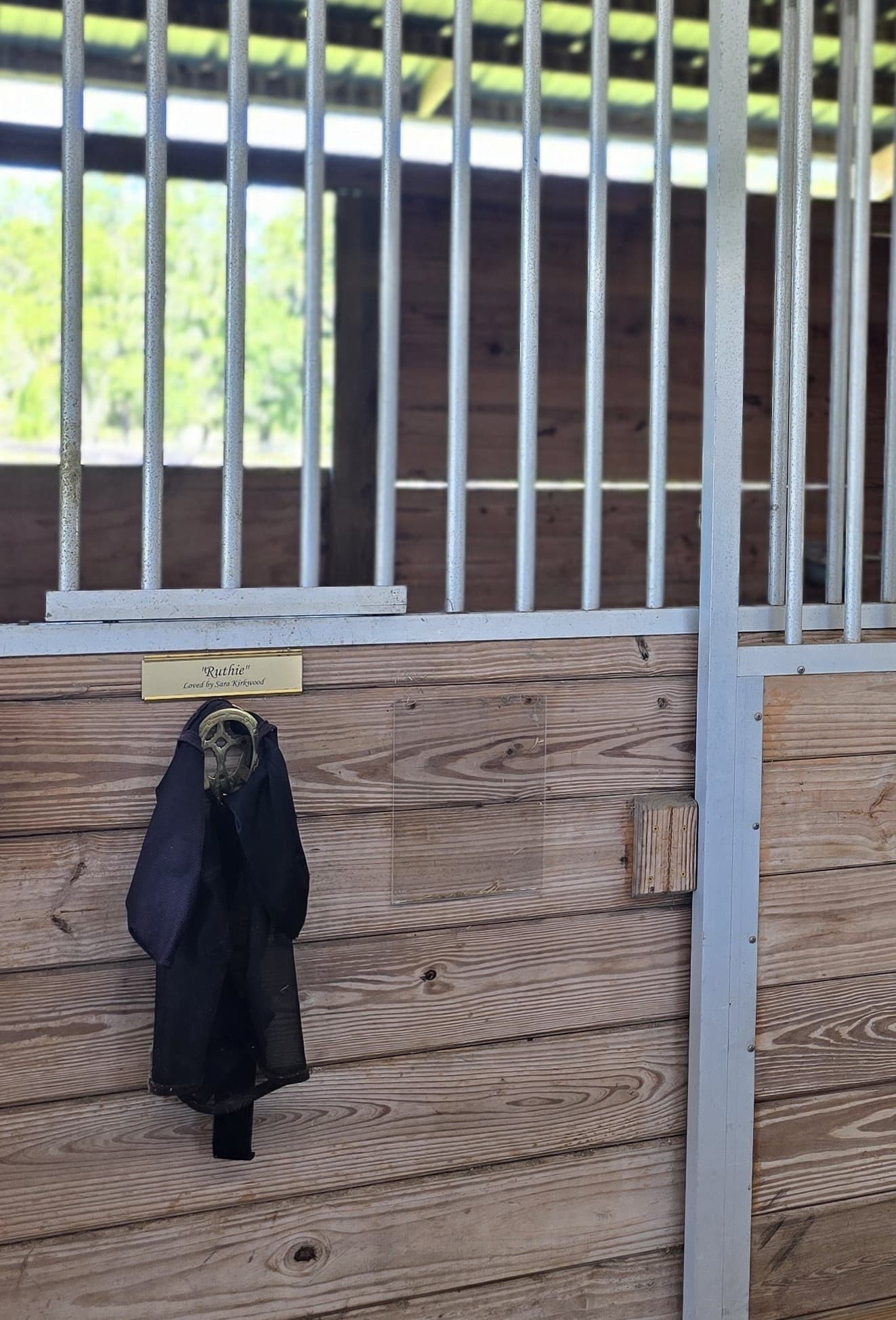
It shows up as the small stuff. I look out the window expecting Ruthie stretched out for her afternoon nap, and remember she’s gone. I drive the UTV into the barn loaded with hay nets and brace for the attitude — she hated that UTV, head up, ears pinned in pure offense, right until she clocked that it was bringing her hay — and then I tear up a little at the empty stall.
A friend gave me the words for it: a phantom limb. A phantom future. All the plans and expectations and ordinary tomorrows that were still woven into my habits don’t vanish when they die — they have to unwind slowly, one caught breath at a time. The expectation she’ll be there, the half-second realization she won’t, the small clean burst of sadness. It comes when it comes. There is no being done.
So I tell stories. I do not want to be left standing in the last image — the body going down, the trailer taking her off the property. That is not what she was. Telling the stories is how I get back through the hurt to the reason it hurts at all: because it was worth it. Because I would not give back one minute of that time, even knowing it ends exactly here. The stories are how the brutal final picture loosens its grip and the living one comes back — the good, the maddening, the genuinely hilarious.
I mentored kids for about eleven years, and I forget how much they take in. One of them is grown now, living nearby, and after a loss of her own she reached out yesterday and asked: can I come over and tell stories? That is the whole thing come full circle.
On Ruthie’s last week with us, before I knew any of this was about to happen, my student and I were sitting in the aisle reflecting on her lesson the way we always do, and I’d left her stall open. Ruthie sauntered out slowly and instead of heading out to the pasture, visiting the other horses or even making a break for the grass in the front yard, she decided to just hang out with us, a welcome participant included in the conversation. How wonderful to simply share space without micromanaging the experience. That’s one memory I will enjoy revisiting.
In practice: stop waiting for a finish line. Tell the stories — out loud, to someone safe — and carry the love forward for as long as you need to walk with it.
Losing every animal hurts, but the alternative is never having experienced my life with them in it. If you’ve read this far, thank you for listening to my stories. I will share more about all of my animals, living and gone, as I continue writing. As Truvy (played by the incomparable Miss Dolly Parton) said in the movie, Steel Magnolias, “Laughter through tears is my favorite emotion.”