Flat $5 shipping — FREE on orders $49+!
No salt. No electrolytes. They drink because they love the flavor.
Start Here

Category: The Opinions

Clearly-labeled opinion pieces from Sara M. Kirkwood

  • Decouple Electrolytes From Hydration, Optimize For Both

    Foundations cover what a horse needs. Optimization is what happens when you decide to do better than the floor — and the only way to do that is to control your levers independently.
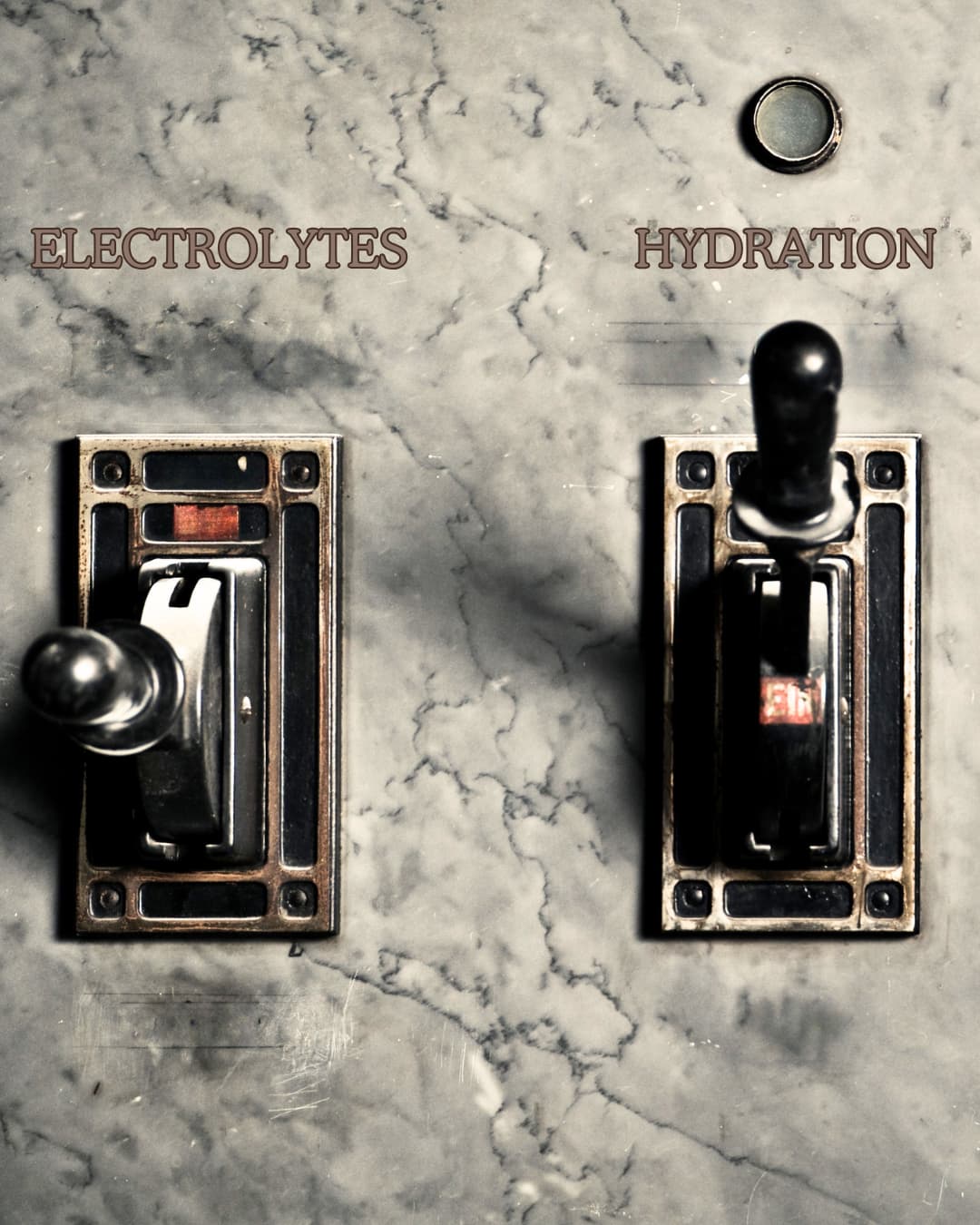
    Water and electrolytes as independent inputs for equine optimization

    For the past two weeks, we’ve been working through the foundations. The Cost of “Free” Water spoke to how important hydration is in our horses and why it’s necessary to prioritize and plan it in our horse’s daily lives because of how many systems it affects. This week, we’ve discussed the nutritional foundation and how between forage, a ration balancer, and one to two tablespoons of iodized table salt, a horse’s basic needs, including trace minerals, are all covered.

    Now here’s where the fun starts. Optimization. When we have a solid base to build off of, all of our supplements have the greatest opportunity to succeed when applied correctly.

    Reading what’s in the bottle

    Walk through any supplement aisle and you’ll see products built around synergy — a pharmacological term for when two or more ingredients elevate each other’s effects, producing a result greater than what each one would deliver alone. That’s a genuinely useful design principle when the combined ingredients are matched to the outcome you’re after. The question every owner should be asking is whether the multiple inputs in a given product actually match the need they’re trying to address. The bottle promises one thing. The chemistry inside is doing several things at once. Understanding what those things are — and whether they fit your specific horse’s situation — is the difference between a tool that’s working for you and a tool that’s overcorrecting in a direction you didn’t intend.

    Joint supplements are a quick example of why this matters, and one I’m thinking through for my own horses right now. There are really two distinct situations under that one shelf label. The first is a young or sound horse where I’m trying to support healthy joints and prevent damage going forward. The second is a horse who already has joint damage, where I’m trying to support healthy remodeling, prevent further degeneration, and reduce inflammation and discomfort. The ingredients in a joint supplement may help one situation, the other, or both. They are not the same outcome, and they aren’t always served by the same combination. The question — am I spending money on the right product for the outcome I’m actually trying to achieve? — is the question every supplement purchase deserves.

    Which brings us to one of the most common combinations in the horse world, and one of the most worth understanding clearly — electrolytes and water.

    The coupled lever

    In the case of hydration, we have always leaned into the idea that either my horse drinks plain water just fine, or my horse isn’t drinking enough and so I need to give them extra salt and electrolytes to make them thirsty so they will.

    That’s coupling two inputs to generate one result. The industry has handed us electrolytes and water as one solution for decades. Add electrolytes, the horse gets thirsty, and (hopefully) the bucket empties… biochemistry is assumed to be balanced. But in this situation you can’t dial up water intake without also dialing up sodium. You can’t address an electrolyte deficit without also driving thirst. Whatever the right answer was for either question individually, you’re now hitting one compromise number somewhere in the middle.

    Decouple them and you can optimize for both.

    Hydration as its own problem

    Sometimes a horse simply needs water, and you can move them toward it faster by giving them something they want to drink. Peer-reviewed research bears this out: when horses have access to a drink they find desirable, they will voluntarily take in up to three and a half gallons more per day (Van Diest et al., 2021, Journal of Equine Veterinary Science).

    Three and a half gallons a day is reserve. It’s resilience to travel stressors. It’s a buffer for water that suddenly smells different at a new venue, for the bucket they don’t like, for the cold snap that drops trough temperature thirty degrees overnight. In the most literal sense, it’s a margin of safety for everything else you’re going to ask of that horse.

    No sodium load is required to produce that result. The horse drinks because the water tastes like something they want. The mechanism is behavioral, not osmotic — and the tool stays dedicated to one job.

    Electrolytes as their own problem

    Look at it seasonally. In winter, if a horse is getting one to two tablespoons of iodized salt and a ration balancer, the electrolyte side is already handled. They just need water. The foundation is doing its job.

    Summer changes the picture. So does any horse working at performance levels. The trace mineral profile that needs to be replaced for a horse standing out in the Florida sun grazing all day is different from a horse competing in a fifty-mile endurance race. Slow, steady, low-volume sweat losses across months of heat are not the same physiological problem as acute, massive losses concentrated into a single endurance event.

    Once the two levers are separate, you get to choose the exact mineral profile that matches the situation your horse is actually in. You’re not picking one product and hoping it works for everything. You’re matching the tool to the job.

    How you deliver also matters as much as what you pick

    This is where the research has something specific to say.

    Add electrolytes to a horse’s drinking water and you have to make sure they actually drink the entire amount of that water to get the full dose — and many won’t, because heavily mineral-laced water often tastes off enough that voluntary intake drops. The horse drinks less, takes in fewer minerals than intended, and the protocol won’t work as designed.

    The other common method is paste, dosed orally by syringe. This is standard practice for endurance riders during competition, and it’s where the research gets specific. Holbrook et al. (2005), published in the Equine Veterinary Journal, ran a randomized, blinded, crossover trial on fourteen horses given concentrated electrolyte paste orally once per hour for eight hours — simulating typical endurance competition practice. The result: a statistically significant increase in both the number (P = 0.0174) and severity (P = 0.0006) of gastric ulcers in the squamous gastric region. The authors concluded that this schedule of supplementation, commonly used in endurance horses, may be harmful to the gastric mucosa.

    That’s a real finding. It doesn’t mean electrolytes themselves are the villain. It means hypertonic paste, delivered to an empty stomach repeatedly across a competition day, has a measurable physiological cost. A follow-up by Alshut et al. (2023) in the Journal of Veterinary Internal Medicine tested whether sodium chloride pellets fed with meals twice daily produced the same gastric damage. They did not. The fed-with-food approach neither caused nor exacerbated lesions over the study period.

    Read those two papers together and the pattern is clear: it’s not the minerals causing the problem. It’s the delivery — concentrated, repeated, on an empty stomach, into the part of the stomach least equipped to handle a hypertonic insult. When the same minerals go in with feed, forage and saliva buffer the gastric environment, the horse absorbs the dose gradually, and compliance with the full intended amount is much higher. Same chemistry. Completely different outcome.

    So instead of a single lever pulled whenever we suspect dehydration, we’re building a system — components that can be dialed in independently to give the horse what they need, in the form they tolerate best, for the situation they’re actually in.

    What this looks like in practice

    The argument falls apart without worked examples. Here are three real situations, each calling for a different combination of the same two levers.

    Situation: Winter cold snap, pasture horse at maintenance.

    Protocol: Foundation already covers the mineral side — forage, ration balancer, one to two tablespoons of iodized salt daily. The risk is water intake. When the temperature drops thirty degrees and the trough goes from comfortable to ice-rimmed, voluntary water consumption plummets, and impaction colic risk climbs. Three days before the forecasted cold snap, put a water buffet out in the pasture — plain water alongside palatability-enhanced options the horse already likes. Build reserve before they need it. The mineral lever stays where it is. Only the intake lever moves, intentionally, in advance.

    Situation: Traveling to and competing in a fifty-mile endurance event.

    Protocol: Foundation is still the floor — forage, ration balancer, iodized salt. The optimization play has multiple moving parts, each pulled separately. Start the water buffet days before the event so the horse arrives at the venue with reserve in the tank. During conditioning, supplement with a mineral profile appropriate to current training volume, fed with meals so the dose is absorbed gradually and the gastric environment stays buffered. During travel and at the venue, bring their preferred palatable flavors with you, offered side-by-side with plain water at the new location, so unfamiliar water doesn’t tank intake when you need it most. During and immediately after the event itself, switch to a profile specifically calibrated to endurance-level sweat losses — not the conditioning-day product — delivered in a form that respects the Holbrook findings. If paste is the right tool at that moment, pair it with a small forage meal first. The same logic applies to barrel racing, racing, three-day eventing — anywhere the work creates a specific physiological demand.

    Situation: Critical dehydration. Emergency veterinary care.

    Protocol: This is the situation where coupling electrolytes and water is exactly the right tool. A vet administers IV saline — electrolytes dissolved in water — because the osmotic mechanics are doing therapeutic work. The dissolved electrolytes help pull fluid into the cells faster than plain water could on its own. It’s the clinical, lifesaving use of the coupled lever, and it works because the situation requires both forces moving in the same direction at once. The reason we build a decoupled kit at home is so we don’t end up here. Optimization at the maintenance and performance levels is what keeps the IV bag in the vet’s truck instead of in your horse’s vein.

    “But how do I know what my horse actually likes?”

    You put options in front of them and watch which ones they pick. A water buffet — three to five buckets, different flavors plus plain water — is how you find out. The horse votes with the bucket. You watch which ones empty faster and you have better data on your horse’s preferences than any general protocol could give you. Even within intake-as-its-own-problem, the right answer is horse-specific. Let them tell you.

    Above the floor, the questions get specific

    The baseline diet is deliberately broad because its job is to cover the published requirement for any normal horse doing any normal thing. Above that, the questions get specific, and specific questions deserve specific tools. The Florida pasture gelding, the Tevis endurance horse, the show jumper schooling at home, the broodmare in late lactation — they’re all asking different questions, and the right answer for each one looks different.

    That precision is only available to you if you have independent levers. Once water and minerals are decoupled, both can be tuned — and the work you put into tuning them at the maintenance and performance levels is the work that keeps you from needing the emergency intervention later.

    References

  • The Cost of “Free” Water

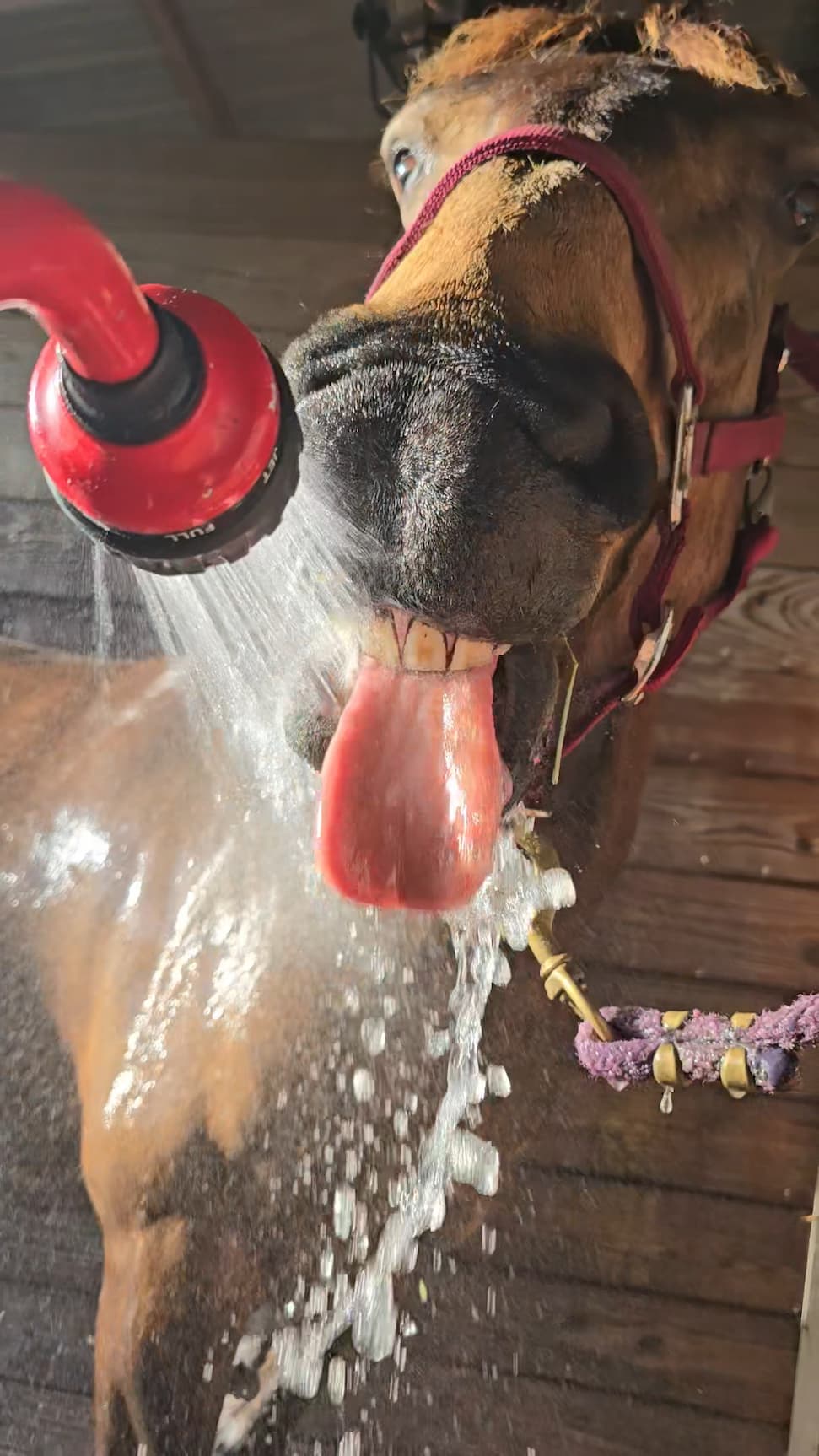
    Horse drinking from a hose with its tongue stuck out

    In the horse industry, we have a psychological blind spot: we tend to equate price tags with value. We feel more confident in a $1,000 hock injection or a $200 tub of joint supplement because the cost suggests importance. The expensive thing must be the thing that’s working. The expensive thing must be where the result comes from.

    Meanwhile, water comes out of a tap. So we treat it as a background utility — something that is just there.

    Here is the straight talk: water may be free, but putting “free water” in front of your horse is not the same thing as optimizing their hydration. And until we treat hydration with the same daily intentionality we give to feed, supplements, and training, every other investment we make is operating at less than full strength.

    This isn’t a value problem. It’s a prioritization problem.

    We have built daily strategies for everything else. Hay quality is planned. Grain is measured. Supplements get baggied out for the week. Saddle pads are rotated. Bodywork is scheduled. Vet appointments are calendared. There is a daily plan for every input we believe matters.

    The Availability vs. Utilization Gap

    For hydration, the plan is: fill the bucket.

    That is not a strategy. That is an assumption. And the assumption is that if a bucket is full, the horse is hydrated. That is a failure of logic. Availability does not guarantee utilization.

    A 2003 Michigan State study by Butudom and colleagues looked at horses dehydrated by endurance exercise (about 3.3% body mass loss). Even when those horses had unlimited water available immediately after exercise, they still showed persistent body mass loss an hour later. The water was there. The horse drank. It still wasn’t enough. The system was operating in deficit, and offering more water didn’t automatically close the gap.

    Geor and McCutcheon’s 1998 work at the University of Guelph went further. They showed that horses dehydrated by 5-6% body mass during exercise-heat stress had measurably reduced cardiac output, reduced stroke volume, reduced sweat rate, and significantly higher core body temperature than horses kept euhydrated. That’s not a clinical-skin-tent crisis. That’s a horse functioning at a meaningful percentage below their capability — quietly, daily, without anyone necessarily noticing.

    If a horse’s base fluid is at a deficit, every system downstream of that fluid — and that’s all of them — operates at less than full strength.

    Four Systems We’re Already Investing In

    Let me walk through four places where you are almost certainly already spending money. In each case, the question to hold is: what is that spending actually doing if the upstream system isn’t optimized?

    Joints

    If you have a performance horse, you are probably spending real money on joint care. Maybe oral supplements. Maybe IRAP, PRP, or hyaluronate injections. Maybe shockwave or laser. The cost adds up fast, and it’s worth every dollar when the horse moves better for it.

    Here’s the part nobody puts on the invoice: synovial fluid is largely water. Its lubricating, shock-absorbing properties depend on hyaluronate, but hyaluronate’s function depends on the aqueous environment that suspends it. Recent equine work from Cornell — Watkins, Fasanello, Reesink and colleagues (2021) — established that hyaluronate concentration is the primary determinant of synovial fluid viscosity in horses. When hyaluronate concentration drops or molecular weight degrades, viscosity drops with it.

    Hyaluronate injections give the joint a targeted boost. That boost is real. But the boost works best when the horse has the systemic hydration to sustain it. The injection isn’t competing with hydration. It’s depending on it. If the base fluid isn’t there, you’re asking a high-performance joint to lubricate without the foundation it needs.

    Lungs

    If you have a horse with equine asthma, heaves, or any chronic inflammatory airway condition, you’re already in a familiar cycle: dust management, environmental change, steroids, nebulizers, mucolytics. Each of these is a real intervention with a real cost.

    Hydration is the internal version of all of them. Airway mucus is mostly water. When a horse is well-hydrated, mucus stays thin enough to do its job — trapping inhaled particles and clearing them out via the mucociliary escalator. When a horse is dehydrated, mucus becomes inspissated — thick, tacky, and far harder to clear. Gerber and colleagues (2000) at Michigan State measured this directly. Horses with recurrent airway obstruction, on environmental challenge, showed measurably increased mucus viscoelasticity and reduced mucociliary clearance.

    A 2022 review by Simões and colleagues in Lisbon walked through the cascade: mucus accumulation traps allergens, allergen exposure drives inflammation, inflammation drives more mucus, mucus accumulation traps more allergens. Hydration is one of the points where that cycle can be interrupted. You can spend on the steroids and the nebulizers — and you should, when they’re indicated — but you’re treating a system that depends on adequate base hydration to clear itself.

    Skin

    Sweet Itch — the allergic response to Culicoides midges — is its own line item in the budget for any horse owner whose horses are exposed to biting insects. The fly sheets, the SWAT, the topical steroids, the antihistamines, the bug spray, the boots, the masks. We spend on the outside of the skin all summer long.

    Underneath all of that, the skin barrier is doing work most horse owners never think about. Marsella (2025) at the University of Florida reviewed what’s currently known about equine skin barrier function. Transepidermal water loss — TEWL — is the measurable parameter for how well the skin is holding its hydration. In healthy skin, the barrier is intact and TEWL is low. In allergic horses, the lipid barrier shows ultrastructural disorganization, similar to what’s documented in human and canine atopic disease.

    That barrier doesn’t reorganize itself out of nowhere. It depends on systemic hydration to maintain its lipid structure and its protective function. A horse running on a hydration deficit has, by definition, a less-resilient skin barrier — exactly when biting insects are at their worst.

    Thermoregulation

    This is the one that matters most heading into warm weather. Plasma volume is the carrier for heat exchange. Blood moves heat from the muscles to the skin, where evaporative cooling — sweat — dissipates it. Lindinger (2022), in his thorough review of oral electrolyte and water supplementation, makes the mechanism plain: when a horse becomes dehydrated, plasma volume contracts. With less blood volume to carry heat, the horse’s ability to cool through sweating is directly impaired.

    Geor and McCutcheon (1998) demonstrated this experimentally. Horses exercised in heat without hydration support had a core body temperature roughly 1°C higher than horses given oral fluid replacement during the same exercise. One degree Celsius. The difference between a horse who handles a hot competition day and a horse who tips into heat strain — or, in some cases, into anhidrosis.

    Heat is not a “next month” problem in much of the country, and it isn’t a problem you out-product. No amount of cold-hosing, no rinse, no fan, no shade tent fully substitutes for a horse who walked into the heat already topped off.

    The Optimization Shift

    So here is where the conversation lands.

    A horse trial, a clinic, an extra lesson, a new bridle, a chiropractor visit, a custom-baggied supplement program — all of these are deliberate investments. We don’t approach any of them with “I’ll just leave a check on the counter and walk away.” We strategize. We plan. We track results. We adjust.

    Hydration deserves the same intentionality. Right now, in most barns, it doesn’t get it. The bucket is filled. The horse drinks “fine.” The water bill is essentially zero. And because the line item on the spreadsheet is small, we assume the impact on the horse must be proportional. It isn’t. The impact is foundational, and the cost is one of the lowest in the entire horse care budget.

    Running a Water Buffet — offering flavors and choices that give your horse agency over their own hydration — does carry a small daily cost. For less than the price of a cup of coffee, you provide the horse a real choice, multiple bucket options, and the kind of intake variability that mirrors how horses are biologically designed to forage. The ROI on that investment is some of the best in the barn: you make every supplement, every injection, every training session, every dollar already in motion more effective — because you’ve finally optimized the input they all depend on.

    By giving horses agency through choices that they like, peer-reviewed studies and field observations have shown we can increase total daily water intake by as much as 3.5 gallons a day. Van Diest, Kogan, and Kopper (2021) ran a controlled trial in 40 hospitalized horses at Washington State and documented that when horses had a flavored water option alongside plain water, total intake went up significantly — with the headline figure landing at roughly 3.5 additional gallons per day for an average 1,100-pound horse. That extra hydration isn’t an extra burden on the horse. It’s an act of agency the horse is doing on their own, in their own preferred pattern, when given the choice.

    One Lever to Optimize Them All

    I want to name something directly, because I think both lenses on this matter.

    For the horse owner whose first priority is their horse’s comfort, health, and quality of life: hydration is the upstream input that determines how much of the rest of your care actually reaches your horse’s body. The joint supplement, the allergy management, the bodywork, the saddle fit, the careful conditioning — these are things you do because you love your horse and want them to feel good in their body. If hydration isn’t optimized, your horse is not fully receiving what you’re giving them. They’re not as comfortable as they could be. They’re not as resilient as they could be. The investments you’re making out of love are working at less than their full strength, and your horse is the one paying the difference.

    For the horse owner whose lens is performance — the 1% edge, the half-second, the cleaner round, the longer career — I want to be honest that this lens is real and it’s valid. If you’re squeezing every margin to get the most out of your horse, hydration is one of the biggest underused levers available to you. Plasma volume, cardiac output, sweat rate, recovery time, joint resilience, respiratory clearance — every measurable performance variable runs through systemic hydration. You cannot fully optimize the rest of your program if you’re leaving the hydration variable unoptimized. The performance edge you’re chasing is partially hidden in the bucket you didn’t strategize about.

    Both lenses point at the same answer. The horse is the same horse either way. The hydration plan is the same plan either way. And the cost — the small, daily, less-than-a-coffee cost of giving your horse a real, intentional, choice-based hydration strategy — is the same regardless of which lens you came in through.

    We have been failing to prioritize hydration with the daily intentionality we already give to almost every other input in our horse’s care. It’s not because we don’t value our horses. It’s because we’ve been working with a flawed mental model — assuming that because water is cheap, hydration must be ambient. It isn’t. It’s the input that decides whether everything else works.

    It’s time to move beyond fine. It’s time to build hydration into the daily plan — the way we already build in everything else.

    Ready to build hydration into your daily plan?

    The Water Buffet method is the simplest way to start. Two or three buckets, different flavors, plus plain water always available — your horse picks. The Sampler line lets you test multiple flavors without committing to a full pouch. If your horse is metabolic or has Cushing’s, our products are formulated with no added sugar, no added salt, no electrolytes, and under 35 calories per serving — see the dedicated guide here. Browse all eleven flavors →

    Frequently Asked Questions

    If water is just water, why does my horse need a hydration strategy?

    Because the strategy isn’t about the water itself. It’s about whether your horse drinks enough of it. Plenty of horses underdrink quietly — especially in cold weather, after travel, during stall rest, around feed changes, or in performance environments. A strategy means knowing how much your horse normally drinks, watching for shifts, and giving them options that they actually want to consume. Filling the bucket is not a strategy. Filling the bucket and watching what gets consumed is.

    How much water does my horse actually need per day?

    For an average idle 1,100-pound horse in cool, mild weather, the published baseline range is roughly 6-10 gallons per day, with most maintenance estimates landing around 8-12 gallons depending on diet (dry hay drives intake higher; lush pasture drives drinking-water needs lower because the horse is getting moisture from the grass).

    That number multiplies fast under real-world conditions. An idle horse in hot weather (above 85°F) can need 15 gallons per day. Working horses average 10-18 gallons per day. And a horse doing heavy training in hot, humid weather can have water requirements 3-4 times maintenance — pushing as high as 25-30 gallons per day. (Source: NRC Nutrient Requirements of Horses, 6th Revised Edition, 2007 — the gold-standard reference for equine nutrient requirements, including water.)

    So when Van Diest’s study found roughly 3.5 additional gallons per day from a flavored-water option, that’s not a small bump. That’s the difference between a horse running at the bare edge of their requirement and a horse with the system topped off — enough reserve to absorb a hot afternoon, a tough workout, a stressful trailer ride, or a stretch of dry feed without immediately tipping into deficit. Three and a half extra gallons is the buffer between “fine” and resilient.

    How do I know if my horse is dehydrated?

    Skin tent and capillary refill tests catch clinical dehydration — the kind that needs a vet now. Subclinical dehydration is much harder to spot and far more common. The most reliable signal is intake itself. If you don’t know roughly how many gallons a day your horse drinks, you don’t have a baseline to detect a deviation. Start there. Measure for a week. After that, the data tells you when something has shifted.

    Aren’t electrolytes the answer to keeping a horse hydrated?

    Electrolytes have a real and legitimate use — recovering mineral deficits from heavy work, heat, or illness. But for day-to-day hydration in a horse that isn’t depleted, dosing electrolytes to force thirst is using a recovery tool to do a daily-hydration job. The two are not the same. Day-to-day hydration is better served by a horse who wants to drink. That comes from giving them a real choice, not from making them salty enough to need water. We dig into this more in our piece on rethinking the hydration loop.

    My horse is metabolic or has Cushing’s. Is a hydration mix safe?

    Our products are formulated with no added sugar, no added salt, no electrolytes, no copper, and under 35 calories per serving. They are safe for metabolic horses, Cushing’s horses, IR horses, and laminitic horses. Full guide on safe hydration for metabolic horses here. Always loop your vet in for any horse with active metabolic disease.

    I board my horse and can’t change much. What’s the minimum effective version?

    Two buckets. One plain water, always available. One alternative — a flavored bucket, a different temperature, a different location. The act of choosing is what gives the horse agency, not the size of the menu. A boarder who adds one extra bucket has done more for their horse’s hydration strategy than a barn full of single-bucket stalls.

    Will this change how my joint supplement / asthma medication / allergy management works?

    Yes — in the sense that the underlying systems those interventions support will be operating with their proper base fluid. Synovial fluid lubricates better when there’s adequate systemic hydration. Airway mucus clears better. Skin barrier holds better. Plasma volume is more stable for thermoregulation. Hydration doesn’t replace the targeted interventions. It makes them work the way they’re supposed to.

  • Choice Is a Welfare Tool

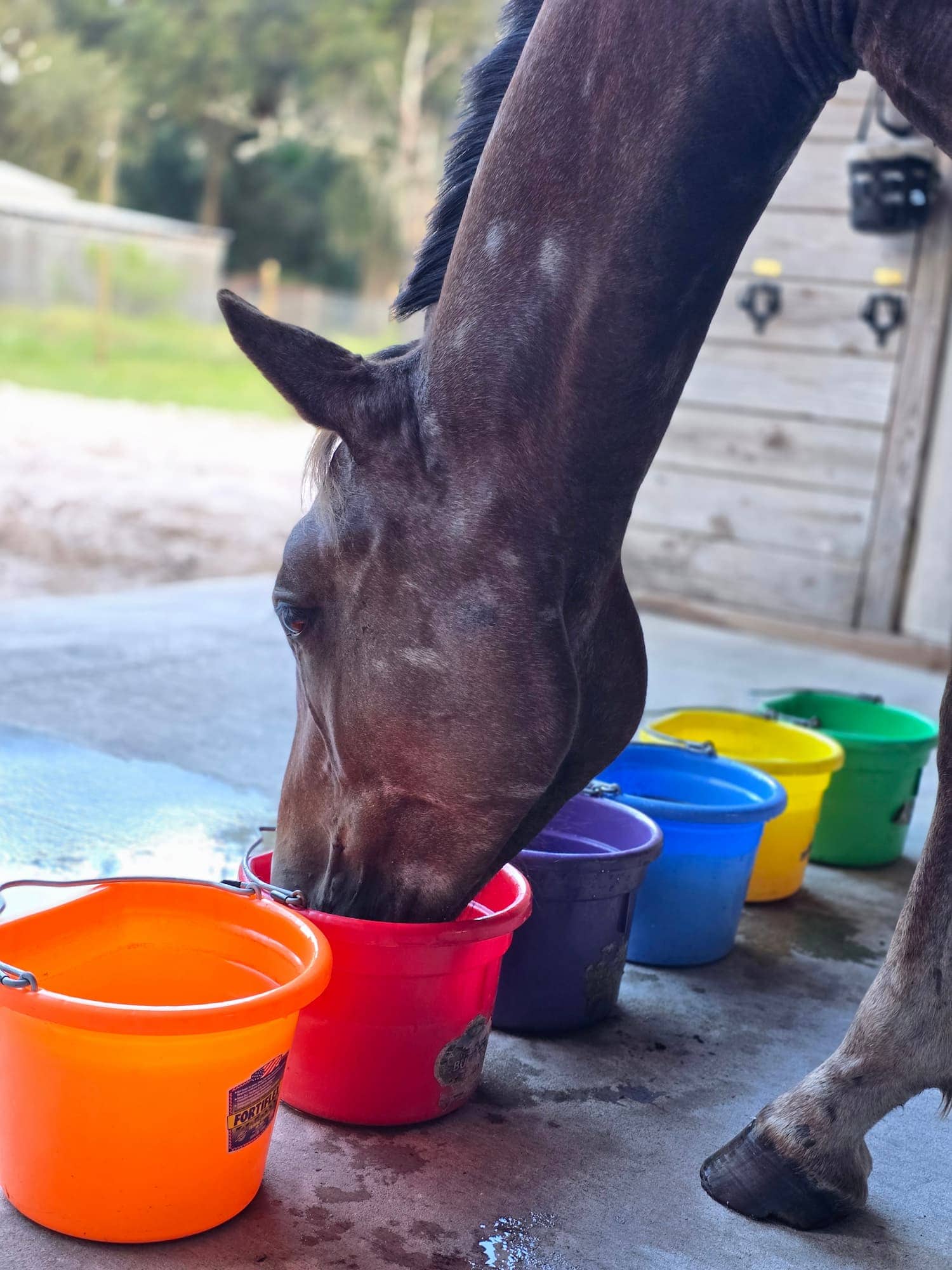
    A horse exercising choice — choosing from a Water Buffet of flavored hydration options

    Years before I knew anything about horse welfare science, I was running an agency experiment on humans. I just didn’t know that’s what it was.

    The last line of defense

    The first four years or so of my career at a major telecom, I worked in a network test center. We were the last tier. By the time a customer reached us, they had already been bounced through every layer of customer support that came before. They had explained their problem four times. They had been transferred. They had been put on hold. They had been told things that turned out not to be true. They had been told nothing at all.

    By the time they got to me, they were frothy. Not difficult — frothy. Stripped down to their last nerve. And my job was either to fix it, or to explain — with enough credibility to land — exactly why what looked like a problem was actually the system working as designed.

    I only worked in the test center for those early years, but what I learned there carried me through the rest of a twenty-six-year career. The thing that worked, almost every time, was not the fix.

    It was the menu.

    What I actually said

    Once I understood the situation, I would stop trying to push a single resolution. I would lay out what was actually possible. Something like:

    • I can add this to your line.
    • I can remove this from your line.
    • I can fix this so it works the way you want it to.
    • I can explain how this is supposed to work, so you can decide whether it’s worth keeping.

    That was it. Not unlimited choices. Not everything they wanted. Sometimes the menu was three things, sometimes two. Sometimes one of the items was a frank explanation of why the thing they were asking for wasn’t going to happen. The menu was bounded by what was actually within my power to do.

    And almost every time, the customer’s tone shifted before they even picked an option. The frothy edge dropped out of their voice. They moved from fighting me to thinking with me. Sometimes they picked the option I would have picked for them anyway. Sometimes they picked the “explain it to me” option and we ended the call without changing a single thing on the account, and they thanked me.

    I thought, for a long time, that this was a customer service trick. A way of de-escalating a hard call. It was actually neuroscience. I just didn’t have the vocabulary for it yet.

    The vocabulary I was missing

    Animal welfare scientists have a name for what I was doing. They call it agency — the ability of an individual to act on their own will, to engage with their environment in a way that serves their own goals, to gather information and make a real choice about what happens to them. Researchers in the field talk about three Cs of agency: choice, control, and challenge. The ability to choose between options. The ability to actually affect the outcome. The ability to do something that takes some skill or attention to figure out.

    Agency is not a luxury. It’s a welfare input.

    Strip it from a system — any system with a nervous system on the receiving end — and the system gets sicker, more reactive, harder to work with, and over time, quieter in a way that looks like compliance but isn’t.

    Restore it — even imperfectly, even partially, even with two options instead of ten — and the system starts to self-regulate again.

    The customer on the line was a frothy horse. The frothy horse is the customer who has been told “no” five times in a row and has stopped trying. The mechanism is the same. And that is not a metaphor. It is research.

    Three studies. One pattern.

    Last week’s issue of The Receipts, our Tuesday research newsletter, walked through three studies on horses and choice. I want to put them back on the table here, because together they make a single argument that holds up against any rigor you want to apply to it. This is the long version, with the full citations and the welfare science underneath.

    Receipt 01 · Hydration: flavored water doesn’t replace plain water. It drives more of both.

    A 2021 Washington State University study tested 40 hospitalized horses over 72 hours. Every horse had access to two buckets of water. The control group got two buckets of plain water. The three test groups got one bucket of plain water plus one bucket of flavored water (sweet feed, peppermint, or apple-electrolyte).

    The headline result: horses given a sweet-feed-flavored option alongside their plain water drank significantly more total water than the controls who only had plain water available. For an average 1,100-pound horse, that worked out to roughly 3.5 additional gallons of water per day — with the study’s confidence range running from about 1.9 to 5.1 extra gallons depending on the horse (P = 0.0001, which is about as statistically strong as veterinary intake studies get). Not a rounding error. Not a vague trend. Three and a half gallons, every day, from adding one flavored bucket beside the plain one.

    Here’s what I see in my own herd that explains it. The horses go back and forth between the two buckets. They drink some flavored water, then drink some plain water, then go back to the flavored. It’s not an either-or. They don’t drink the flavored bucket dry while ignoring the plain — they drink more of both. Plain water gets used like a palate cleanser between sips of flavor. Like reaching for a glass of milk between bites of a cookie. The variety is what keeps them coming back to the buckets, and what they come back to is everything in the stall, plain water included.

    The flavored bucket isn’t competing with the plain bucket. It’s making the plain bucket more interesting too.

    A note from the founder

    The strong result in this study came from sweet-feed-flavored water — basically, water with a scoop of sweet feed mixed in. Some commercial mashes work the same way: a high-sugar, high-calorie feed product gets dunked into water and the horse drinks more. That works. The science here is real.

    The science is also incomplete in a way I want to name out loud, because it matters.

    The study tested sweet feed water. It did not test no-added-sugar, low-calorie, whole-food flavored water against sweet feed water side by side. I cannot give you a head-to-head number that says Improve Equine’s flavors drive total intake equally well, because that study has not been run yet. I would love to see it, and one day I would like to fund it.

    What I can tell you is what the broader research shows. The Goodwin study you’ll see in Receipt 02 ranked the top eight flavors horses preferred when given a real choice. Fenugreek, an herb, came in first. Rosemary, cumin, peppermint, and oregano — all herbs and spices, none of them sugar — also placed in the top eight. The horses’ preferences are not driven by sugar alone. They are driven by flavor variety as a real choice alongside plain water, and many of the preferred flavors are herbs and spices that don’t carry a sugar load at all.

    The Improve Equine flavors are built on that finding. Whole food, whole herbs and spices. No added sugar, no added salt, no electrolytes, under 35 calories per serving, safe for metabolic and Cushing’s horses.

    What we are trying to do is innovate on giving horses a healthy choice. Horses get offered a lot of choices that are less than healthy — treats, sweet mashes, bribes to get them to take medicine, sugary additives in their water to get them to drink. Each one gets rationalized on its own. It’s just this once. It’s just for an event. It’s just to get her to drink. It doesn’t happen that often. The cumulative load adds up over a year.

    The premise of this company is that the welfare benefit of choice doesn’t have to come with a sugar payload, a calorie load, or a feed dump in the bucket. You can give your horse the agency the science is talking about in a format that doesn’t compound a different problem.

    — Sara

    Citation: Van Diest TJ, Kogan CJ, Kopper JJ. (2021). The effect of water flavor on voluntary water intake in hospitalized horses. Journal of Equine Veterinary Science, 98:103361. DOI 10.1016/j.jevs.2020.103361

    Receipt 02 · Variety isn’t a preference. It’s biology.

    Horses are patch-foragers. They evolved to move across landscapes, sampling different plants based on visual cues, odor, taste, texture, and — critically — variety itself. That last part isn’t a luxury. It’s how a free-roaming horse self-medicates, balances nutrients, and adapts to whatever the landscape is offering that month.

    Goodwin and colleagues offered stabled horses a battery of fifteen different flavors layered into otherwise-identical concentrate diets. The horses showed clear, consistent preferences (fenugreek and banana topped the list) and used flavor variety to drive feed acceptance. The takeaway: when the same horse gets the same hay, the same grain, and the same plain water for months, we are asking a patch-forager to thrive in a monoculture. The picky eater turning up their nose at a bucket they have eaten from for ninety days is not being difficult. They are following biology.

    You can’t redesign a system to violate its own architecture and call the user broken when it fails. Engineering knows this. Welfare science knows this.

    Citation: Goodwin D, Davidson HPB, Harris P. (2005). Selection and acceptance of flavours in concentrate diets for stabled horses. Applied Animal Behaviour Science, 95(3-4):223-232. DOI 10.1016/j.applanim.2005.04.007

    Receipt 03 · Lack of choice is itself a stressor

    This is where the research gets harder to look at. Hall and colleagues laid out the case in 2008 that horses living in environments where their behavior cannot affect outcomes — where their actions don’t change anything — show measurable signs of learned helplessness: passivity, behavioral despair, reduced ability to learn new tasks. The same condition that was first documented in dogs in the 1960s, the same mechanism that shows up in chronically stressed humans, applies to horses too.

    The chronic stress markers tell a complementary story, and an interesting one. A 2021 four-season hair cortisol study by Mazzola and colleagues didn’t find that “stables make horses sick.” What it found was more useful than that: horses who had the option to come into the stable at night showed lower chronic stress markers than horses whose stable access was decided for them, in either direction. The variable wasn’t the building. The variable was whether the horse got to choose.

    And in April of this year, a single-author review article from Cornell’s Department of Animal Science synthesized the entire research domain under the title that says everything: Opportunities for agency in domestic horses. The author, Dr. Lindsay Goodale, is the one who introduced the three-Cs framework I used above — choice, control, challenge — and her review is open access if you want to go read it yourself. I recommend you do.

    It does not have to be the perfect choice. It does not have to be the choice you would have made for them. But it has to be a choice, and the horse has to be the one making it.

    Citations: Hall C, Goodwin D, Heleski C, Randle H, Waran N. (2008). Is there evidence of learned helplessness in horses? Journal of Applied Animal Welfare Science, 11(3):249-266. DOI 10.1080/10888700802101130 · Mazzola SM, et al. (2021). Do You Think I Am Living Well? A Four-Season Hair Cortisol Analysis on Leisure Horses in Different Housing and Management Conditions. Animals, 11(7):2141. DOI 10.3390/ani11072141 · Goodale L. (2026). Opportunities for agency in domestic horses: Applying the behavioural domain to increase equine welfare. Animal Welfare, 35:e26. DOI 10.1017/awf.2026.10085

    The line that holds it all together

    Horses don’t need predictability of options. They need predictability of access to options.

    That distinction is the whole game. Horse care has historically tried to deliver welfare by standardizing everything — same feed, same water, same routine, same everything — on the assumption that consistency itself is calming. Some of that is true. Predictability of access matters. Knowing the food shows up at six and the water bucket gets refilled at four matters. Horses are creatures of routine and there is real welfare value in that.

    But predictability-of-access has been confused with predictability-of-options, and they are not the same thing. A horse who knows that fresh water will be there twice a day, and that a few different flavor choices will sometimes be in those buckets, and that the choice of which to drink belongs to them — that horse has both. Predictable access. Real choice within that access.

    That horse is not stressed by variety. That horse is fed by it.

    What this looks like in your stall

    The Water Buffet method is the equine version of the menu I was offering frothy customers a quarter-century ago. Three to five buckets out, different flavors, plus plain water always available. The horse picks. The horse changes their mind. You watch which buckets empty fastest and you get better data on your horse’s preferences than any forced-thirst electrolyte protocol could ever give you. Here is the full method.

    You don’t need a full buffet to start.

    A “mini buffet” is enough. Plain water in one bucket. A second choice in another — even just a different temperature, a different location, a different bucket. That is still a choice. The act of gathering information and making the choice itself is what gives the horse agency. It does not have to be unlimited. It does not have to be perfect. It has to belong to the horse.

    If you want to try it with our flavors, you can browse the eleven options here, or grab a sampler if you want to test a few without committing to a full pouch. If your horse is metabolic or has Cushing’s, the products are formulated with no added sugar and we have a dedicated guide for that.

    Frequently asked, with the welfare answer

    How many buckets do I need to start a Water Buffet?

    Two. That’s it. One bucket of plain water and one bucket of anything else — a different flavor, a different temperature, a different location, a different bucket entirely. The minimum effective version of choice is one option plus an alternative. The act of choosing is the agency, not the size of the menu.

    My horse only drinks one flavor. Am I doing it wrong?

    No. That’s the whole point. Your horse is exercising agency — gathering information, making a preference, sticking with it. Watch which buckets empty fastest. That’s data, not failure. The Water Buffet works because the horse is choosing, not because the horse is sampling everything.

    Doesn’t giving horses too many choices stress them out?

    This is the most common pushback, and the research speaks directly to it. What stresses horses isn’t variety. It’s unpredictability of access — not knowing whether food and water will be there at all. Predictability of options is different from predictability of access, and conflating the two has cost a generation of horses real welfare. Knowing the buckets will be there at the same time every day is the structure. What’s in those buckets, and which one the horse picks, is the agency.

    What if my horse refuses everything new?

    This one is interesting. The R&D research from the pet food industry has a recurring finding: people think they know what their animals will accept, and when researchers run blind trials, the animals often don’t respond the way the owners predicted. Horses are no different. My mare Lorilei refused the flavors entirely for the first month or two. I didn’t push her. I just let her watch the other horses drink from them, kept the buckets out, and gave her time. Eventually she tried them on her own terms. Exposure without pressure is itself a form of choice — the choice to investigate, on her timeline, with no consequence for opting out. That is agency too.

    How is this different from electrolytes?

    Electrolytes have a real and legitimate use. When a horse has actually depleted minerals through hard work, heat, or illness, electrolytes rebalance what’s been lost. In emergency dehydration, electrolytes give you an osmotic lever to pull water into the body faster than plain hydration can. Those uses are real and important.

    But somewhere along the way, the industry started using electrolytes as a daily hydration tool — dosing horses with salt to make them thirsty so they would drink more. That’s legacy thinking, and it conflates two completely different jobs. Recovery from a mineral deficit is one job. Day-to-day hydration is another. We’ve been using the recovery tool to do the hydration job, and that’s why so many horses end up on rotating electrolyte protocols their bodies don’t actually need.

    The Water Buffet decouples the two. Hydration is the everyday concern — horses need to drink, and they drink more when they have a real choice. Electrolytes stay in their proper lane: a tool for actual depletion or genuine emergency, deployed when they’re actually called for. Modernizing hydration means understanding the difference, and not asking one tool to do two jobs.

    My horse is metabolic or has Cushing’s. Is the Water Buffet safe?

    Our products are formulated with no added sugar, no added salt, no electrolytes, and no copper, with under 35 calories per serving. They are safe for metabolic horses, Cushing’s horses, and the rest of the farmily. Full guide on safe hydration for metabolic horses here. Always loop your vet in for any horse with active metabolic disease — that’s their lane, not mine.

    I’m a busy boarder. What’s the minimum effective version?

    Two buckets. Done. Plain water always available. One alternative beside it — even a second bucket of plain water in a different spot in the stall. That is still a choice. You are not coddling your horse. You are handing the system back its self-correction loop.

    Back to the test center

    The reason the frothy customers calmed down was never that I always fixed the problem. Sometimes the right answer was “I can’t change this, and here is why it’s designed this way.” Sometimes the right answer was a partial fix that wasn’t the one they originally wanted. Sometimes the right answer was the one they would have arrived at on their own if anyone had given them five quiet minutes and a real menu.

    The mechanism wasn’t the resolution. It was the respect for their agency in arriving at one.

    Horses deserve no less. The science says so. Our farm runs on it. And if you want to try the smallest possible version of it — one extra bucket, one extra choice — that is enough to start.

  • The Ride Is Earned: My Non-Negotiables as a Horsewoman

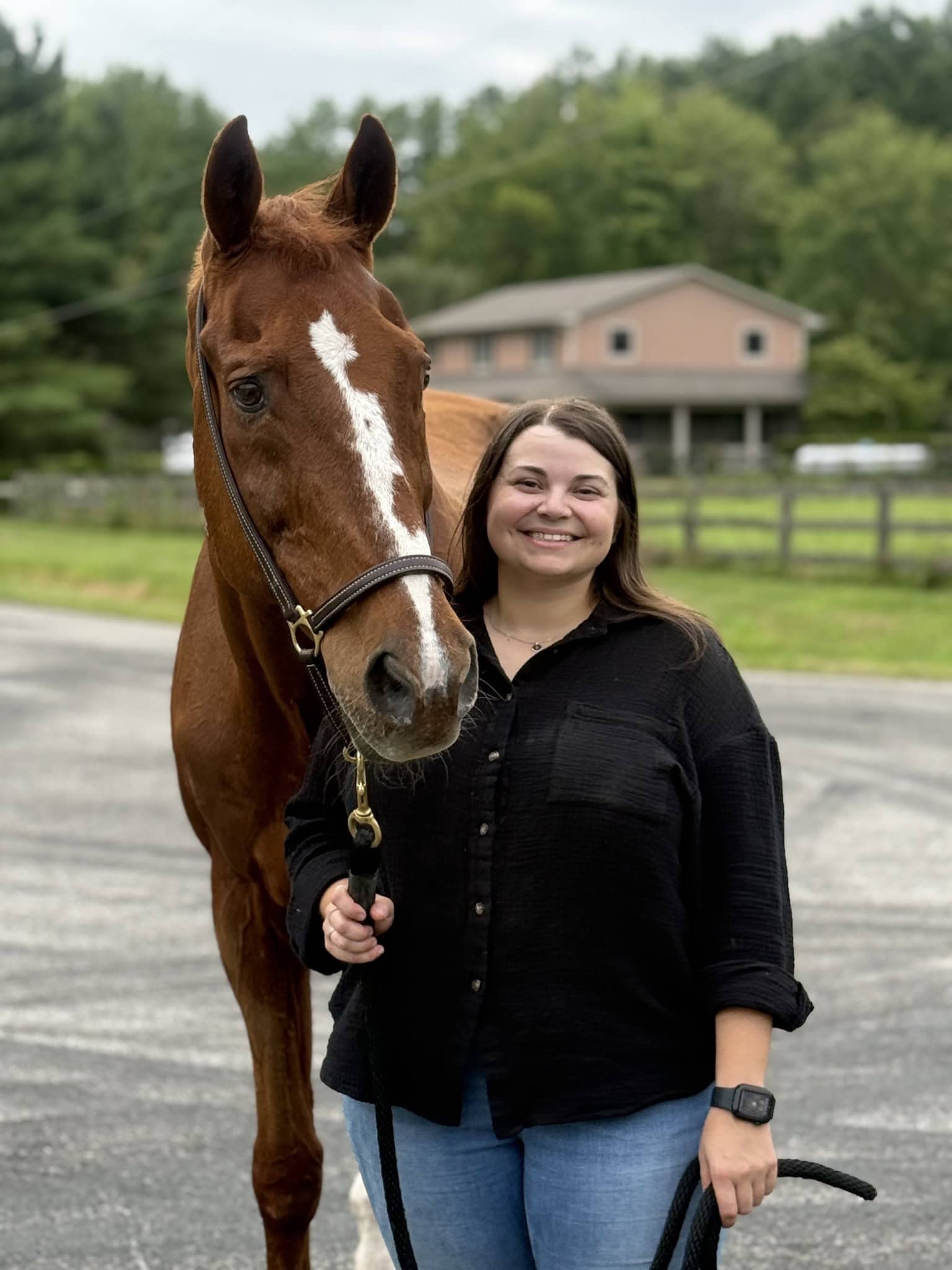
    Nichole Binkoski with her chestnut OTTB

    I have been a horsewoman for 26 years. Hunter/jumper world, mostly. Two off-the-track Thoroughbreds at home — one is 31 and has been mine for sixteen years, the other is 17 and has been mine for eleven. Between the barn, my clipping business Top Trim Equine, and teaching eighth-grade ELA, the days are long and the standard does not move.

    People sometimes ask why I do as much as I do for my horses. Why the meticulous grooming. Why the saddle pad rotation. Why the warm-up and the cool-down and the aftercare and the bodywork. The answer is simple, and it is the only answer I have ever had.

    The ride is earned.

    It is earned long before I put a foot in the stirrup, and the work continues long after I am back on the ground. Anybody who tells you otherwise is taking a shortcut, and the horse is the one paying for it.

    Grooming Is Not Cosmetic

    Grooming is not about how my horse looks in a photograph. Grooming is about my hands on every inch of that animal before I ask anything of him. It is how I find the heat I would have missed. The tightness behind the shoulder. The little nick that did not exist yesterday. The flinch I am not going to push past.

    By the time my horse is tacked, I already know how he is feeling that day. That is not extra. That is the bare minimum.

    Tack And Saddle Pads Get Fitted, Not Decorated

    Tack fits or tack does not get used. That is the rule. A saddle that pinches, a girth that rubs, a bridle that sits wrong on the poll — these are not aesthetic complaints. They are pain my horse cannot tell me about in language I understand, so I have to find them before he has to.

    Saddle pads get rotated. Clean pad, clean back, every ride. Not because the show ring requires it. Because his skin requires it.

    Nutrition Is Not Negotiable

    Both of my horses are on care plans built around what they actually need, not what is convenient for me to scoop. Forage first. Supplements as appropriate. Hydration treated like the foundation it is, not the afterthought it usually becomes.

    This is the part where I will be honest about Improve Equine. I started using the products because the science made sense and the ingredients are clean — no added sugar, no salt, no electrolytes, no copper, low calorie, metabolic-safe. That matters when you have a 31-year-old whose hydration directly affects how he feels every single day. When my horses drink, I know exactly what is going in. That kind of transparency is rare and I am not going to pretend otherwise.

    The point is not which brand. The point is: know what is in the bucket. Know why it is in the bucket. Adjust when the horse tells you to adjust.

    Warm-Up And Cool-Down Are The Ride

    The ten minutes before and the ten minutes after are not a formality. They are the part of the ride that protects the part of the ride everybody talks about.

    You do not get a soft, willing, sound horse for years on end without giving him the time to come into the work and the time to come back out of it. A horse that gets thrown into a session cold and put away hot is a horse on a clock, and that clock runs faster than anybody wants to admit.

    Aftercare Is Where The Real Work Happens

    Magnawave. Massage. Chiropractic. These are not luxuries. These are maintenance for an athlete who cannot describe his own body to me. My job is to listen with my hands and my eyes and my standing appointments, and to bring in the people who can listen better than I can in the places I cannot reach.

    I do not wait for a problem to fix a problem. By the time the horse shows you the problem, the problem has been there a while.

    Hydration As A Practice, Not A Crisis

    People reach for the salt bucket when their horse stops drinking. I understand the instinct — it is what we were taught. But forcing a horse to be thirsty is not the same as making sure a horse is hydrated, and I do not have it in me to pretend those are the same thing.

    Hydration in my barn is built around desire. Make the water something they actually want. Offer choice. Pay attention to which flavors each horse picks on which kind of day. That is not anthropomorphism. That is just respecting that they are individuals with preferences, the same way I am.

    None Of This Is Doing Too Much

    Every once in a while somebody will tell me, kindly or not so kindly, that I am doing too much for my horses. That the bodywork is overkill. That the supplements are overkill. That the warm-up is overkill. That a 31-year-old does not need this level of attention.

    He absolutely does. And so does the 17-year-old. And so will the next horse, and the one after that.

    These animals carry us. They carry our weight, our nerves, our ambition, our bad days, our good days. They carry our daughters in the show ring and they carry our grandmothers down the trail. The least we can do — the absolute floor, the bare minimum — is carry them back.

    I am their advocate. I am their voice. And horse care will always be my number one priority.

    The ride is earned. Every single time.

    A note from Sara —

    Nichole’s standard is the standard. This is what high-quality horse care actually looks like in practice, written by someone who has been doing it for 26 years and is not interested in shortcuts. If her piece resonated, share it with someone in your barn who would appreciate it. That is how the people doing it right find each other.

    Got something to say? Voices publishes opinion pieces from horse people whose perspectives we trust. Email info@improveequine.com.

  • Loading for Bone Density: What the Science Says About Starting Young Horses

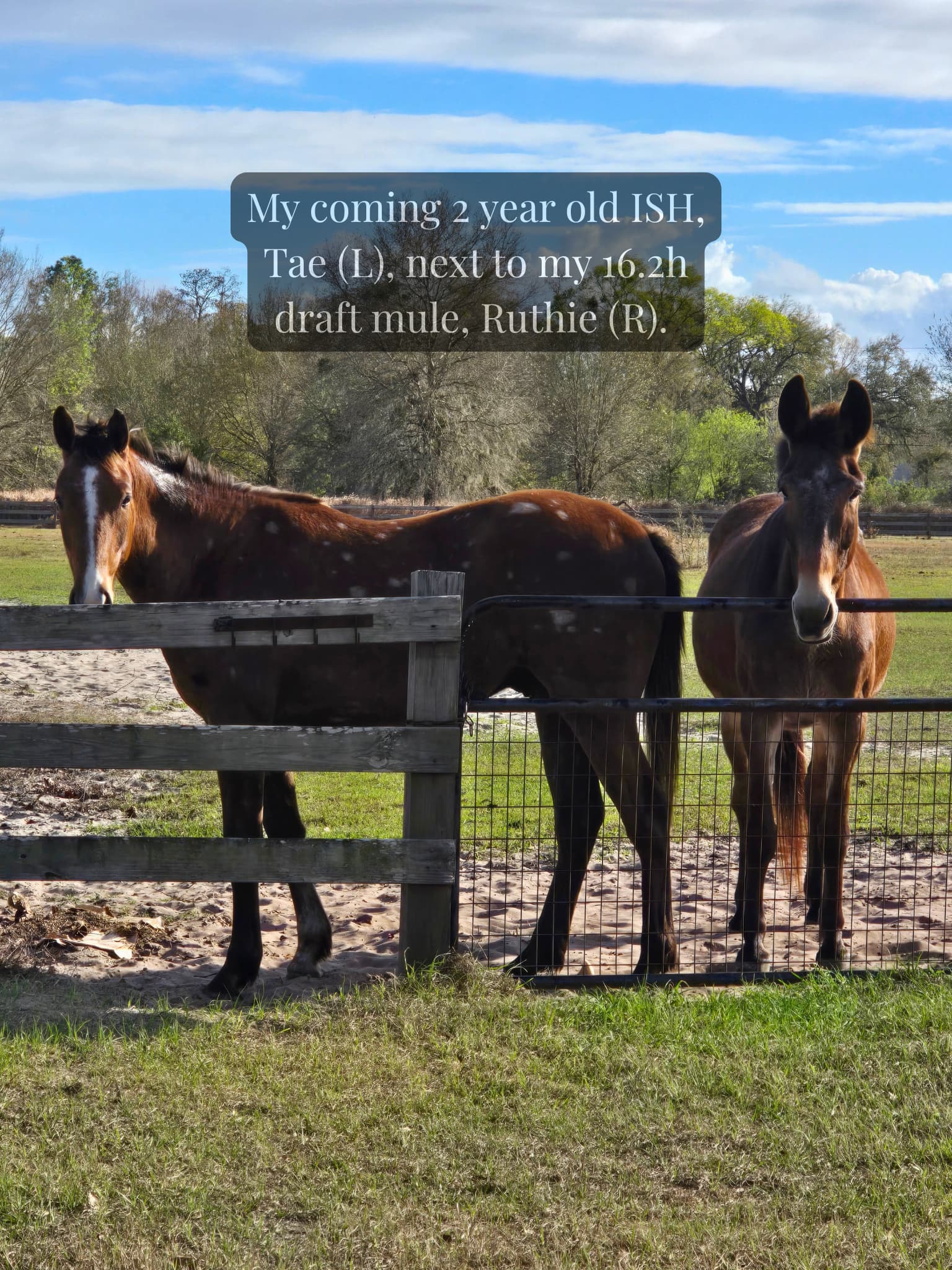
    My coming 2-year-old ISH Tae L. next to my 16.2h draft mule Ruthie

    Loading for Bone Density: What the Science Says About Starting Young Horses

    The equine industry has long utilized the science of bone modeling to justify the early training of juvenile horses. The logic is grounded in a fundamental biological truth: juvenile bone is highly plastic, and targeted load-bearing exercise is a mechanical necessity for developing the bone mineral density required for an athletic career (Logan & Nielsen, 2021). On this point, the science is clear. Bone adapts to the stresses placed upon it by becoming stronger and denser.

    However, the decision to start a horse between the ages of two and three is rarely based on biology alone. It is almost always driven by two powerful human motivations: economic pressure — the need for a return on investment in racing or performance futurities — and personal desire — the horse owner’s goal to begin their journey with a young prospect. If we are to use science to justify these timelines, we must also be willing to follow that science to its logical conclusion regarding the horse’s management.

    The Biological “Tax” of Confinement

    If we accept the premise that loading builds bone, we must also accept the inverse: a lack of loading leads to its degradation. Current research into “disuse osteopenia” shows that bone mineral content begins to drop significantly when a horse is confined to a stall.

    For a young horse in a traditional training program — stalled for 23 hours a day to “protect” an investment or simplify logistics — the short periods of work under a rider are often insufficient to counteract the mineral loss occurring during the other 23 hours. Studies show a measurable decrease in bone density in as little as 28 days of stall confinement (Logan & Nielsen, 2019).

    Conversely, a horse raised with maximum turnout participates in constant, voluntary loading. Every turn and burst of energy at liberty sends a signal to the skeletal system to reinforce itself. Research suggests it takes remarkably little high-speed movement to build bone; a single 50-meter sprint once or twice a week is a more effective stimulus for bone modeling than hours of slow, controlled work (Logan et al., 2019).

    Ground-Up vs. Top-Down: The Direction of Force

    To make an educated decision on training timelines, we must differentiate between two types of force and how they interact with the developing skeleton:

    Axial Loading (Ground-Up): When a horse runs at liberty, the concussion travels from the ground up through the legs. This is the ideal stimulus for the cannon bones and the maturation of joint cartilage.

    Transverse Loading (Top-Down): When a rider is introduced, the force is applied downward onto the spine. This requires a young, unfused skeleton to compensate for a human’s weight, balance shifts, and mechanical cues.

    This distinction is vital because the leg bones and the spine do not mature on the same timeline. While the growth plates in the lower limbs typically fuse by the age of two, the equine spine is the final part of the skeleton to reach maturity. The vertebral growth plates do not fully ossify until a horse is between 5.5 and 6 years of age (Dr. Deb Bennett).

    Evaluating the Path Forward: Three Management Models

    Based on these scientific realities, we can identify three distinct paths. Each carries a predictable set of consequences for the horse’s long-term soundness.

    Model A — The Traditional Training Model (Confinement + Early Start). Driven primarily by economic pressure, this model starts the horse at two or three while maintaining stall confinement. The result is often a “fragile” bone structure due to stall-induced mineral loss, combined with high risk to the unfused spine. This model prioritizes a specific timeline over structural sustainability.

    Model B — The Biological Foundation Model (Full Turnout + Late Start). Driven by long-term durability, the horse remains on pasture until age 4 or 5. This allows for maximum bone mineral density through natural loading and ensures the spine is fully fused before a rider is introduced. This model minimizes injury risk and maximizes the horse’s useful lifespan.

    Model C — The Hybrid Optimization Model (Full Turnout + Targeted Early Start). If personal desire or industry requirements dictate a start at age two or three, this model insists on 24/7 turnout to ensure the skeletal “bank account” is maintained by natural movement. Under-saddle work is kept minimal and sub-maximal to protect the immature spine while leveraging the “modeling window” of the lower limbs.

    Conclusion

    Whatever you decide, it’s ultimately in your hands. We have enough information now to understand what these decisions will result in as far as consequences are concerned. So now that you have the information — what do you want to do with it?

    Frequently Asked Questions

    How does a horse move differently with a rider versus at liberty?

    At liberty, a horse moves in self-carriage. Their balance, head position, and stride are organized entirely around their own center of gravity, and the concussion of every footfall travels from the ground up through a freely swinging spine. The moment a rider is added, the horse has to reorganize that entire system to compensate for an external load applied downward onto the back. Vertical force through the rider has been measured at roughly 3.83 N/kg at the walk and rises to 5.60 N/kg at the gallop (de Cocq et al., 2009, Equine Veterinary Journal). That force changes spinal kinematics, redistributes weight toward the forelimbs, and forces the horse to recruit different musculature just to stay balanced. It is not a small adjustment. It is a fundamental change in how the body moves.

    It’s not just the weight, is it? What else is the young horse adapting to?

    Correct — the weight is only one input. A ridden horse is simultaneously processing rein cues that change head and neck carriage, leg cues that redirect the barrel, weight aids that shift the center of gravity, and the rider’s own posture and asymmetry. Peer-reviewed biomechanics research has documented that even a 5 cm difference in stirrup length is enough to measurably alter the movement of the horse’s thoracolumbar spine and create asymmetries that mimic hind-limb lameness (Williams et al., 2023, Animals). Multiply that by the dozens of micro-corrections a green horse makes every minute under a rider, and you start to see why “just sitting on them” is never just sitting on them. The horse is constantly recalibrating, and a young horse is doing it with a skeleton, musculature, and proprioceptive system that are all still developing.

    What does “adaptation” actually mean for a developing skeleton and musculature?

    Adaptation is not a temporary thing. Bone, muscle, fascia, and connective tissue all remodel in response to repeated patterns of load. In a mature horse, that remodeling produces the conditioned athlete. In a still-developing horse, you are not training movement — you are sculpting structure. The patterns you reinforce now, good or bad, become the horse’s default carriage for life. A young horse repeatedly drilled in the same movement, on the same lead, in the same frame, develops a body that is shaped around that pattern. This is exactly why the variety and freedom of pasture movement matters so much in the early years: it builds a body that can do many things rather than a body locked into one.

    Why are tools like side reins and draw reins a particular concern in young horses?

    Because they don’t train movement — they impose a posture. A 2024 systematic review and meta-analysis of 58 peer-reviewed studies on neck hyperflexion (including draw-rein, side-rein, and Rollkur use) found consistent negative associations with welfare and biomechanics, including elevated stress markers, restricted movement, hollowed backs, and altered spinal kinematics (Pérez-Manrique et al., 2024, Scientific Reports). When you set a horse’s head with a gadget, you’re not asking the horse to find balance — you’re forcing them to develop musculature and connective tissue around a frame they didn’t choose and can’t release from. In a horse whose spine isn’t even fully fused yet, that’s not training. That’s permanent structural shaping.

    But don’t young horses get hurt in pasture? Isn’t stalling them safer?

    This is the question that drives most “protective” stall management, and the research answers it directly: no, stalling is not safer. A peer-reviewed review of three decades of equine bone research from Michigan State University found that horses moved off pasture and into stalls actively lose bone mass, and that the highest rates of bone-related injuries cluster in the period when bone density is at its weakest — which, in confined young horses, is the very window when training and racing begin (Nielsen, 2023, Animals). Pasture turnout, by contrast, builds bone. Even partial turnout (12 hours a day) was enough to prevent the bone loss seen in 24/7 stalled horses. The pasture-injury fear is real but small; the catastrophic-injury risk from confinement-weakened bone hitting fast work is much larger and much better documented.

    If I do start my horse young, what should I be watching for?

    Keep sessions short. Vary the work — no drilling the same patterns, the same direction, the same frame. Let the horse find their own balance rather than holding them in a shape with a gadget. Prioritize honest forward movement over a “pretty” outline. Maximize turnout between rides; the bone-building work is happening out in the field, not in the arena. And watch for the early signals — short stride, reluctance to bend a particular direction, asymmetric muscling — that tell you the body is compensating rather than developing. A young horse asking for a break is not being naughty. They’re telling you their structure is at its limit.

  • The End-User Fallacy

    Designing for Humans, Feeding for Horses

    In software engineering, a “UX Failure” occurs when you design a beautiful interface for the person paying for the software, but completely ignore the person actually using it. In the equine world, we are currently living through a massive UX failure of our own making.

    For decades, feed manufacturers have designed for “acceptance” by targeting human-centric triggers: fats, oils, and sugars. We think a “happy horse” is one that dives into a bucket of molasses-coated pellets because that’s what we think looks appetizing. But by prioritizing these high-intensity, static flavors, we are essentially “patching” a biological system that is designed for a completely different set of inputs.

    We’ve mistaken our end-user.

    The Evolution of the “Chemical Seeker”

    Horses are not just grazers; they are highly sophisticated browsers. On my own 11-acre farm in Land O’ Lakes, one way I’ve moved away from the industrial monoculture model is by implementing self-selection herb gardens. The observation is consistent: horses don’t just eat for calories; they eat for biological data.

    This isn’t “woo-woo” conjecture. It is the science of Zoopharmacognosy — the process by which animals select and use specific plants with medicinal properties to support their health (Huffman, 2003, Proceedings of the Nutrition Society). Research by Goodwin and colleagues has demonstrated that horses show strong foraging preferences when offered multiple forages rather than a single source (Goodwin et al., 2002, Equine Veterinary Journal), and later confirmed that horses possess sensory-specific satiety, actively seeking novel flavors even when maintained on a nutritionally complete diet (Goodwin et al., 2005, Applied Animal Behaviour Science). For a grazer, dietary diversity directly correlates with microbiome richness and hindgut resilience — a relationship now well-established in the equine literature (Costa & Weese, 2012, Animal Health Research Reviews; Julliand & Grimm, 2016, Journal of Animal Science; Garber et al., 2020, PLOS ONE).

    Every single herb and spice they seek out has a supportive health benefit — benefits that were once dismissed as “herbalism” but are now appearing in clinical-grade supplements because the research finally confirms their efficacy. When a horse targets fenugreek or licorice root, they aren’t looking for a “treat.” They are responding to an evolutionary drive to acquire secondary metabolites that support everything from metabolic regulation to gastric health.

    The “Chicken & Broccoli” Problem: A System Redundancy Model

    In my engineering career, we talk about System Redundancy. You don’t rely on a single server for a critical mission; you layer your assets so that if one fails, the others hold the line.

    I apply this exact principle to the forage on my farm. My horses don’t live on a monoculture. Their diet is a carefully designed stack of Bermuda pasture, Timothy, Orchard, and Teff hays, supplemented with chopped Alfalfa. This layers the nutritional profile to cover the gaps through natural food sources and feeds a diverse, resilient biome. By layering, I’m building a nutritional profile that mirrors how their biological system would operate in the wild.

    The Domestic Friction

    But here is where the engineering of the “Standard” diet often hits a wall. Most domestic horses are “Stabled Users,” confined to the same concentrated feed and the same hay, 365 days a year. It is the physiological equivalent of being told you must eat skinless chicken breast, steamed broccoli, and brown rice for every single meal for the rest of your life.

    Technically? It meets your macros.

    Physiologically? It’s boring as hell.

    We call this “pickiness,” but it’s actually Flavor Burnout. It is a biological signal telling the horse that the “Monoculture Loop” has reached its limit.

    The Economical “System Update”

    I want to be very clear: I am incredibly fortunate to have the resources and the acreage to provide this level of diversity. I know that isn’t the reality for everyone. Most owners are operating within the constraints of boarding barn rules and hard-capped budgets. If you are feeding a single-source hay and a consistent ration balancer, you aren’t “doing it wrong.” You are doing what is possible.

    My flavor profiles weren’t created to guilt people into doing “more.” I developed them to give you an economical, high-impact tool to bridge the gap. You don’t need to find five new hay suppliers or abandon a perfectly good nutritional profile. You don’t need “The Sugar Patch” of molasses to trick them into eating. By introducing modular, clinical-grade botanical flavors, you are providing the sensory variety they crave without the insulin-spiking cost.

    Don’t change the macros.

    Change the flavor.

    Frequently Asked Questions

    What is flavor burnout in horses?

    Flavor burnout is the biological response to dietary monoculture — the same hay, the same grain, the same flavors, 365 days a year. Horses evolved as selective browsers who encounter dozens of plant varieties a day, and when that variety is removed, they start refusing food their macros are perfectly designed to provide. It’s not pickiness. It’s a grazer’s nervous system telling you the loop has hit its limit.

    What is sensory-specific satiety in horses?

    Sensory-specific satiety is the phenomenon where an animal becomes satiated on one flavor while still being motivated to eat a different one. Peer-reviewed research (Goodwin et al., 2005, Applied Animal Behaviour Science) demonstrated that stabled horses offered multiple concentrate flavors actively sought variety even when the nutritional content was held constant. Variety itself is a motivational need, independent of calories.

    What is zoopharmacognosy?

    Zoopharmacognosy is the science of animal self-medication — the process by which animals select and use specific plants with medicinal properties to support their health (Huffman, 2003, Proceedings of the Nutrition Society). When a horse seeks out fenugreek, licorice root, or peppermint, they’re not chasing a treat. They’re responding to an evolutionary drive to acquire secondary plant metabolites.

    Why does a monoculture diet affect the equine microbiome?

    Dietary diversity directly supports hindgut microbial diversity, and microbial diversity is what makes the gut resilient. A diet of one hay, one grain, and one set of flavors feeds a narrow microbial community; a diverse diet feeds a diverse one. The equine literature is clear on this (Costa & Weese, 2012; Julliand & Grimm, 2016; Garber et al., 2020).

    Do I need to change my horse’s feed to fix flavor burnout?

    No — and that’s the whole point. Changing the macros means reformulating a protocol that may be working exactly as designed. The problem isn’t the nutrition. The problem is the sensory monotony. Introducing modular botanical flavors gives the horse the sensory variety their biology is asking for, without touching a single macro.

  • The Standard is the Standard: Why I’m Done With “Proprietary”

    Opinion — Sara M. Kirkwood · Clearly labeled. This is not a scientific claim.

    In the business world, “proprietary” is a fancy way of protecting intellectual property. It’s the gate that keeps others from duplicating your secret sauce. But in the largely unregulated world of horse supplements, that gate often creates a wall between the brand and the consumer. It leaves us wondering: Is what I think is in there actually in there? And more importantly, is it enough to actually work?

    Anyone can slap a proprietary label on a bag and avoid being held accountable for the specifics. Technically, I could tell you a product contains isoquercetin to help with a horse’s histamine response. But if I’m only “fairy dusting” a tiny amount into the mix — an amount that won’t actually move the biological needle — I’m still technically telling the truth.

    Functionally, though? It’s a failure. It won’t do the job you’re buying it for.

    That’s why I’m not doing proprietary anything. I’ve had other business owners and peers tell me I’m crazy or ask if I’m sure I want to take this leap. For me, it’s not even a question. I don’t come from a place of scarcity. Scarcity says if you get a piece of the pie, there’s less for me. I don’t live that way. I believe there is enough room for everyone to succeed, and the way I want to live my life is by helping everyone else rise — my peers, my customers, and especially the horses.

    As a manufacturer, the decisions I make at the mixing table have a direct effect on an animal’s quality of life. If I bring a product to market that isn’t as good as I could possibly make it, or if I’m not forthright about what’s inside, the real “effect” is a horse that isn’t getting the support it needs. It’s an owner who spent hard-earned money and is now frustrated because they still can’t help their horse.

    I can’t sleep at night if that’s my business model.

    Maybe it goes back to my military background, but I have a phrase on a loop in my head: The standard is the standard. In the military, there’s a right way to do things. That’s the standard. If you aren’t hitting it, it’s substandard. It’s “unsat.” It’s not okay. You do it again, and you do it right.

    To me, the standard for equine care is total transparency. If I’m not meeting that, I’m not meeting the standard. You can see exactly what’s in Benchmark and Benchmark MAX — every ingredient, every dosage, every study linked. The Library exists specifically so you can read the same primary research I read and verify the reasoning yourself. No gatekeeping. No mystery. Just the math.

    I wrote about the specific ingredient obsession behind this — choosing isoquercetin over standard quercetin because bioavailability actually matters — in The “Secret Sauce” is Actually Just Science. Same philosophy, different angle. Worth reading alongside this one.

    I’ll always be a horse person first and a business person second, because my alignment with my own morals and ethics is worth more than a “secret” formula. I’m just going to keep doing it the right way… because the standard is the standard.

    This is an opinion piece. It reflects the perspective of Sara M. Kirkwood, founder of Improve Equine, and is clearly labeled as such. See the Science section of The Library for the peer-reviewed research behind every ingredient decision.


    Referenced in this piece:
    Isoquercetin Bioavailability Research ·
    Benchmark & Benchmark MAX ·
    Quercetin & Mast Cell Research ·
    The Library ·
    The “Secret Sauce” is Actually Just Science ·
    About the Founder

  • Rethinking the Hydration Loop: From “Forced Thirst” to Choice

    Opinion — Sara M. Kirkwood · Clearly labeled. This is not a scientific claim.

    If you’ve spent much time around horses, you’ve probably seen the standard play: if a horse isn’t drinking enough, the go-to is salt and electrolytes to “hack” their biology into getting thirsty. The idea is to create a physiological need, cross our fingers, and hope they drink enough to offset the very minerals we just gave them.

    Now, don’t get me wrong — salt and electrolytes have their place. If a horse is working in extreme heat or doing heavy exercise, they absolutely need them. But for most horses getting a well-balanced diet (which usually includes about two tablespoons of salt a day), their baseline needs are already covered. When we’re just trying to ensure a horse stays hydrated during a weather shift or a stressful day, adding more salt can be unnecessary — and potentially counterproductive.

    The flaw in the loop is that if a horse is already tipped toward dehydration and they don’t drink enough to flush those extra minerals, we haven’t actually solved the problem. We’ve just made a dehydrated animal even more so.

    Because salt and electrolytes are naturally bitter, the common fix is to add sugar or molasses to make the bucket palatable. While those products work for some, they introduce complications I can’t afford in my own barn. Between my two metabolically sensitive Mustangs and my draft mule, Ruthie, I have to be incredibly careful. I’m looking at these products as an owner who cannot have my horses ingesting hidden sugars or unnecessary calories just to get them to hydrate. If you’re managing a horse with Cushing’s, insulin resistance, or laminitis, you already know this calculation intimately.

    I started wondering… what if we moved toward desire-based hydration instead?

    Instead of trying to trick their biology, why not make the water something they actually want to consume? I decided to look at the herbs and spices we already know have supportive health benefits and use them for their original purpose: flavor. By mixing these with human-grade, organically sourced whole foods — carrots, apples, pumpkins, bananas — and a touch of organic oat flour for “mouthfeel,” the whole experience changes.

    I ended up creating 11 different flavors because horses have distinct opinions. Think of it like inviting a friend over to your house. You don’t just shove a drink in their hand and tell them what they’re having; you say, “Hey, this is what I have — what would you like?” To make it even easier, I offer these in samplers so you can try a few (or all of them) to see which ones your horse actually gravitates toward. Once you know their favorites, you can stock up, and the solution is easy peasy.

    It also makes management so much easier. When a big weather shift hits, I don’t have to stand out in the freezing cold, holding a bucket and trying to entice a horse to take a sip. I can set up a choice of flavors in a stall or leave 40 gallons of flavored water out in the pasture next to their regular fresh water. I can head back inside, bundle up, and when I check on them later, the flavored trough is usually drained.

    The best part? These are low-calorie treats — usually 35 calories or less per serving — that are safe for the metabolically compromised. And because there’s no salt, electrolytes, or copper, it’s safe for the dogs or any wild animals that might stop by for a sip. That’s the whole premise behind The Farmily™ — one product, every animal on your farm.

    I’m always looking for a softer, more intuitive way to partner with my horses. When we stop trying to “hack” them and start taking their opinions into consideration, they usually tell us exactly what they need. The Water Buffet method is the clearest demonstration of this I know — you put out the options, you step back, and they vote with their nose. Watching my horses choose their favorite flavor and drink deeply isn’t just a relief… it’s a reminder that a little hospitality goes a long way.

    This same desire-based logic is what makes scent conditioning work for horses who refuse to drink at shows. If you’ve built a positive association with a flavor at home, that association travels — even to a show ground with unfamiliar chlorinated water. Why horses refuse to drink at shows covers the protocol. And for those of us in Florida dealing with well water that smells like sulfur, Florida horse hydration addresses the same aromatic masking principle applied to a different problem. The principle doesn’t change: you’re always working with what the horse’s nose finds appealing, never forcing past it.

    This is an opinion piece. It reflects the perspective of Sara M. Kirkwood, founder of Improve Equine, and is clearly labeled as such. See the Science section of The Library for peer-reviewed research on hydration and equine health.


    Referenced in this piece:
    Safe Hydration for Metabolic Horses ·
    Flavors Hydration Mix — All 11 Flavors ·
    Sampler Packs ·
    The Water Buffet Method ·
    Why Horses Refuse to Drink at Shows ·
    Florida Horse Hydration ·
    The Farmily™ ·
    The Library

  • The “Secret Sauce” is Actually Just Science… Who Knew?

    Opinion — Sara M. Kirkwood · Clearly labeled. This is not a scientific claim.

    Let’s talk about the horse supplement aisle for a second. We’ve all been there… standing in the fluorescent light, squinting at a label and trying to play detective with a “proprietary blend.” Most companies have their reasons for keeping things under wraps—trade secrets, business models, you name it—and that’s their journey. But for me? I’ve always been a horse owner first and a business person… well, much later.

    I found myself wanting to see the “math” behind the magic. I wanted to know exactly what was going into the bucket, what form it was in, and if it was actually bioavailable enough to make a difference.

    That’s why I decided to do something a little radical with Benchmark and Benchmark Max. I’m putting it all on the table. No gatekeeping, no mystery… just the facts.

    Every single thing in these formulas is an active ingredient, and I’m telling you exactly what the dosage is. I’m even giving you the links to the actual research so you can verify it yourself. That research lives in The Library — a digital repository where every ingredient is linked to the primary studies I used to make formulation decisions. The dosage in the bag matches the dosage in the study. That’s the whole standard.

    See, there is a mountain of peer-reviewed data out there, but sometimes the form or the amount used in a product doesn’t actually match what the scientists used to get those results. If a study says X amount of an ingredient works, that’s what I’m putting in the bag.

    I’m also obsessing over the form of those ingredients — like choosing isoquercetin because it’s way more bioavailable than standard quercetin. Because if my horse’s body can’t actually use the ingredient, I might as well be throwing my money directly into the manure spreader.

    I’ve had a few people caution me. They say, “What if someone steals your formula?”

    Honestly… let them. The information is already out there in the scientific journals; I’m just the one doing the homework and actually following the instructions. If another company wants to use the same research-backed approach, then more horses get helped… and isn’t that the whole point?

    I’ve also been told that others might use less expensive ingredients to offer a lower price point. My response to that is simple: if a different product fits your budget better, even if it’s a less potent form, and it helps your horse… buy it. I’m not here to dominate an industry or be the only choice on the shelf. I just want to give you a tool that actually does what it says it’s going to do. I’m tired of the guessing games and I just want to do right by the horses… I figure you probably do, too.

    If this resonates, The Standard is the Standard covers the same philosophy from a slightly different angle — why “proprietary” is a wall between a brand and its customers, and why I won’t build that wall.

    This is an opinion piece. It reflects the perspective of Sara M. Kirkwood, founder of Improve Equine, and is clearly labeled as such. See the Science section of The Library for peer-reviewed research behind every ingredient decision.


    Referenced in this piece:
    Benchmark & Benchmark MAX ·
    Isoquercetin Bioavailability Research ·
    Quercetin & Mast Cell Research ·
    The Library ·
    The Standard is the Standard