Category: The Science

Peer-reviewed research on Improve Equine ingredients

  • Zoopharma-what?

    “Natural” and “proven” are not the same word, and neither are “a plant” and “a drug.” Before we ever get to which herbs do what in a horse, it’s worth slowing down on what these words actually mean — because the space between them is where most of the confusion in the supplement aisle lives.

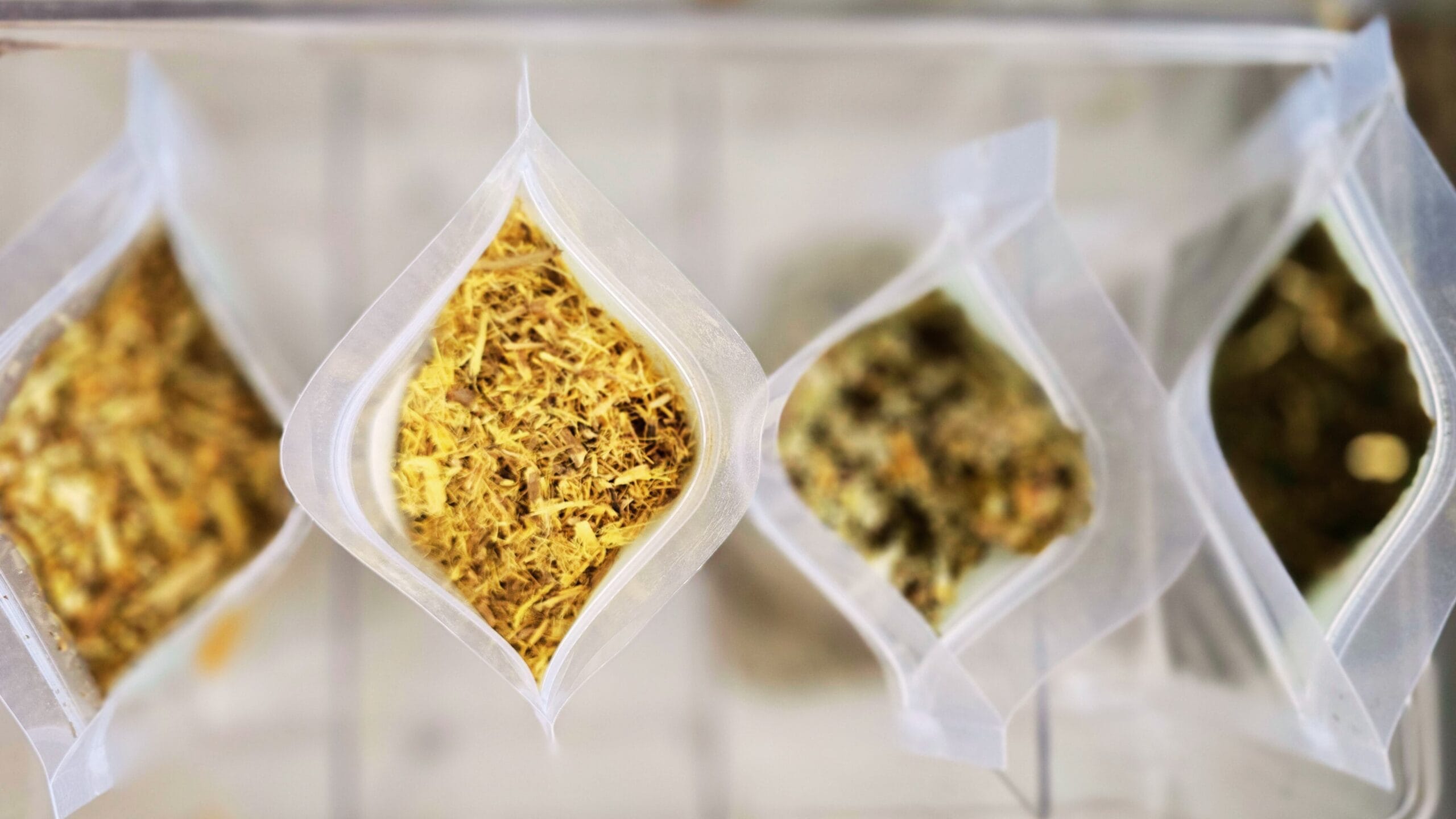
    Improve Equine herb and spice pouches viewed from aboveZoopharmacognosy. Say it five times fast.
    It’s the word people reach for when they talk about animals and plant medicine, and it sounds impressive enough to end an argument. But it’s worth knowing what it actually means, because the word is doing a lot of quiet work in the herbal-supplement world — some of it earned, some of it borrowed.

    Zoopharmacognosy is a real, peer-reviewed field of study. The name was coined in the early 1990s by chemical ecologist Eloy Rodriguez and primatologist Richard Wrangham, stitched together from Greek roots — zoo (animal), pharma (drug), gnosy (knowing) — to mean, roughly, “animals knowing medicine.” And it studies exactly that: wild animals selecting and using plants, soils, even insects to treat themselves.

    The evidence is genuinely remarkable. Wild chimpanzees swallow certain rough, bristly leaves whole, without chewing — and the stiff hairs on those leaves physically scour parasitic worms from the gut wall, sweeping them out within hours. The behavior was documented across multiple populations and tied directly to the control of nematode infections (Huffman et al., 1996). Sick chimps have also been seen chewing the intensely bitter pith of Vernonia amygdalina — a plant local healers use for the same parasites — and recovering over the following days (Huffman & Seifu, 1989). Honeybees gather antimicrobial plant resin into the hive, and colonies with that resin envelope show measurably lower expression of costly immune genes — they get sick less, so they spend less defending themselves (Simone, Evans & Spivak, 2009).

    But notice how narrow that is. Every one of those examples is a wild animal, while sick, using a specific substance against a specific ailment — and the researchers who study this hold it to strict criteria precisely so it doesn’t get confused with ordinary eating. It is careful, bounded science. When you see “nature knows” or “horses choose their own medicine” stretched into a sales pitch, that’s the impressive word being asked to carry weight it was never built to hold.

    The word that actually matters: pharmacognosy

    Drop the “zoo” and you get the field that genuinely underwrites this entire conversation: pharmacognosy — the science of drugs derived from natural sources. It’s old and serious, named back in 1811, and it’s the study of what’s actually in a plant, animal, or fungus that does something in a body, and how to identify, isolate, and standardize it.

    I notice a tendency to split the world into “natural” over here and “drugs” over there, as if a medication is something purely man-made in a lab and therefore a little suspect, while an herb is innocent. That split is mostly a myth. An enormous share of modern medicine didn’t escape from nature — it came out of it. Aspirin traces to willow bark. Morphine comes from the poppy. Artemisinin, the frontline malaria drug, comes from sweet wormwood — and won its discoverer a Nobel Prize in 2015. The heart medication digoxin comes from foxglove. This isn’t a handful of charming exceptions: in the most careful accounting we have, roughly two-thirds of the small-molecule drugs approved between 1981 and 2019 were natural products, derived from them, or directly inspired by them (Newman & Cragg, 2020).

    So “it’s just a plant” and “it’s a drug” are not opposites. Very often they’re the same compound at different points in its story — the plant is where we found the active ingredient, and the drug is what happened once we isolated it, concentrated it, and delivered it on purpose. The thing that turns a plant compound into a medicine isn’t magic and it isn’t man-made wickedness — it’s dose. Isolated, concentrated, standardized, and prescribed at a level chosen to produce an effect.

    Nature is not gentle

    There’s an assumption tucked underneath the word “natural” that I want to pull out into the light, because it quietly drives a lot of decisions: the feeling that natural means benevolent. Gentle. On our side. Nature as a nurturing force that only ever wants to heal.

    This is a false narrative.

    Nature is not gentle. Nature is a constant, savage negotiation between things trying to grow and things trying to eat them. And a plant is in a particularly tight spot, because a plant cannot run. It can’t flee a grazing mouth, it can’t swat an insect, it can’t hide. So over millions of years, plants evolved the only defense available to something rooted in place: chemistry. They became expert poisoners.

    The compounds we prize in medicinal plants — the alkaloids, the glycosides, the bitter and the pungent and the aromatic — are, overwhelmingly, the plant’s chemical weapons: substances it manufactures specifically to sicken, deter, or kill the animals and microbes that would otherwise consume it (Wink, 2003). Caffeine is a natural insecticide. Nicotine is a plant toxin. The active compound in foxglove that steadies a failing human heart will also stop one. These molecules are potent in animal bodies precisely because they were engineered by evolution to disrupt animal biology. That is the whole reason they “do something.”

    Which brings us right back to dose, and to the oldest rule in pharmacology. Five hundred years ago, the physician Paracelsus put it in one line: the dose makes the poison. A lot of these natural ingredients are toxic at some dose, therapeutic in a narrow band, and harmless below it. The line between medicine and poison is not a wall between two different substances. It is a dial on the same substance. That’s not a reason for fear — it’s the reason dose is the only serious question. “Natural” tells you nothing about where you are on that dial. Only the amount does.

    And there’s one more wrinkle worth naming, because it matters for how we should think about whole herbs. When a pharmacologist isolates a single active compound, they know precisely what they’re dosing. When you hand a horse a whole herb, you’re handing over the isolated compound and everything else the plant built alongside it — fiber, other chemistry, buffers, compounds we haven’t even characterized. Sometimes that whole-plant matrix softens the edges of the active compound. Sometimes it adds effects of its own. It’s a genuinely interesting distinction, and it’s a big enough subject that it deserves its own article rather than a paragraph here. For now it’s enough to say: a whole herb is not a clean single dose of anything, and that cuts both ways.

    And then there’s the hopeful version

    There’s a third thing in this space, and I want to talk about it gently, because the people drawn to it have their hearts in exactly the right place. It often goes by “applied zoopharmacognosy” — offering a horse a tray of herbs or essential oils and letting the horse “self-select” what it supposedly needs, on the theory that the animal’s instinct is reaching for medicine.

    I understand the pull of that completely. It’s a beautiful idea: that your horse knows its own body, that instinct will guide it to exactly what will help. And here’s the honest, interesting truth — there is real science on animals selecting beneficial plants. It’s just earthier and less woo woo than the marketing suggests. In careful studies, parasitized sheep will, under some conditions, increase their intake of tannin-rich forage that helps suppress their worm burden (Villalba, Provenza & Shaw, 2006). But when researchers looked closely at how, the mechanism wasn’t a mystical inner knowing — it was learning. The animal samples something, its body registers whether it felt better afterward, and it forms a preference through that feedback over time. And even then the results are mixed: some well-designed studies find the effect, others don’t find it at all. It’s a real, fragile, learned phenomenon — and nearly all of it has been shown in ruminants like sheep and goats, whose digestive lives are very different from a horse’s.

    So where does that leave the horse’s bucket? Honestly: as a beautiful idea that hasn’t been vetted. Not debunked — vetted. Nobody has run those studies in horses, which means it sits under a big question mark. It might be doing something real. It might be nothing more than a horse picking what tastes good. We don’t know, because the work to find out hasn’t been done.

    And that question mark is exactly where your own reason for doing it starts to matter. So ask yourself honestly which one you’re standing on:

    If you’re doing it because you believe it’s effective — because you think the horse is treating a real problem and you’re relying on that — then you owe it the science. Is there evidence in horses? Is it the right dose? Is the compound even absorbed? When your horse’s health is riding on something working, a good feeling isn’t enough; that’s precisely the moment to ask for verification, because being wrong has a cost.

    But if you’re doing it because it’s a kind, pleasant thing your horse plainly enjoys — no treatment claim attached, just a nice moment offered to an animal you love — then that is already reason enough, all by itself. It doesn’t need to be dressed up as medicine. It doesn’t have to move mountains. A thing can be healthy, good for the horse, and something the horse genuinely likes, and that combination is a perfectly good reason to do it.

    The whole trick is just being honest with yourself about which of those two you’re actually doing — because the moment you’re relying on it to treat something, the bar quietly moves from “the horse enjoys it” to “show me the evidence and the dose.” That’s a much more comfortable, and a much more truthful, place to stand.

    Where this leaves us

    Three words that get tangled together, pulled apart: zoopharmacognosy, the careful science of wild animals treating themselves; pharmacognosy, the rigorous field that turns plant compounds into measured medicine; and the hopeful, largely untested practice that borrows the first one’s name and the second one’s credibility without having earned either in a horse.

    Underneath all three is the same quiet truth. Nature is not a gentle pharmacy with your horse’s name on the prescriptions. It’s a brilliant, indifferent chemist, and the compounds it makes are powerful exactly because they were built to act on animal bodies. What decides whether one of them helps your horse, does nothing, or does harm is never the word “natural.” It’s the dose, the evidence, and the rigor to answer the question you’re really asking.

    Frequently asked questions

    What’s the difference between zoopharmacognosy and pharmacognosy?

    Zoopharmacognosy is the study of wild animals medicating themselves — chimps swallowing rough leaves to clear parasites, bees lining the hive with antimicrobial resin. It’s a real, narrow field about sick animals using specific substances against specific ailments. Pharmacognosy is the older, broader science of drugs derived from natural sources: identifying the active compound in a plant, isolating it, and standardizing it into a measured medicine. One describes animal behavior; the other produces roughly two-thirds of our small-molecule drugs.

    If a drug comes from a plant, isn’t the plant itself just as good?

    Not necessarily, and the reason is dose. A drug is the plant’s active compound isolated, concentrated, and delivered at a level chosen to produce an effect. The whole herb contains that same compound but usually at far lower concentration, alongside everything else the plant made — fiber, other chemistry, buffers. That can be a fine thing for flavor and gentle nutrition, but it isn’t the same as a measured therapeutic dose, and it shouldn’t be assumed to do the same job.

    Doesn’t “natural” mean safe and gentle?

    No. The compounds that make medicinal plants active are, overwhelmingly, chemical defenses the plant evolved to sicken or deter the animals eating it. They’re potent in bodies precisely because they were built to disrupt biology. That’s not a reason for fear — it’s the reason dose is the only serious question. As Paracelsus put it five hundred years ago, the dose makes the poison. “Natural” tells you nothing about where you are on that dial; only the amount does.

    Can horses really choose the plants that are good for them?

    There’s real science that some animals can — parasitized sheep will, under certain conditions, eat more of a tannin-rich forage that helps suppress worms. But the mechanism is learned through trial and post-ingestive feedback, not mystical instinct, the results are mixed even in the animals where it’s been studied, and nearly all of that work is in ruminants, not horses. In horses specifically, the “let them self-select” tray hasn’t been properly tested. It might reflect something real; it might just be a horse picking what tastes good. It’s an open question, not an established fact.

    So should I offer my horse herbs or not?

    It depends entirely on why. If you’re relying on the herb to treat a real problem, you owe it real evidence: is there data in horses, at what dose, and is the compound even absorbed? If you’re offering it simply because it’s wholesome and your horse enjoys it — no treatment claim attached — that’s a perfectly good reason on its own. The mistake is doing the second thing while telling yourself it’s the first.

    References

  • Yes, But Will It Actually Work? How To Evaluate Supplements For Horses

    Supplements live in a buyer-beware market. A claim on the label and a result in the bucket may be two very different things, and the distance between them is where I invest my attention.

    Reading what's actually in the bucketThe supplement aisle is one of the least regulated places a horse owner spends money. Companies can make a lot of claims that only require a loose tie to the truth to make it onto a label. That isn’t an accusation. Products are developed to sell, and clearly stating what problem it addresses is what achieves the objective. My due diligence is the part the label doesn’t always have to do: clearly answer whether the supplement in the tub will reproduce an expected and desired result in my horse.
    Start with the study, not the label

    A claim is only as good as the research underneath it. The standard I want is peer-reviewed: a hypothesis that was tested, with results that were reproduced under stated conditions. The gold standard is a randomized, double-blind, placebo-controlled trial on horses. If a company markets an ingredient but can’t point to a study on that ingredient, in the form they’re actually using, on the species they are treating, they’re selling a hypothesis dressed as a solution. That doesn’t make the ingredient useless. It means the evidence isn’t there yet, and I get to decide what I do with that.

    This is also where a proprietary blend gets in the way. I understand wanting to protect a formula — the recipe is intellectual property, and nobody wants their work copied. But the effect of “proprietary” is that the per-ingredient amounts are withheld, and those amounts are exactly what I need to run every test in this article: the dose, the form, whether the active clears a level that does anything.

    Did they put in the dose the study used?

    Here’s where most products quietly fall apart. A study that proves an effect proves it at a specific dose. If the research shows that 5 grams a day produced a response, and the scoop in front of me delivers 2.5, the label still gets to list the ingredient, but the protocol that produced the result is broken. I might get some benefit at half the dose, but I am no longer reproducing the results I was sold on.

    Will the horse actually absorb it?

    An ingredient on the label is not the same as an ingredient in the bloodstream. The same compound, in a different chemical form, can reach the body at wildly different rates, and quercetin is the clearest example I know of.

    In its plain, free form, quercetin is poorly absorbed. In dogs, its absolute oral bioavailability came in at roughly 4 percent (Reinboth et al., 2010, British Journal of Nutrition) — the overwhelming majority never reached circulation. Attach it to a sugar and the picture changes. In rats, plain quercetin landed at about 2 percent, the glucoside form isoquercitrin reached 12 percent, and an enzymatically modified version reached 35 percent (Makino et al., 2009, Biological and Pharmaceutical Bulletin). And in people, a lecithin-based formulation reached plasma levels up to twenty times higher than the same dose of unformulated quercetin (Riva et al., 2019, European Journal of Drug Metabolism and Pharmacokinetics).

    So “500 mg of quercetin” on two different labels can mean two completely different things in the horse, without either label saying a single false word. The form is the part you have to read for. (And worth noticing: every number I just gave you is from a dog, a rat, or a person. Hold that thought — it comes back at the end.)

    Does it survive the bag, and then the stomach?

    A compound only counts if it’s still active when it reaches the place it gets absorbed, and there are two stretches of road where it can erode along the way.

    The first is the shelf. Plenty of raw ingredients break down on contact with light, oxygen, or moisture. An antioxidant that has been exposed to air in the tub in your feed room is degraded before it ever hits the bucket. Processing is part of this too. Pelletizing a supplement is convenient, and it keeps a horse from sifting out the powder they don’t like, but it applies heat and steam and then pressure, and heat-sensitive actives can degrade in the process. In pelleted swine diets, recovery of vitamin K fell to about 75 percent under high-temperature, high-compression pelleting, compared with roughly 84 percent under gentler conditions (Wang et al., 2021, Animals). What went into the mixer is not always what’s in the bag.

    The second stretch is the gut itself. The equine stomach is an acidic environment, and some compounds and most unprotected probiotics are degraded there before they reach the small intestine or hindgut where absorption actually happens. Feed lactobacilli tested against simulated gastric and bile conditions survived poorly unless they were buffered by a protective carrier (De Angelis et al., 2006, Research in Microbiology). “It’s in there” and “it arrived intact” are two different claims.

    When more is just more

    Absorption has a ceiling. Every nutrient has a saturation point, where the body’s transporters are full and additional ingredient simply passes through. Past that point, more of the ingredient isn’t more effect. It’s more expense, leaving the horse in urine or manure.

    This is why a label boasting two or three times the amount of an ingredient isn’t automatically stronger. If the horse saturates well below that number, the extra is doing nothing but making the tub feel generous. And a cheap ingredient is easy to overload — if it costs the company almost nothing, they can put two and a half times the useful amount in there all day long and let the big number do the selling. A high number on the label may be a marketing decision and not a biological one.

    The right tool for the outcome you want

    Two products can share a shelf label and be built for completely different jobs. Joint supplements are the example I keep coming back to with my own horses. Supporting a young, sound joint to keep it healthy as long as possible is one goal. Keeping a geriatric horse with existing damage comfortable, slowing further degeneration, and calming inflammation is a different goal. The ingredients index on different mechanisms — some on cushioning, some on inflammation, some on oxidative stress — and the right one depends entirely on the outcome you’re actually after. Buying a preventive cartilage-support product for an arthritic senior is using the wrong tool, even if it’s a good formula.

    The same is true even when two ingredients aim at the identical target. Quercetin and cromolyn both calm mast cells, the cells that drive allergic responses, but they don’t work the same way: in cultured human mast cells, quercetin worked prophylactically, building protection before exposure, while cromolyn had to be present at the moment of the trigger or it rapidly lost effect (Weng et al., 2012, PLOS ONE). Same destination, different route. Which one fits depends on whether you’re preventing a problem or reacting to one.

    Who was actually in the study?

    When a company points to a study, the next question is simple: proven on whom? A real finding in the wrong population can still be the wrong answer for your horse. Joint research, for instance, often runs on young, fit racehorses — animals with acute, exercise-driven inflammation, excellent blood supply, and a huge capacity to repair themselves. A result in that group doesn’t automatically carry over to a twenty-two-year-old with chronic, structural change. Different body, different biology, potentially different outcome.

    And here’s the sharpest version of it, the one I promised to come back to. A great deal of the most-cited supplement science isn’t equine at all. The quercetin absorption numbers above came from dogs, rats, and people. The allergy research behind several popular ingredients — spirulina included, where the supporting trial was conducted in people with allergic rhinitis (Cingi et al., 2008, European Archives of Oto-Rhino-Laryngology) — lives almost entirely outside the horse. The underlying biology may well translate. But “may” is the honest word, and a study population that looks nothing like your horse is a reason to ask more questions, not fewer.

    What I’m actually buying

    None of this means supplements don’t work, or that the industry is out to get you. It means the label is written to balance information and marketing, and the answers that decide whether a product works aren’t always volunteered. Citation of a real study. Verified inclusion of the therapeutic dose in every serving. Presented in a form the horse can absorb. Packaged to survive the journey to the gut. Not over the saturation ceiling so I’m paying for what I don’t need. The mechanism matched to the outcome I want. Studied in something that resembles my horse. When you have all of those checked off, you’re buying results you can reasonably expect to reproduce.

    References

    A few definitions, because this can all be confusing

    Active ingredient. The part of a listed ingredient that actually does the work — not the total weight printed on the label. The two are not necessarily the same number.

    Concentration. What percent of the raw ingredient is the active. A DHA-from-algae meal might be only a fraction DHA by weight; the rest is everything else in the meal.

    Bioavailability. Of the active that’s actually present, the fraction that crosses into the bloodstream. This is a second discount, applied on top of concentration.

    Bioactive form. The same molecule can exist in different chemical forms — bound to a sugar, formulated with lecithin, left plain — and the form changes how much is absorbed. “Quercetin” on two labels can behave completely differently for this reason.

    Dose. The amount actually delivered per serving. The number that matters is the dose of active, not the dose of listed ingredient.

    Therapeutic dose. The amount of active, reaching circulation, that a study showed produced the effect. Below it, you may have something in the bucket, but not the thing the study measured.

    Sub-therapeutic dose. An amount that’s present on the label but sits below the level that does anything measurable. Common, and legal, and the reason “it’s in there” isn’t the same as “it works.”

    Efficacy. Evidence that the ingredient produces the intended effect under controlled conditions. Separate from whether a given product contains enough of it, in the right form, to reproduce that effect.

    Saturation point. The ceiling past which the body can’t use any more. Above it, extra ingredient is expense, not effect.

    Frequently Asked Questions

    If the label says 4 grams, am I getting 4 grams that works?

    Not usually, and this is the single most useful piece of label math I can give you. Say a product lists 4 grams of a DHA-from-algae ingredient, and that ingredient is 16 percent DHA by weight. That means only about 0.64 grams of the serving is actually DHA — 4 grams times 0.16. Then bioavailability takes its own cut: only a fraction of that 0.64 grams crosses into the bloodstream. So “4 grams” on the front of the tub can quietly become a few tenths of a gram of active reaching the horse. If the dose that worked in the study was higher than what’s left after both discounts, you are not getting the dose the study measured — no matter what the big number on the label says. (The 16 percent here is just to show the arithmetic; the real figure depends on the specific ingredient.)

    How do I know if a supplement actually works?

    I start in one place: is there a peer-reviewed study on that ingredient, in the form the product actually uses? Not a testimonial, not a claim, a study with a tested hypothesis and reproducible results. If that exists, the next question is whether the serving delivers the dose the study used. A real study at a sub-clinical dose is still a product that won’t reproduce the result. Study first, then dose — that’s the order I run.

    Why does the form of an ingredient matter so much?

    Because what’s on the label isn’t what reaches the bloodstream — the form decides that. Quercetin is the clearest case: in its plain form it’s only a few percent absorbed, but attached to a sugar, or built into a lecithin-based formulation, the amount reaching circulation can climb many times over. So two tubs can both say “quercetin” and behave completely differently in the horse. When a product leans on an ingredient, I want to know which form of it I’m buying.

    Is a bigger number on the label better?

    Not on its own. Absorption has a ceiling. Once the body is saturated, extra ingredient doesn’t do extra work — it leaves in the urine or the manure. So a label boasting two or three times the amount of a cheap ingredient isn’t necessarily stronger; it may just be a bigger number doing the selling. I’d rather see an effective dose of the right form than a giant dose of something the horse can’t use.

    Does pelleting hurt a supplement?

    It can, depending on what’s in it. Pelleting is convenient and keeps a horse from sifting out the powder, but the process uses heat, steam, and pressure, and heat-sensitive ingredients can degrade along the way. What went into the mixer isn’t always what ends up in the bag. It doesn’t make pellets bad — it makes the question worth asking when a product’s active ingredient is one of the delicate ones.

    Can I trust a study that was done in people or other animals?

    Sometimes, but it’s a reason to ask more questions, not fewer. A lot of the most-cited supplement science was done in people, dogs, or rats rather than horses. The underlying biology may translate — but “may” is the honest word. When the study population looks nothing like my horse, I treat the finding as a promising lead, not a guarantee, and I want to see whether anyone has checked it in horses specifically.

  • A Topic We All Get a Little Salty About

    A horse loses minerals in a very specific pattern when it sweats and most of what we reach for to replace them may be solving a problem the horse didn’t have — or worse, creating one. So let’s start from what’s actually leaving the body, and work forward from there.

    A scoop of loose salt beside a feed tub

    This is filed under “The Science” because that’s where this ends up but I want to lay my bias on the table before we start, because it’s the thing I’ve asked the research to either confirm or correct. My instinct is that electrolyte supplements get reached for far more often than the horse in front of us actually warrants and that a lot of what gets sold as electrolyte replacement is really a drinking strategy in disguise — tip the chemistry, make the horse thirsty, hope it drinks. If true, a good portion of what we pour into a bucket ends up as expensive urine.

    I asked the research to push back on me, and it did… but the core of it held up better than I expected so let’s build the whole thing from the ground. This is a peek into how I educate myself so you understand that questioning my own assumptions is where I start — because the goal isn’t to be right. It’s to get it right.

    First, why any of this matters at all

    Before we talk about what’s leaving the body, it’s worth a minute on why it matters that anything’s leaving at all. Salt and the trace minerals aren’t only nutrition sitting in the feed pan. Dissolved in the blood and in the fluid around every cell, they are the electrical system of the animal. Sodium and potassium moving across cell membranes are how a nerve fires and how a muscle contracts and then lets go — including the largest, most important muscle on the roster, the heart. Calcium and magnesium help time those signals. Chloride holds fluid balance and the body’s acid-base balance steady. When someone says a horse “needs electrolytes,” this is the actual stakes underneath the word.

    The body runs all of that inside a remarkably narrow window, and it defends that window hard. Equine blood sits at a pH right around 7.4 and the body will spend real resources to keep it there. The horse is not passively losing and topping up minerals like a leaky bucket. It is constantly hunting for balance. Sweat carries minerals and water out. Thirst pulls water back in. The gut draws minerals from forage and feed. The kidneys quietly trim whatever’s in excess. Drink, sweat, eat, filter, repeat — that entire loop is one long balancing act, a body forever seeking its own equilibrium and never quite sitting still at it.

    This is exactly why supplementing is a more delicate thing than adding a scoop implies. You are not filling an empty tank. You are adding to a system that is already working, every second, to balance itself. Put the right amount of the right thing in at the right moment and you help that process along. Put in too much, or the wrong thing, or at the wrong time, and you’ve shoved a self-correcting system off the center it was trying to find — which is its own kind of harm. Are we helping it find balance, or knocking it further off?

    Horse sweat is hypertonic: What that means and why it’s important

    When a human sweats, the fluid that comes out is hypotonic — more dilute than blood. We lose proportionally more water than salt, which is why a person who only drinks plain water during heavy exercise can still do reasonably well, and why human sports drinks are mostly water with a light mineral content.

    A horse is the opposite. Equine sweat is hypertonic — more concentrated in electrolytes than the horse’s own blood plasma. The horse loses proportionally more salt than water. This is not a small species footnote; it changes what replacement has to look like, and it changes how the horse’s own thirst behaves.

    Because a horse sweats out a fluid saltier than its blood, heavy sweating can actually lower the sodium concentration of the blood rather than raise it. And it’s the rise in blood sodium that normally tells a body, in plain terms, that it’s thirsty. So a heavily sweating horse can be genuinely depleted and dehydrated and still not feel the urge to drink. The internal alarm that should be going off has been muffled by the very chemistry of equine sweat. Hold onto that, because it’s the hinge the whole “just make them drink” strategy turns on, and it’s exactly where that strategy gets dangerous.

    Side Note: This mechanism of hypertonic sweat is also why the Gatorade trick doesn’t do what people think it does. Pouring a sports drink in the bucket replaces what a human loses — and a human loses a fraction of what a horse does, in a far weaker brine. A 20-ounce bottle of Gatorade carries about 270 milligrams of sodium. A single liter of horse sweat carries somewhere around 3,500 milligrams — roughly thirteen bottles’ worth — and a hard-working horse in heat can lose ten or more liters in an hour. One bottle replaces a negligible amount of what’s actually leaving, while delivering 34 grams of sugar to do it. In a horse’s bucket, Gatorade is essentially artificial flavoring and sugar, and if the whole goal is to get a horse to drink, there are better and healthier ways to encourage hydration.*Carefully climbs back down off soapbox*

    What’s actually in the sweat

    If sweat is the loss, we should be precise about what’s leaving. Across the research, equine sweat runs roughly in this range: sodium around 3.1 to 3.5 grams per liter, chloride around 6 grams per liter, potassium around 1.2 to 1.9 grams per liter, and then small amounts of calcium and magnesium — on the order of a tenth of a gram of each per liter, sometimes less.

    Read that list again, because the proportions are the whole story. Chloride is the largest single loss. Sodium is second. Potassium is a distant third. Calcium and magnesium are trace. So if you’re going to replace what a horse loses, the thing you mostly need to put back is sodium chloride, which is to say: salt.

    There’s one more thing I learned that is interesting so I’m going to share it. A meaningful fraction of horse sweat is protein — a surfactant called latherin, the reason equine sweat foams into lather between the hindquarters and under the tack. It’s what lets a horse wet its own coat for evaporative cooling despite all that hair. It’s a real loss, but it is not an electrolyte, and no electrolyte product replaces it. The horse rebuilds it from ordinary dietary protein.

    Where the replacement actually comes from

    Now that we understand what is being lost, let’s discuss what is added every single day in a balanced diet. Forage does the heavy lifting on potassium. Hay and pasture are naturally potassium-rich. A horse eating an appropriate amount of forage is, in almost all cases, meeting and exceeding its potassium requirement without anyone adding anything.(You can have your hay tested to verify and, if needed, adjust.)

    A ration balancer or a complete feed covers the trace minerals, calcium, and magnesium — the calcium-to-phosphorus ratio, the copper, zinc, manganese, selenium, the things a forage-only diet tends to come up short on. But here is the sentence I need you to actually read, because it’s where most of these diets quietly fail: a ration balancer only delivers what it promises if it’s fed at the recommended rate.

    A balancer is formulated to be fed at a specific daily amount — often a pound or two for an average horse — precisely because that’s the amount that carries a full day’s fortification. Feed less than that and the horse isn’t on a balanced diet anymore; it’s on a partially fortified one, and no amount of electrolyte supplement on competition day fixes a baseline that’s been quietly underfed for months. If you can’t or won’t feed a balancer at its recommended rate, that’s not a failure — it just means the baseline minerals need to come from somewhere else, deliberately, rather than being assumed.

    What the diet does not reliably cover is sodium. This is the consistent hole. Forage is low in sodium. A ration balancer contains some salt, but fed at its small daily rate it contributes only a couple of grams of sodium — nowhere near a day’s requirement. This is not an accident or an oversight by the feed companies; it’s why nearly every balancer label tells you in plain print to provide free-choice salt alongside it. Sodium is the one macromineral the horse cannot store in meaningful reserve which is exactly why it’s the one we have to think about every single day.

    What the published requirement actually is

    Let’s put numbers to it, because “add salt” is vague and the vagueness is where people either under-do it or panic-buy. The National Research Council’s Nutrient Requirements of Horses is the reference the entire field works from, and for a roughly 1,100 pound horse at maintenance — standing around, light activity, temperate weather — the daily requirement lands near 10 grams of sodium, around 40 grams of chloride, and about 25 grams of potassium.

    Forage hands you the potassium and a good share of the chloride. The sodium is on you. About two tablespoons of plain table salt — on the order of 34 grams — supplies roughly 13 grams of sodium and 20 grams of chloride, which covers the maintenance requirement and a bit of light, everyday sweat besides.

    The requirement climbs with work, and the NRC scales it: moderate work pushes sodium toward the high teens of grams per day, heavy work into the high thirties, very heavy work past forty. But notice how it climbs — it climbs because the horse is sweating more, and what’s in that sweat is mostly sodium and chloride. The thing that goes up is, again, mostly the need for salt.

    So when is it salt, and when is it electrolytes?

    Here’s the decision, stripped down: An electrolyte supplement earns its place when the horse is losing trace minerals faster, and in greater total volume, than salt-plus-forage can comfortably replace — and specifically when the losses start to include enough potassium, calcium, and magnesium that plain salt no longer matches the pattern. That’s a real situation. It is just a narrower one than the shelf space suggests.

    For the large majority of horses — light to moderate work, ordinary weather, a sound baseline diet — the honest answer is salt and water. Forage has the potassium handled. The balancer has the trace minerals handled. The sweat losses are modest enough that the extra sodium and chloride from a tablespoon or two of salt closes the gap. Reaching past that for a flavored electrolyte scoop isn’t dangerous in this case, but it’s usually replacing minerals the horse either already had or didn’t lose in meaningful quantity. That’s the “expensive pee” instinct I came in with.

    But it is not true that electrolytes are always a waste. Sodium in particular isn’t stockpiled by the body the way some nutrients are, so a horse coming off a genuinely hard, sweaty effort does need active replacement — water alone won’t refill that tank, and in fact water alone after heavy sweat can dilute things further. The precise enemy isn’t “electrolytes.” It’s electrolytes given without matching the actual loss, and without making sure the horse drinks. Give a horse a big balanced electrolyte dose after a forty-minute schooling ride in spring and yes, most of it is going out the other end. Give that same dose to an endurance horse fifty miles into a hot ride and you’re replacing exactly what left. Same scoop. Completely different verdict. The question is never “electrolyte or not” in the abstract — it’s “does the loss in front of me actually call for this.”

    The drinking problem — and why it’s the dangerous part

    There is a caution to oversupplementation.

    Remember how hypertonic sweat may trick a depleted horse into NOT feeling thirsty? A very common strategy has grown up around that gap — load the horse with salt or electrolytes specifically to drive thirst, to force the drink the horse isn’t volunteering. And on paper it works: raise the body’s sodium, trigger the thirst response, horse drinks, bucket empties.

    The problem is what happens when the horse doesn’t drink. Now you’ve concentrated the horse further — pulled more salt into a body whose water tank you were trying to refill — and the horse is worse off than before you intervened. You’ve manufactured the dehydration you were trying to prevent. Giving a horse a concentrated electrolyte dose and hoping thirst follows is a bet, and the downside of losing that bet is a more dehydrated horse, not a neutral outcome.

    So if the goal is genuinely that the horse drinks more water, the safer route isn’t to throw the chemistry off and gamble on thirst. It’s to make the water itself something the horse wants to drink — to work with the horse’s preferences rather than against its physiology.

    When horses were offered flavored water alongside plain, voluntary intake did go up — but only for the flavor the horses actually liked. Horses were given four options: plain water, sweet-feed–flavored, apple-electrolyte–flavored, and peppermint. Of those four, the sweet-feed flavor beat plain water handily; horses drank meaningfully more of it, on the order of several gallons a day more for a full-sized horse. Plain peppermint and the apple-electrolyte flavor actually lost to plain water — the horses drank less of them than of plain.

    The the most useful thing in the paper: flavor works, but the right flavor is individual, and the best way to find it by offering options. Of note, the three most appealing profiles for horses (fenugreek, banana and cherry) were not offered as options in that study.

    What this looks like in the situations you’re actually in

    The argument is only worth anything if it survives contact with real horses in real conditions. So here are the cases, sorted the way I think about them: the idle horse just trying to survive the weather, the horse traveling, and then the athlete across the disciplines. The thread running through all of them is the same — how much is actually leaving, and does that loss call for salt or for genuine electrolyte replacement.

    The idle horse in ordinary summer heat. A horse standing in a warm pasture doing nothing but existing is still sweating, but at a low rate, and the total across a day is modest. The mineral side is covered by forage and salt; what’s actually at risk is water intake, not electrolyte depletion. This horse needs its normal salt and reliable access to water it will actually drink — offered as a choice, so you learn what it likes before you need to know. Preloading appealing water ahead of a hot stretch helps. A competition electrolyte scoop does not. On an ordinary hot day, salt and water is the whole answer.

    The same horse in a genuine heat wave. Now change the weather, not the horse. When the heat index climbs into that 150-and-up band (temperature plus humidity) and the horse is sweating visibly for hours — soaked flanks, sweat dripping rather than flashing off — the loss stops being modest. This is where I change what I do, and it’s worth showing exactly how, because it’s a measured response. In a heat wave I’ll move from a straight salt baseline to roughly half a competition dose of a balanced electrolyte alongside about a tablespoon of salt — so the horse gets the extra sodium and chloride plus the potassium that’s now leaving in real quantity, but at a measured fraction, not a full athletic dose it isn’t earning through work. And critically, that goes on top of the hydration strategy, not instead of it: water preloaded before the worst of the heat, plain water always offered next to anything flavored, and the electrolytes delivered in wet feed — never as a concentrated dose into a horse that isn’t drinking.

    The horse in a hot trailer. This is the one that gets undersold. Transport combines real thermal sweat with a horse that often won’t drink unfamiliar water in a strange, stressful place — so the problem is as much a drinking failure as a mineral loss. The danger here is precisely the “drive thirst and gamble” trap: dosing a stressed, non-drinking, already-warm horse with concentrated electrolytes can deepen the dehydration you’re hauling toward. The better approach is to arrive with water the horse will drink — familiar, flavored to its known preference if that’s what it takes — and to use soaked feed and offered water at stops to keep fluid going in. Salt to keep the baseline honest, yes. A concentrated electrolyte load into a horse that isn’t drinking, no.

    The horse working hard, possibly in those same conditions. This is where genuine electrolyte replacement starts to earn its keep — but the threshold is volume of sweat, and it varies enormously by discipline. The short, explosive efforts lose surprisingly little total fluid; the long ones lose staggering amounts. Sorted roughly from least to most total sweat loss:

    Barrel racing and flat racing are over in seconds to a couple of minutes. The intensity is maximal but the duration is tiny, so the total fluid loss per run is small — a liter or two for the barrel run, a handful for the sprint. The real challenge in these is metabolic, not depletion. Across a hot multi-run show day the losses accumulate, but the per-effort need is modest, and plain salt with good water management covers most of it.

    Dressage, show jumping, and polo sit in the middle. Sustained or repeated submaximal work, several liters of sweat over a session or a match in heat. Here a balanced electrolyte on the hard, hot days starts to make sense — the potassium and the extra sodium and chloride are being lost in enough quantity to be worth replacing deliberately, rather than relying on salt alone.

    Three-day eventing and especially endurance are the genuine deep end — the cases that justify everything the electrolyte aisle is selling. The cross-country phase of eventing can cost a horse close to twenty liters of body fluid. A long endurance ride can run to forty, fifty, sixty liters of sweat across the day. At that scale you are losing real, large quantities of sodium, chloride, potassium, and now meaningful calcium and magnesium too — the trace losses stop being trace when you multiply them across fifty liters. This is where full balanced electrolyte replacement, dosed across the effort and paired with water the horse will drink, is not optional. It’s the whole game. And it’s worth saying plainly: this — the genuine endurance athlete — is the horse the strongest electrolyte products were designed for. Most horses are not this horse.

    That’s the spread. Two short-and-explosive disciplines where salt and water do most of the work, a middle band where balanced electrolytes start to matter on the hard hot days, and the long-haul athletes where serious replacement is genuinely required. The mistake I see — the one I came in biased against and still believe is the common one — is treating the barrel horse like the endurance horse. Buying the deep-end product for the shallow-end need.

    Where I landed, after asking the science to argue with me

    My bias mostly survived, but it came back more precise, and I think the detail is the useful part.

    It’s true that salt is the thing most horses actually need which, in this economy, is a relief as it’s the cheapest thing on the shelf by a wide margin. It’s also true that forage and a properly fed ration balancer have already handled most of the rest.

    It’s true that a great deal of electrolyte supplementation is replacing what wasn’t lost, and ends up as expensive urine — with the honest agreement in a need “that matches the loss.”

    And it’s true that using electrolytes to force a non-drinking horse to drink is a risky proposition.

    So the order of operations I’d hand anyone who asked is the same one I’ve built my own barn around. Feed the baseline diet at the rate it’s designed for. Add salt, every day, because the diet assumes you will. Make sure the horse has water it actually wants to drink — and find that out by offering choices, not by tipping its chemistry and gambling. And then, only when the work or the conditions are genuinely pulling more out of the horse than salt and forage can replace — real heat, real volume, real sustained sweat — reach for a real electrolyte, and match it to the loss in front of you.

    And, because this is a topic where being wrong has real consequences, I am not your veterinarian, and I am not your nutritionist. What you’ve read here is me pushing back on my own bias and trying not to over- or under-supplement when it isn’t warranted — learning from the published requirements, what the science actually supports, and demonstrating how I think it through for my own horses. The ultimate authorities on your specific horse are the NRC for baseline requirements, your veterinarian for that animal’s health and any heat emergency, and a qualified equine nutritionist for dialing in the diet. Especially in extreme heat, in a horse that won’t sweat, or in a horse that won’t drink — that’s a phone call, not an article.

    So start from what’s leaving the body and subtract what the diet already gives back… whatever’s left is the only thing you actually need to add. For most horses, on most days, that’s a couple of tablespoons of salt and a bucket they’re happy to drink from. The rest is for the horse that’s truly earning it — and on the hottest days, that horse might be standing in your own pasture.

    References

    • Walton, R.M., Cowell, R.L., & Valenciano, A.C. (eds.) (2020). Acid–Base and Electrolytes. In Equine Hematology, Cytology, and Clinical Chemistry, 2nd ed. Hoboken, NJ: Wiley-Blackwell. DOI 10.1002/9781119500186.ch7.
    • Kerr, M.G., & Snow, D.H. (1983). Composition of sweat of the horse during prolonged epinephrine (adrenaline) infusion, heat exposure, and exercise. American Journal of Veterinary Research, 44(8): 1571–1577. PMID 6625308.
    • McCutcheon, L.J., & Geor, R.J. (1998). Sweating: Fluid and ion losses and replacement. Veterinary Clinics of North America: Equine Practice, 14(1): 75–95. PMID 9561689.
    • National Research Council (2007). Nutrient Requirements of Horses, 6th rev. ed. Washington, DC: The National Academies Press.
    • Holbrook, T.C., Simmons, R.D., Payton, M.E., & MacAllister, C.G. (2005). Effect of repeated oral administration of hypertonic electrolyte solution on equine gastric mucosa. Equine Veterinary Journal, 37(6): 501–504. DOI 10.2746/042516405775314880. PMID 16295925.
    • Van Diest, T.J., Kogan, C.J., & Kopper, J.J. (2021). The effect of water flavor on voluntary water intake in hospitalized horses. Journal of Equine Veterinary Science, 98: 103361. DOI 10.1016/j.jevs.2020.103361. PMID 33663710.
    • Geor, R.J., McCutcheon, L.J., et al. (2000). Heat storage and thermoregulatory responses during exercise in hot/humid conditions in horses. (Equine exercise-physiology series; see also McCutcheon & Geor 1998, above.)
    • Lindinger, M.I. (2022). Oral electrolyte and water supplementation in horses. Veterinary Sciences, 9(11): 626. DOI 10.3390/vetsci9110626.
    • Waller, A.P., & Lindinger, M.I. (2021). Pre-loading large volume oral electrolytes: tracing fluid and ion fluxes in horses during rest, exercise and recovery. Journal of Physiology, 599(16): 3879–3896.
    • Marlin, D.J., Scott, C.M., Roberts, C.A., Casas, I., Holah, G., & Schroter, R.C. (1998). Post exercise changes in compartmental body temperature accompanying intermittent cold water cooling in the hyperthermic horse. Equine Veterinary Journal, 30(1): 28–34. PMID 9458396.
    • Johnson, E.B., MacKay, R.J., & Hernandez, J.A. (2010). An epidemiologic study of anhidrosis in horses in Florida. Journal of the American Veterinary Medical Association, 236(10): 1091–1097.
    • Goodwin, D., Davidson, H.P.B., & Harris, P. (2005). Selection and acceptance of flavours in concentrate diets for stabled horses. Applied Animal Behaviour Science, 95(3–4): 223–232.
  • Follow The Money

    Follow the Money: What the Horse World Pays to Learn

    I went looking for proof that a more varied diet builds a more resilient horse. What I found instead was a map of who pays for equine science — and what those dollars are really asking.

    Tae, an Irish Sport Horse, with his head over the grooming-area door

    I started with a question: if I deliberately built a diet around diversity — varied forages, a wider range of plants and fibers, the kind of mixed browsing a horse would do if left to its own devices — would I be able to create a resilient biome, one that would be less likely to be thrown by a sudden change in feed?

    The logic is simple. For a gut to process a food, it has to have the bacteria on hand that can break that food down. So the theory runs like this: feed a varied diet and I’m feeding a diverse set of bacteria — and that range of microbes is the thing standing ready to process whatever range of inputs I put in front of my horse. Keep the bench deep, and a new feed stops being a shock to the system. It’s just one more thing the gut was already equipped to handle.

    Because if the answer were yes, then the rule every one of us was raised on — introduce any new feed slowly, over ten to fourteen days, or risk colic — would start to look less like a fixed law of equine biology and more like a workaround for a fragile gut we built ourselves. That was the idea. I wanted to know if it had merit. So I went looking for the peer-reviewed research.

    What I found was not a clean yes or a clean no. What I found was a hole.

    The specific test — does feeding diversity build a biome resilient enough to absorb a change — has barely been run in horses. What exists sits just to the side of it, pointing the right direction without ever closing the loop. Horses given a choice of several forages instead of one forage more naturally and clearly prefer the variety. And as a broad principle, lower microbial diversity tends to mean lower gut stability. The mechanism is sound ecology — diversity in, diversity maintained, resilience as a result. But the horse study that would carry it from sound theory to demonstrated fact isn’t there. No one has run it.

    And here is the part that turned a feeding question into a different kind of question entirely. The diet research that has been funded — the well-cited, repeated, peer-reviewed work — is almost all pointed the other direction. It is about managing the fallout of how we already feed. We know, from large prospective studies, that a change in batch of hay or type of grain raises the risk of colic, and that feeding large grain meals does measurable things to the gut. That’s good science. But look at what it’s for: it tells us how to safely operate the delicate system we designed. It does not ask whether we could build a sturdier one.

    So I stopped asking about diet and started asking about money. Who funds equine science? What are they trying to prove? And who does it actually serve?

    Who pays, and what they ask

    The first name you hit, when you go looking for who pays for horse research, is the Grayson-Jockey Club Research Foundation — the best known, and the longest at it. It committed about $2.7 million in 2025, part of more than $44 million across 450-plus projects since 1940. It was built by Thoroughbred horsemen, its career-development award is named for a stallion, and while its findings genuinely benefit all breeds, the orientation shows in the portfolio: year after year, the largest categories of work are infectious disease and the injuries that end racing careers.

    The Morris Animal Foundation is the other American pillar — more than $26 million across 670-plus equine studies since 1959 — and its record is built on vaccines, genetic screening tests, and disease.

    In the UK the pattern isn’t subtle, it’s structural. The Horserace Betting Levy Board funds equine veterinary research from a statutory levy on horse-race betting — on the order of two to three million pounds a year, explicitly for the benefit of the Thoroughbred — and its stated priorities are disease control and the minimising of fatal and non-fatal injury in training and racing.

    Breed associations follow suit. A recent American Quarter Horse Foundation round put $417,673 into projects on drug-resistant foal infections, osteoarthritis drugs, and wearable sensors — funding, in its own words, the “health, welfare and utility” of the horse.

    Even the public money asks a production question. At the USDA’s research arm, horses are funded as livestock, inside programs for animal health and animal reproduction, where the named outcomes are vaccines, diagnostics, and reproductive efficiency.

    And the flagship academic institute, the Gluck Equine Research Center at the University of Kentucky, is by its own description the only US center where nearly all faculty research equine health and diseases full-time — the birthplace of six of the ten major equine vaccines — sustained in large part by Thoroughbred breeding money whose custodians describe their mission as responding to existential threats to the breeding industry.

    Then there’s the money that dwarfs all of the above: the pharmaceutical industry. The global animal-health market was already a $23 billion market when Zoetis — the world’s largest animal-health company, with 300-plus product lines — spun out of Pfizer. Boehringer Ingelheim runs on the order of $4.5 billion in annual animal-health research and development. And what is that money chasing, on the equine side? Their own catalog answers it: vaccines, de-wormers, joint therapy, and solutions for ulcers and pain. The shots. The joint injections. The ulcer meds. The painkillers.

    The further I went, the more the pools looked alike. I kept expecting to find at least one big, disinterested source — money given to understand the horse for the horse’s own sake. Among the money that actually moves the field, I didn’t. Every major pool runs the same arithmetic: money in the front, a return out the back, the horse somewhere in the middle. Racing’s return is the race. Pharma’s is the cure. The feed company’s is the bag. The government’s is production. And the registry’s is the most literal of all — the foal itself, bred and registered and sold, then sold again into breeding and showing and racing, each its own market. There, the horse isn’t even the means to the product. The horse is the product. Almost none of it is spent without expecting the horse to earn it back.

    What it buys the horse

    The truth is, the research does help horses. Vaccines stop outbreaks that would kill them. Better diagnostics and surgical techniques and safer footing mean fewer catastrophic breakdowns. Genetic screens let us retire heritable disease out of the population. The merit is real and the benefit to horses is real, and nothing I’m turning over here takes that away.

    But I keep coming back to the shape of it. Almost without exception, the money buys ways for the horse to tolerate us — to withstand being hauled and stabled in large groups, to keep running, to keep breeding, to keep performing on our schedule. Strip it all the way down and that is what we have funded, over and over: how to make a horse tolerate the things we do to it and the way we keep it. What we have rarely paid to ask is the other question entirely — whether the things we do, and the way we keep them, are part of what wears them down in the first place.

    And I don’t think that’s a conspiracy, or even a failing. I think it’s history. For almost all of the time horses and humans have shared, a horse was livestock — a work tool, an asset, a way to get somewhere. The idea that we’d study a horse’s diet, or its gut, or its behavior for the horse’s own sake rather than for its output is genuinely recent. Species-appropriate care, gentler training, welfare treated as its own end — these are young conversations, and the money hasn’t caught up to them. Which is exactly why so much of what we know about them is still observational, or anecdotal, or built on a handful of small studies. The questions aren’t settled because no one has funded them long enough to settle.

    What’s starting to change

    Here is the budding shift, and the reason I think this is hopeful rather than bleak. That disinterested money — the kind given purely to understand the horse — does exist. It’s just small, and new. Welfare charities like World Horse Welfare and The Horse Trust fund research into equine quality of life and behavior for no reason other than the horse’s own good. The one dedicated equine-behavior fund I could find at a major foundation exists because a single donor created it, capped at $20,000 a project, after concluding such funding had been “minimal.” Twenty thousand dollars, beside billions. But it’s there. And around it, in just the last few years, a genuine body of peer-reviewed work has begun to build — led out of the UK, though international in reach — asking a different question than any of the big funders ever have. Not how to make the horse endure us. How the horse actually lives, what it feels, and what it is to us.

    Some of it is aimed squarely at the bond. Researchers recently adapted the classic “strange situation” attachment test for horses and found that horses approach their own rider faster than a stranger and stay closer to them — behavioral evidence of a specific attachment, and an argument that we should be studying the socio-emotional side of the relationship at all (Kovács et al., 2026). Another team built the first validated scale to measure the human-horse bond, from more than 3,600 owners, and found it has six dimensions — companionship, personal wellbeing, dependence, status, growth, and, tellingly, sacrifice: the financial and personal investment owners pour in (Corrigan et al., 2025). Sacrifice didn’t show up as the opposite of love. It showed up as one of its measures. The money we spend on a horse and the bond we have with it are, it turns out, the same gesture.

    Dog people have known this for a while, and the science followed them there. Because a dog’s whole value is the relationship, the funding flowed toward how dogs think, how they age well, how the bond works — an entire field of canine cognition and healthy-aging research, some of it federally funded, built around the life of the animal rather than its output. The horse world is arriving at that same door now. For more and more of us, the horse stopped being a tool a long time ago. The science is finally catching up to what we already felt.

    We don’t have to burn it down to do better

    None of this makes anyone a villain, and I want to be careful here. You can love a horse and still need it to earn its keep — horses are expensive, and there is no shame in that. The groom at the track who says “but we love our horses” is telling the truth. Loving a horse and seeing room to do better by it were never opposites; they live in the same person, easily. I know, because they live in me.

    So here’s what I can’t stop thinking about. We have spent decades, and fortunes, funding ways to help horses tolerate how we keep them — chasing longevity, soundness, fewer ulcers, steadier minds, by managing the consequences. What if we spent even a fraction of that following the science that’s beginning to point upstream — toward better ways to feed them, house them, handle them, and start them? Not a teardown. Not throwing out everything we know. Small, evidence-based changes to how we already do things could move that bar — the same bar we’ve been straining to move from the wrong end — faster than another decade of buying the durability back one injection at a time.

    A great deal of “the way we’ve always done things” is good. It’s hard-won and true and worth keeping. Modernizing it doesn’t mean discarding it; it means holding it up to the light of the research and the behavior of the horses themselves, and keeping what holds. That is the entire reason Improve Equine exists — not to tear down the way we’ve always done things, but to sort the wisdom from the habit, grounded in science and in what our horses are plainly trying to tell us. Keep the baby, just change the water. And maybe, if enough of us start asking the question with our attention and our dollars, the science will finally come meet us where the horses already are.

    References

    Related reading from The Library

  • Don’t Get Choked Up

    Don’t Get Choked Up

    Tae eating from his feeder — chewing is what produces saliva

    Choke gets treated as a feeding-management problem: soak the beet pulp, slow down the horse that bolts. Those things matter — but they are pieces of one underlying mechanism, and it isn’t the water in the bucket. It’s saliva. Once you see the role saliva plays, the things that actually prevent it line up and start to make sense.

    What moves a bolus — and what makes it

    When a horse chews, feed is mixed with saliva and formed into a bolus that travels down the esophagus by muscular contraction. What lets it pass cleanly isn’t the moisture in the feed — it’s latherin, a surface-active protein in saliva that sharply lowers surface tension. Equids appear to have adapted it specifically to wet and soften the dry, fibrous food they are built to eat. When a bolus isn’t adequately coated, it can lodge. That is choke.

    And saliva is made only one way: by chewing. Equine salivary glands don’t secrete continuously the way ours do — secretion is triggered by mastication. No chewing, no saliva. So how much saliva a horse produces, and how well it works, comes down to how the horse chews and how hydrated it is.

    What actually contributes to choke

    Three things change how well that system work and they all work synergistically.

    Dentition. A horse with sharp points, uneven wear, or dental pain can’t chew normally, and poor chewing means less saliva and a poorly formed bolus. Across the choke literature, impaired chewing from dental disease is the most consistently identified factor — dental abnormalities were a prominent finding in a long-term study of 60 choke cases, and poor dentition is among the recognized contributors in the largest retrospective on the condition. Routine dental care isn’t cosmetic; it determines whether a horse can prepare a safe bolus at all.

    Bolting. A horse that eats too fast doesn’t chew enough to coat what it swallows. This is where feed type matters. A concentrated hard feed goes down with little chewing — there’s nothing to slow the horse down. Mixing in a chopped forage changes that: the horse has to work through the roughage to get to the feed, which slows the meal and forces more chewing. That does two things at once — it keeps the horse from bolting, and because forage demands several times more chewing per pound than grain, it produces more saliva. The same change that slows the meal also lubricates it.

    Hydration. Saliva is almost entirely water, and the glands that make it draw on the body’s water stores. A horse in water deficit makes less saliva, and what it does make is more concentrated and more viscous — thicker, and less able to coat a bolus. There are no published equine studies measuring saliva against hydration directly; in humans the relationship is well established, and because the salivary glands are exocrine glands in both species, the same direction of effect can reasonably be expected in the horse. A horse that comes to a meal already short on water has less saliva to work with, and poorer saliva, than one that doesn’t.

    A word on soaking feed

    Soaking is the prevention step most people reach for, and it does help: wetting the feed mass lowers how much the bolus depends on saliva to move. For a horse that bolts dry feed or can’t chew well, it’s worth doing. But two things are worth being clear about. Soaking isn’t the mechanism — it stands in for saliva’s job rather than improving the saliva the horse actually makes. And it doesn’t aditionally hydrate the horse: research published in 2025 found that horses fed soaked feed simply drink less to compensate, leaving total water intake unchanged. Soak the feed if it helps your horse eat safely — just don’t mistake it for extra hydration, or for a substitute for chewing.

    Choke isn’t one problem with one fix. It’s a chewing-and-saliva problem, and the things that prevent it are ordinary: teeth that work, feed that makes a horse chew instead of bolt, and a horse hydrated enough that the saliva is there when it’s needed.

    Hydration is the piece we work on at Improve Equine — our flavored hydration mixes are made to help horses choose to drink, so the saliva is there at every meal. See the flavors →

    Frequently Asked Questions

    How often should my horse’s teeth be checked?

    Most horses benefit from a dental exam at least annually; seniors and those with known dental issues may need more. The real question isn’t the schedule — it’s function. If your horse is dropping feed, eating slowly, or losing condition, have the teeth looked at before adjusting the feed program.

    How much forage does a horse need?

    The figure most commonly cited is a minimum of 1.5% of body weight in forage dry matter per day — roughly 15 pounds for a 1,000-pound horse. More continuous access is better than less, because chewing time is what produces saliva across the day.

  • Foundational Horse Nutrition But Make It Make Sense

    The maintenance baseline and the three things that cover it before you consider additional supplementation.

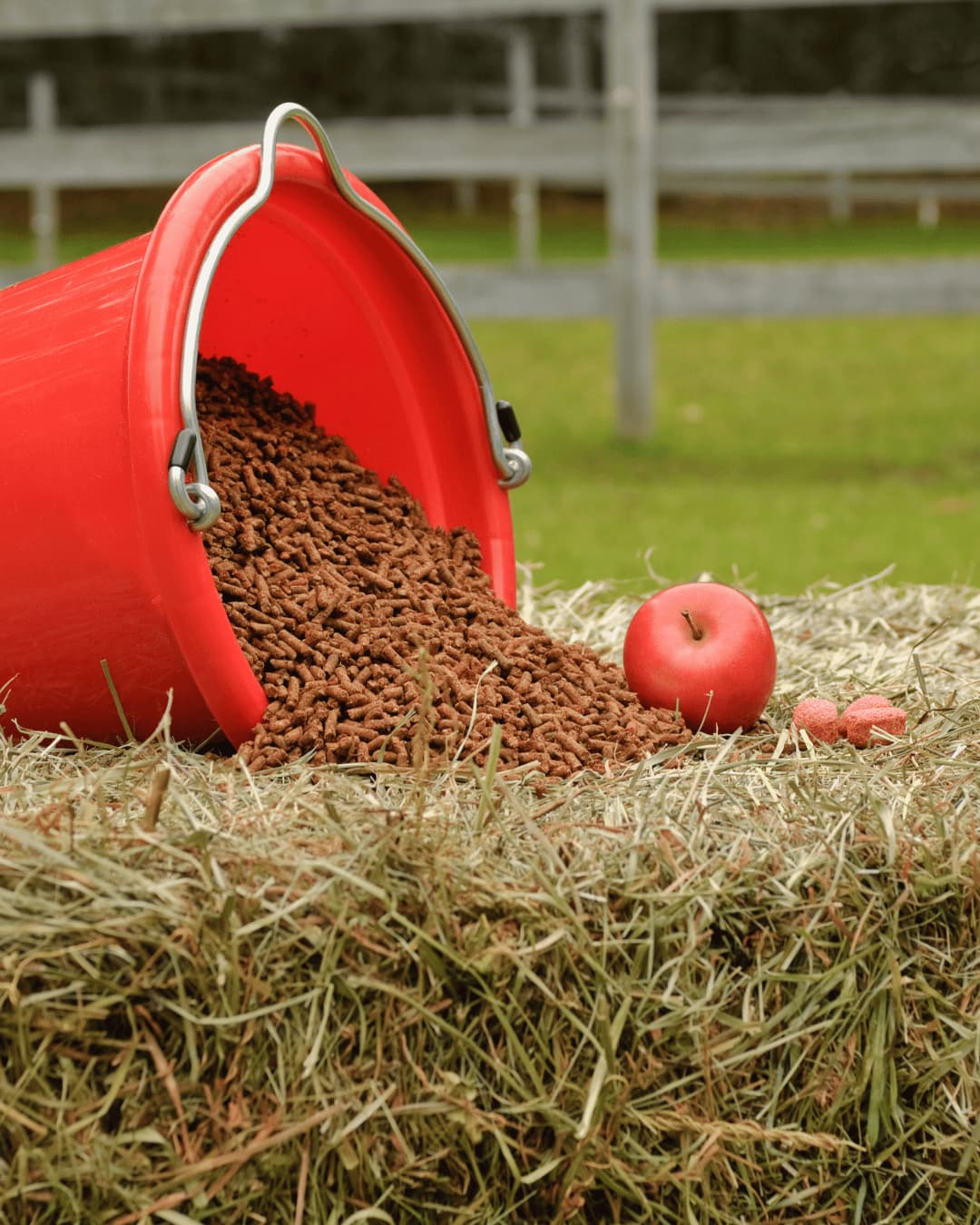
    A horse bucket of feed spilling out onto a bale of hay

    Most horse owners walk out of a feed store feeling like they’re underdoing it. The aisles are long, the marketing is confident, the labels are dense, and the implicit message is that figuring out what a normal horse needs to eat requires a chemistry degree, a calculator, and a hay analysis.

    The published reference standard for equine nutrition tells a quieter story. For a horse at maintenance — a normal horse doing normal horse things, not in heavy competition or hard daily work — the entire daily mineral and vitamin package is largely handled by three things most owners are already doing. Adequate forage. A ration balancer fed at the recommended rate. One to two tablespoons of plain iodized salt on the feed.

    That is the foundation. It is not “most of what your horse needs” or “a good starting point.” For a maintenance horse, the foundation is sufficient on its own. The National Research Council’s Nutrient Requirements of Horses (6th rev. ed., 2007) lays out exactly what a maintenance horse needs each day. The forage analysis literature lays out exactly what a normal flake of grass hay delivers. Side by side, the math is clean.

    This piece walks through that math. It also draws a clear line between maintenance and everything else, because there are real, evidence-supported reasons to add specific supplementation for certain horses, and those decisions deserve their own conversation but that determination is above the foundational needs, and the supplement aisle has done horse owners a disservice by blurring the two.

    What the NRC says a maintenance horse needs

    The National Research Council publishes the foundational reference document for equine nutrition. For an 1,100-pound (500 kg) mature horse at maintenance — no work, no lactation, no growth, no significant heat or cold stress — the published daily requirements for the major minerals are approximately:

    MineralDaily requirement (1,100 lb maintenance horse)
    Sodium~0.35 oz (10 g)
    Chloride~1.4 oz (40 g)
    Potassium~0.9 oz (25 g)
    Calcium~0.7 oz (20 g)
    Phosphorus~0.5 oz (14 g)
    Magnesium~0.26 oz (7.5 g)

    Mineral requirements are conventionally reported in grams because that’s the unit the NRC tables and the underlying research literature use. Ounce equivalents are included for everyday reference.

    The full NRC tables also publish requirements for trace minerals (copper, zinc, selenium, iodine, manganese, iron, cobalt) and the fat-soluble vitamins (A, D, E, K), with adjustments for working horses, lactating mares, growing horses, and other categories at elevated needs. Those numbers are the floor. Every other claim in this piece is measured against them.

    What forage already delivers

    Forage is the foundation laid on top of the floor. And the foundation covers more of the requirement than most owners realize.

    Potassium is the cleanest example. Analysis of mixed grass hays at commercial forage labs consistently shows potassium content in the range of 1.2 to 2.5% of dry matter, with some samples running higher. A horse eating about 22 pounds of typical grass hay per day — a normal amount for an 1,100-pound horse — is consuming roughly 4 to 9 ounces of potassium daily. That’s six to ten times the maintenance requirement of about 0.9 ounces. The Merck Veterinary Manual states the conclusion directly: a ration containing at least 50% roughage provides more than sufficient potassium for maintenance animals.

    Potassium deficiency in horses on adequate forage is genuinely rare. The exception is horses doing significant sweat-loss work, who can lose meaningful potassium through hypertonic equine sweat — but that’s a different physiological state from maintenance, and it has different management. (That conversation belongs in the electrolytes piece, not here.)

    Calcium and magnesium are similar stories. Calcium content in forage runs typically 0.3 to 1.5% of dry matter (higher in legumes like alfalfa, but adequate even in grass hays for a maintenance horse). Magnesium follows the same pattern. A horse on 22 pounds of grass hay is generally getting roughly 1 to 3.5 ounces of calcium and 0.4 to 0.9 ounces of magnesium daily, against requirements of about 0.7 oz and 0.26 oz respectively. Forage handles the macromineral side of the calcium and magnesium ledger for maintenance.

    Chloride and phosphorus. Forage supplies meaningful chloride (more as the forage matures) and adequate phosphorus. Combined with intentional sodium supplementation, which brings additional chloride along with it, the chloride requirement is comfortably met without a separate intervention.

    The picture across the macrominerals is consistent: forage is doing real work. A horse on adequate hay or pasture is meeting or exceeding the maintenance requirement for potassium, calcium, magnesium, and phosphorus, with chloride largely covered.

    Where forage leaves gaps, and what a ration balancer is built to do

    Forage leaves two reliable gaps, and they’re the reason ration balancers exist as a product category.

    Trace minerals vary dramatically by region. Soil mineralization in the area where the hay was grown determines what trace minerals end up in the forage. Parts of the Pacific Northwest, Canada, and the upper Midwest have selenium-deficient soils, which means hay from those regions can run short on selenium. Many regions produce hay with high iron content that interferes with the absorption of copper and zinc. Iodine levels vary by proximity to coastal regions and by soil chemistry. The result is that copper, zinc, selenium, and iodine are commonly under-delivered by forage alone, and the deficiency pattern depends on where your hay comes from. A 2021 peer-reviewed feeding trial in Animals phrased the general principle plainly: roughages usually fulfil the requirements for macro minerals but not of trace elements of horses at maintenance.

    Vitamin E is the other major gap. Fresh pasture is rich in vitamin E, but the vitamin is not heat-stable and degrades during the hay-curing and storage process. A peer-reviewed review by Finno and McKenzie (2025) in Veterinary Clinics of North America: Equine Practice documents that vitamin E losses approaching 50 percent occur in alfalfa hay stored for just one month, with continued losses during longer storage. A horse on a hay-only diet — particularly one eating hay that has been stored for several months — is reliably under-delivered on vitamin E.

    A ration balancer is the engineered solution to both gaps. It’s a concentrated feed designed to be fed in small quantities, typically 1 to 2 pounds per day for an 1,100-pound horse, that supplies trace minerals, amino acids, and vitamins calibrated to NRC requirements, without adding significant calories. A ration balancer fed at the recommended rate closes those gaps without requiring an owner to test every batch of hay — though hay testing remains the gold standard for owners who can do it.

    Two notes on ration balancers as a category, because the distinction matters. A ration balancer is not a complete feed; it’s a complement to forage. The whole product is formulated on the assumption that the horse is also eating adequate hay or pasture, and it doesn’t work as a stand-alone diet. A ration balancer is also not interchangeable with a vitamin-mineral supplement that comes in a 3-to-6-ounce daily scoop. The 1-to-2-pound serving size reflects a real density of macronutrients (especially amino acids and macromineral content) that smaller-scoop supplements typically don’t match.

    The one macromineral forage cannot cover

    This is the part of the package that has to come from somewhere else, intentionally, every single day, for nearly every horse.

    A grass hay analysis typically returns less than 0.05% sodium — functionally zero. Forage essentially does not contain sodium in any meaningful amount. This makes sodium unique among the macrominerals: every other one is either supplied by forage at maintenance levels or formulated into the ration balancer as part of the trace mineral package. Sodium is the exception. It has to be added separately.

    The fix is mechanically simple. One flat tablespoon of plain white loose salt weighs about two-thirds of an ounce (roughly 18 grams) and supplies approximately a quarter ounce of sodium (about 7 grams) and a third of an ounce of chloride (about 11 grams). Two tablespoons supplies about half an ounce of sodium, covering the maintenance requirement with comfortable margin, plus a meaningful share of the chloride requirement, with forage handling the balance.

    This practice — top-dressing one to two tablespoons of plain iodized salt on the daily feed — meets both the sodium and iodine requirements established by the NRC for a maintenance horse. Iodized salt addresses both the sodium gap and the iodine trace-mineral gap that forage often leaves short in non-coastal regions.

    Plain iodized salt, top-dressed on feed, is the most evidence-supported daily nutritional intervention in the entire equine literature for a maintenance horse. It is also the least expensive thing in the feed room.

    The complete maintenance package, side by side

    Putting it all together for an 1,100-pound horse at maintenance, on good-quality grass hay, fed appropriately. Amounts in ounces, with grams in parentheses for cross-reference to the underlying research:

    MineralNRC daily requirementForage (~22 lb grass hay)Ration balancer (1–2 lb at recommended rate)Iodized salt (1–2 Tbsp)Total
    Sodium~0.35 oz (10 g)~0~0.07–0.25 oz (2–7 g)~0.25–0.5 oz (7–14 g)Met with margin
    Chloride~1.4 oz (40 g)~0.35–0.7 oz (10–20 g)~0.1–0.3 oz (3–8 g)~0.4–0.8 oz (11–22 g)Met
    Potassium~0.9 oz (25 g)~4–9 oz (120–250 g)minorMet many times over
    Calcium~0.7 oz (20 g)~1–3.5 oz (30–100 g)~0.18–0.5 oz (5–15 g)Met with margin
    Magnesium~0.26 oz (7.5 g)~0.4–0.9 oz (10–25 g)~0.07–0.18 oz (2–5 g)Met with margin
    Phosphorus~0.5 oz (14 g)~0.5–1 oz (15–30 g)~0.1–0.35 oz (3–10 g)Met
    Trace minerals (Cu, Zn, Se, I)variesvariable, often deficientengineered to meet requirementiodine from iodized saltMet by balancer + iodized salt
    Vitamin E~500 IUlow in cured hayengineered to meet requirementMet by balancer

    The package — adequate forage plus a ration balancer at the recommended rate plus one to two tablespoons of iodized salt — covers the published nutritional requirements for a maintenance horse. That’s not a controversial claim. It’s the NRC tables, read straight.

    Above the foundation is a different conversation

    Here’s the line the supplement aisle has not been careful about drawing.

    The foundation — forage, ration balancer, iodized salt — is sufficient for maintenance. It is not sufficient for every horse in every situation, and nobody is saying it should be. There are real, evidence-supported reasons to add additional supplementation to horses’ diets, and those decisions are a legitimate and important part of horse ownership.

    The rule above the foundation is different, though. Anything above the foundation should be answering a specific question. What am I solving for?

    Electrolyte supplements are the cleanest example, and they live entirely above the foundation. They were never designed to be a daily maintenance product. They are formulated for specific situations: heavy sweat losses from endurance work, prolonged exercise in hot weather, multi-hour transport in summer conditions, clinical rehydration where the osmotic mechanics of an isotonic solution are being used as a therapeutic lever. Each of those is a different question with a different answer, and the right electrolyte for one is not necessarily the right electrolyte for another. The full research on this is the subject of the electrolytes piece in this series.

    Hoof supplements answer the question: does my horse have a documented hoof problem that biotin or specific amino acids would help? Joint supplements answer the question: does my horse have age- or work-related joint changes that targeted ingredients have been shown to help? Gut and ulcer supplements answer the question: does my horse have a diagnosed or strongly suspected gastric issue? Hydration-focused water additives answer the question: is my horse drinking enough water, and would a palatability-driven intervention improve voluntary intake? Not every horse needs them. Some do.

    And that’s the line. Foundation is foundation. Above that, name the need.

    FAQ

    My horse is on pasture instead of hay. Do I still need a ration balancer?

    Likely yes, depending on your pasture quality and your region, but pasture changes the picture in meaningful ways. Fresh growing grass contributes things stored hay simply doesn’t:

    • Water. Fresh pasture is roughly 70 to 85% water by weight, depending on species and maturity, which means a pasture horse is getting real hydration from forage that a hay-fed horse isn’t.
    • Vitamin E. Fresh grass is the natural source. Finno and McKenzie (2025) in Veterinary Clinics of North America: Equine Practice document that vitamin E losses approaching 50 percent occur in alfalfa hay stored for just one month, with continued losses during longer storage. A horse on lush, fresh pasture may be meeting requirements directly; a hay-fed horse generally isn’t.
    • Omega-3 fatty acids (specifically alpha-linolenic acid). Pasture grass is the horse’s natural source of ALA. Garton’s foundational 1960 work in Nature on the fatty acid composition of pasture grasses established that fresh grass contains substantial ALA, and subsequent peer-reviewed research has confirmed that the heat-sensitive unsaturated fatty acids degrade during haymaking and storage. This is the main reason omega-3 supplementation has become common practice for horses on hay-only diets, and is the basis for peer-reviewed research on omega-3 effects in horses such as Hess et al. (2013) in the Journal of Equine Veterinary Science.
    • Vitamin A precursors (beta-carotene). The NRC Nutrient Requirements of Horses (6th rev. ed., 2007) documents substantial beta-carotene loss in stored hay compared to fresh grass, with the carotenoid pigment continuing to oxidize during storage.

    What pasture doesn’t reliably change is the trace mineral picture. Soil mineralization where the grass grew still determines what’s in it, and pasture isn’t a free pass on copper, zinc, selenium, or iodine. A horse on rotational grazing across known-quality pasture may need less from a ration balancer than a horse on hay; a horse on overgrazed or poorly maintained pasture may need essentially the same support a hay-fed horse needs. When in doubt, the balancer covers the gaps.

    Do I need to test my hay before I trust this?

    Hay testing is the gold standard for knowing exactly what your horse is eating. If you can test, do. That said, modern horse-keeping doesn’t always make testing realistic. Most boarding barns, and many private owners, buy hay across the year from multiple sources — different farms, different cuttings, different species. Testing every batch isn’t feasible for most people, and waiting on lab results before feeding a new load isn’t either.

    The numbers in this piece are averages drawn from the published forage analysis literature. They’re what the math looks like for a typical batch of grass hay grown under typical conditions. They’re not a substitute for testing your specific hay if you want certainty; they’re a way to make a reasonable decision when testing every load isn’t on the table. Perfect is the enemy of good. You’re doing the best you can with the information you have, and the averages are how we make that work.

    My ration balancer already contains salt. Do I still need to add a tablespoon?

    Read the tag. Most ration balancers include some salt — typically in the range of 0.5 to 1% of the feed by weight — but at a 1-to-2-pound daily serving, that contributes somewhere between about 2 and 7 grams of sodium to your horse’s day. The maintenance requirement is about 10 grams. Most balancers, even ones that prominently include salt, don’t get you all the way there at the recommended feeding rate. A tablespoon or two of plain iodized salt on top closes the gap. If you’re feeding a balancer significantly above the recommended rate (which most people aren’t), the math may shift.

    My horse has a salt block in the pasture. Is that enough?

    Probably not. Multi-year research at the Swedish University of Agricultural Sciences measured voluntary salt intake from individual blocks in Standardbred geldings during active training. The horses consumed an average of 14 to 19 grams of salt per day from the blocks — less than the maintenance requirement of about 25 grams, and intake didn’t increase to compensate after sweat-producing exercise. The authors concluded that voluntary block intake is not a reliable route to meet salt needs. A block is a fine free-choice option to have available, but for most horses it doesn’t close the sodium gap on its own. Loose salt top-dressed on the feed does.

    What if my horse won’t eat salt on their feed?

    A few practical angles. Start small — half a teaspoon for a few days, then a teaspoon, working up gradually so the change isn’t sudden. Mix the salt thoroughly into damp feed rather than sprinkling it on top, which helps with palatability. Some horses prefer fine-grain salt to coarse; others tolerate one brand and not another, so it’s worth experimenting if you hit resistance. Iodized table salt from the grocery store works as well as anything sold for horses, often for a fraction of the cost. If a horse persistently refuses salt on feed even after adjustment, a salt block remains the fallback — not ideal as a sole source, but better than nothing.

    When would my horse actually need an electrolyte supplement?

    Electrolyte supplements live above the foundation, and they answer specific questions: heavy sweat losses from endurance work or prolonged exercise, hot-weather competition, multi-hour summer transport, clinical rehydration where an isotonic solution is being used as a therapeutic lever. Each of those situations has real, evidence-supported reasons to add targeted electrolytes — and the right product for one situation isn’t necessarily the right product for another. The detailed walkthrough of what the research says about sweat composition, when supplementation helps, and when it doesn’t is the subject of the electrolytes piece coming next in the Why So Salty? series. The short answer: if your horse is at maintenance and isn’t sweating heavily, the foundation has them covered.

    References

  • Don’t Change Your Macros. Change Your Flavor.

    The More We Know, The More Complicated It Gets

    Every horse on our farm ends up with a custom routine. Crazy complicated baggies of supplements and medication, customized to every single animal, built with a lot of care and attention to detail. There is thought that goes into every single supplement, every feed, every flake of hay we hand out.

    So when we set it in front of them and they leave half of it uneaten — or worse, just walk away — it is incredibly frustrating.

    The first thing most of us do is try to figure out how to get them to finish it. Did I put too much water in it? Did I not put enough water in it? Maybe I need to split the supplement — but if I do that, it’s not going to be as effective. All of these thoughts go through our head.

    The reality is usually much simpler than any of that.

    It just doesn’t taste good.

    Don’t change your macros. Change your flavor.

    Your Horse Is Not Being Picky. Your Horse Is Being A Horse.

    Before we go any further, let’s get one thing on the table: refusing food because it smells wrong is not stubbornness, not disrespect, and not a character flaw. It is an evolutionary safety latch.

    Horses evolved as selective browsers in a world full of plants that could hurt them. Their nose is the first line of defense, and it is a very good first line of defense.

    A horse has somewhere in the neighborhood of 25–30 million olfactory receptor neurons — compared to roughly 5 million in the average human. That is not a small difference. That is the difference between looking at a photograph and looking at the thing itself.

    Horses have a well-developed olfactory epithelium, suggesting an extensive role of the sense of smell in how they evaluate their environment. Everything they eat, drink, and decide to trust, they evaluate through that nose first. The mouth is the second opinion — the nose has already made a diagnosis.

    So when your horse walks up to a feed pan, takes a single breath, and walks away, something in a several-hundred-million-year-old threat-assessment system just said no. You’re not going to bully your way past that system with a different scoop or a different bucket. You have to work with it.

    That is exactly what the flavors in the Improve Equine Hydration Mix, Feed Topper and Low Calorie Treat line are designed to do.

    Working With The Nose, Not Against It

    In particular, the Palate Profile line was specifically designed using aromatic herbs and spices that horses, across multiple published studies, reliably choose when given the option.

    At the top of that list is fenugreek. In a landmark University of Southampton study, researchers presented horses with a range of flavors and measured what they consumed fastest and preferred most. Of twelve universally accepted flavors, paired preference tests produced a clear rank order — fenugreek came in first, followed by banana, cherry, rosemary, cumin, carrot, peppermint, and oregano. Later research has confirmed the same pattern: fenugreek, a commonly added palatant, was the most consumed flavor in a University of Glasgow study testing flavor preferences in high-fiber diets.

    Fenugreek didn’t win because it’s exotic. It won because horses have been telling us it’s what they want for a long time, and we finally listened.

    Alongside fenugreek, the Palate Profile line leans on Ceylon cinnamon and peppermint — both enticing to horses, both with documented health benefits, and both carrying a strong enough aromatic signature to do real work in the feed pan.

    That work is not cosmetic. That work is enticing.

    What Horses Are Actually Refusing

    When a horse walks away from a bucket, it is usually one specific off-note that their nose has flagged. The usual suspects:

    • Metallics. SMZs are notorious for this. Many horses smell the metallic edge and decide instantly, before the first bite.
    • Chalky bitterness. Bute is the classic example — that dry, persistent bitterness that no amount of applesauce fully hides.
    • Magnesium’s metallic edge. Common in calming supplements, and a frequent reason horses start refusing a regimen they previously accepted.
    • Fishy and sulfurous notes. MSM, some joint supplements, fish-oil-based omegas. All useful ingredients. All capable of flipping the switch from “yes” to “absolutely not.”
    • Generic medicinal funk. That catchall chemistry-set smell that some powdered supplements carry and horses clock from three feet away.

    A heavy aromatic — fenugreek’s warm, nutty, curry-adjacent profile; Ceylon cinnamon’s deep sweetness; peppermint’s bright punch — gives the nose something to lock onto first, before the problem note gets a chance to register.

    That’s the trick. You are not deceiving your horse. You are giving them a reason to keep sniffing long enough to decide the food is worth eating.

    Sometimes It’s Not Masking. Sometimes It’s Just Flavor.

    Not every refusal is about masking something bad. Sometimes whatever you’ve concocted in that dish is simply bland. It doesn’t have good flavor.

    This is where I have to be honest with a certain type of horse person, and I say this with love:

    Do not be the person who gets invited to the cookout and is afraid of spice.

    You know the one. Their dish is technically food. It is technically a contribution. Nobody is going to eat it.

    Do not bring potato salad with raisins to your horse’s cookout.

    Your horse has five times more olfactory receptors than you do. They are built for flavor. They want flavor.

    Give the dish some kick.

    Why Any Of This Matters

    There’s a portion of this that is, honestly, about how it feels. When you put down a pan and your horse finishes every bite, there is not a scrap left, and they walk off content — that feels good. Same way making a really good meal that everyone at your table enjoys feels good. That payoff is real and it is okay to want it.

    But the underlying reason matters more than the feeling.

    Every horse has nutritional needs. Every horse on a care plan has supplements and feed and — sometimes — medication that exists for health, for comfort, for performance. If they do not actually eat it, none of that carefully built plan is doing what we designed it to do.

    We are not in this to save money, although nobody wants to be the person trying to pass along a half-used bag of feed with the description “great macro profile, my horse won’t eat it” — that is the horse-feed equivalent of saying “smell this” after you just made a face at the carton of milk.

    We are in this because we want our horses to feel good. We want them to stay healthy for as long as possible. And when we do ask them to perform, we want them to be able to perform at their best.

    That requires full compliance — feed, supplement, medication — and that means food that smells and tastes good enough to eat.

    And our Improve Equine flavors are here for it.

    Want to try the approach for your own horse? The Palate Profile sampler and the full farmily line are built exactly for this — eleven flavors with clean, low-calorie, metabolic-safe ingredients, so your horse can tell you what they actually want without a single macro having to change. Shop the samplers →

    Frequently Asked Questions

    Why won’t my horse eat their supplement anymore?

    Usually not because the formulation stopped working. It is because something in the supplement smells wrong to a nose that is roughly five to six times more sensitive than yours. The fix is almost always flavor, not macros. Don’t change your macros. Change your flavor.

    Is my horse being a picky eater?

    No. Refusing food that smells off is an evolutionary safety latch — a several-hundred-million-year-old threat-assessment system working correctly. Horses evolved as selective browsers in a world full of plants that could hurt them. Their nose is the first line of defense, and it is a very good first line of defense.

    What flavor do horses prefer most?

    According to peer-reviewed research (Goodwin et al., 2005, Applied Animal Behaviour Science), fenugreek ranked first in paired preference tests, followed by banana, cherry, rosemary, cumin, carrot, peppermint, and oregano. Fenugreek was also the most consumed flavor in a later University of Glasgow study of flavor preferences in high-fiber diets.

    How do I get my horse to eat a supplement that tastes bad?

    Use a heavy aromatic — fenugreek, Ceylon cinnamon, or peppermint — to give the nose something to lock onto first, before the problem note gets a chance to register. You are not deceiving your horse. You are giving them a reason to keep sniffing long enough to decide the food is worth eating.

    Why does changing the supplement not fix the problem?

    Because the problem is rarely the macros. Every time you swap protocols, you introduce a new ingredient matrix to a gut that was adjusting to the last one and you lose continuity on whatever the supplement was actually doing. The horse that stops eating isn’t telling you to change the protocol — they’re telling you the flavor isn’t working. Those are two very different diagnoses.

  • DHA from Algae: Omega-3 Fatty Acids in Inflammation and Allergic Response

    Docosahexaenoic acid (DHA) is a long-chain omega-3 polyunsaturated fatty acid found in highest concentrations in marine algae — the original biosynthetic source from which all dietary DHA ultimately derives. DHA and its downstream metabolites play a central role in resolving inflammation, modulating mast cell activity, and supporting immune regulation in both horses and other mammals. The choice to source DHA from algae rather than fish oil is a formulation decision grounded in stability, species-appropriateness, and supply chain control.

    Key Research

    Protectin D1, an Omega-3-Derived Lipid Mediator, Resolves Mast Cell-Driven Allergic Inflammation via FcεRI Signaling

    Biomed Pharmacother. 2025 Jun:187:118060.
    DOI: 10.1016/j.biopha.2025.118060 | PMID: 40253829

    Protectin D1 (PD1) is a specialized pro-resolving mediator derived from DHA. This study demonstrates that PD1 directly counteracts mast cell-mediated allergic inflammation — the same pathway that Benchmark targets via quercetin and spirulina. Key findings:

    • Oral PD1 markedly suppressed passive cutaneous anaphylaxis (PCA) reactions including ear swelling, plasma extravasation, and mast cell degranulation
    • In active systemic anaphylaxis models, PD1 administration reduced IgE-mediated mast cell activation via the FcεRI signaling pathway — the primary trigger for histamine release in allergic responses
    • This is direct mechanistic evidence linking DHA (as the precursor to Protectin D1) to resolution of the same mast cell degranulation and histamine pathways that drive equine allergic conditions

    Omega-3 Fatty Acid Supplementation in Horses with Chronic Lower Airway Inflammatory Disease

    Nogradi N, Couetil LL, Messick J, Stochelski MA, Burgess JR. J Vet Intern Med. 2015 Jan;29(1):299–306.
    DOI: 10.1111/jvim.12488 | PMID: 25307169

    This randomized, controlled clinical trial examined omega-3 PUFA supplementation in horses diagnosed with recurrent airway obstruction (RAO) and inflammatory airway disease (IAD) — the equine equivalents of heaves and chronic lower airway inflammation. Key findings:

    • Omega-3 supplementation provided additional measurable benefit beyond a low-dust diet alone in managing clinical signs and airway inflammation
    • Supplemented horses showed improvements in lung function and inflammatory markers in bronchoalveolar lavage fluid
    • The study directly supports the use of omega-3 fatty acids as part of a multi-ingredient approach to equine respiratory and inflammatory conditions

    DHA Oxymetabolites Modulate Inflammatory Response in Equine Synoviocytes

    Leclère M, de la Rebière de Pouyade G, Couture F, Laverty S, Lavoie JP. Prostaglandins Other Lipid Mediat. 2019 Jun:142:1–8.
    DOI: 10.1016/j.prostaglandins.2019.02.007 | PMID: 30836143

    This study examined how DHA and its downstream oxymetabolites (docosanoids) affect inflammatory mediator gene expression in equine joint cells stimulated with pro-inflammatory cytokines. Key findings:

    • DHA-derived oxylipids modulated the expression of inflammatory mediator genes in equine synoviocytes — direct in vitro evidence of DHA’s anti-inflammatory activity in horse tissue
    • The mechanism involves downstream conversion of DHA into pro-resolving specialized lipid mediators (SPMs) that actively turn off inflammatory gene expression
    • This supports the use of DHA specifically (not just generic omega-3) in addressing joint and tissue inflammation in horses

    Why Algae-Derived DHA

    Fish don’t make DHA — they concentrate it from eating algae. By going directly to the algae source, Benchmark avoids the fishy palatability issues that can reduce equine supplement acceptance, eliminates the oxidative rancidity risk inherent to fish oil concentrates, and provides DHA in a form that is more stable and consistently dosed. The science on DHA’s mechanism is the same regardless of source; the sourcing decision is about delivery quality and horse compliance.

    Note: These studies provide evidence for DHA’s anti-inflammatory and mast cell-modulatory mechanisms, including equine-specific research. Always consult a veterinarian regarding your horse’s specific health needs.

    Frequently Asked Questions: DHA and Omega-3s for Horses

    What does DHA do for horses?

    Short answer: DHA is the omega-3 precursor to specialized pro-resolving mediators (SPMs) — including Protectin D1 and resolvins — that actively turn off mast cell degranulation, IgE signaling, and inflammatory gene expression, making it a resolution-phase anti-inflammatory with direct evidence in equine tissue. Unlike anti-inflammatory compounds that block inflammatory pathways, DHA-derived SPMs actively signal the resolution of inflammation and initiate tissue repair. This is a distinct and complementary mechanism from the mast cell stabilization provided by quercetin and spirulina. Research in equine synoviocytes (joint cells) has confirmed DHA’s anti-inflammatory mechanism directly in horse tissue, not just in model organisms.

    Is algae-derived DHA better than fish oil for horses?

    Short answer: Algae-derived DHA is the original biosynthetic source — fish concentrate DHA by eating algae. For horses, algae DHA avoids the palatability problems of fish oil, eliminates rancidity risk, and delivers the same active DHA molecule with better stability and acceptance. Fish oil’s fishy odor and taste are significant barriers to equine supplement acceptance. Many horses refuse or reduce intake of feeds containing fish oil, which defeats the purpose. Algae-sourced DHA is flavorless, more oxidatively stable than fish oil concentrates, and provides the identical DHA molecule. For horses, supplement compliance is not a secondary concern — it is the primary one. A supplement the horse won’t eat provides no benefit at all.

    Can DHA help horses with heaves or inflammatory airway disease?

    Short answer: Yes — a randomized controlled clinical trial in horses with RAO and IAD found that omega-3 supplementation provided measurable benefit in lung function and airway inflammatory markers beyond a low-dust diet alone. This is equine-specific clinical trial evidence, not just mechanistic inference. The horses in the Nogradi et al. study showed improvements in bronchoalveolar lavage inflammatory cell counts and lung function with omega-3 supplementation — directly supporting DHA’s use in horses with chronic lower airway inflammation. Combined with quercetin, isoquercetin, spirulina, and MSM, DHA addresses the resolution phase of the airway inflammatory cycle that the other compounds help prevent.

    Does DHA help horses with joint inflammation?

    Short answer: Yes — DHA-derived oxylipids directly modulate inflammatory mediator gene expression in equine synoviocytes (joint cells), with specific in vitro evidence that DHA’s downstream pro-resolving mediators reduce inflammatory gene expression in horse joint tissue. This is one of the most directly applicable pieces of equine research in the Benchmark ingredient library — it was conducted in actual equine joint cells, not a surrogate model. For horses with joint inflammation, arthritis, or post-exercise joint soreness, DHA’s pro-resolving mechanism complements the anti-inflammatory activity of MSM and the antioxidant protection of ascorbyl palmitate. Together these three ingredients address joint health from prevention through resolution.

    Is DHA safe for metabolic horses or horses with Cushing’s disease?

    Short answer: Yes — DHA from algae is a fat-soluble compound with no sugar, no electrolytes, and no glycemic impact, making it appropriate for metabolic horses who need anti-inflammatory support without metabolic risk. Horses with Cushing’s disease (PPID) and insulin resistance often have elevated systemic inflammation as part of their condition. DHA’s pro-resolving anti-inflammatory mechanism is particularly relevant for these horses, who need ongoing inflammatory management but cannot tolerate many standard supplement ingredients. Algae DHA is one of the safest anti-inflammatory tools available for the metabolic horse population. Always confirm with your veterinarian for horses under active medical management. For a complete picture of equine health, see the Complete Guide to Horse Hydration, the Benchmark product page, and the full Improve Equine Library.

  • Ascorbyl Palmitate: Why Fat-Soluble Vitamin C Lasts Longer

    Ascorbyl Palmitate: Why Fat-Soluble Vitamin C Lasts Longer

    Ascorbyl palmitate is the fat-soluble (lipophilic) ester form of Vitamin C. Unlike standard ascorbic acid — which is water-soluble and clears from the body relatively quickly — ascorbyl palmitate integrates into lipid membranes and fatty tissues, providing extended antioxidant protection at the cellular level. This distinction matters for immune function, tissue defense, and the specific demands of an equine supplement designed to support allergy and inflammation pathways.

    Key Research

    Ascorbyl Palmitate Ameliorates Inflammatory Diseases by Inhibition of NLRP3 Inflammasome

    Int Immunopharmacol. 2024 Apr 20:131:111915.
    DOI: 10.1016/j.intimp.2024.111915 | PMID: 38522141

    This research demonstrates that ascorbyl palmitate (AP), as a lipophilic derivative of ascorbic acid, is a potent inhibitor of the NLRP3 inflammasome — a key driver of inflammation in chronic immune-mediated conditions. Key findings:

    • Compared to standard ascorbic acid, ascorbyl palmitate inhibited NLRP3 inflammasome activation with increased potency and specificity
    • The mechanism involves direct scavenging of mitochondrial reactive oxygen species (mitoROS) — a lipid-membrane-accessible activity that water-soluble ascorbic acid cannot replicate
    • Ascorbyl palmitate reduced downstream IL-1β release and inflammatory tissue damage in multiple in vivo inflammatory disease models

    NLRP3 inflammasome activation is implicated in allergic airway disease, skin hypersensitivity, and joint inflammation — making this mechanism directly relevant to the conditions Benchmark is formulated to address.

    Ascorbate 6-Palmitate Protects Cell Membranes from Oxidative Damage

    Hwang J, Hodis HN, Sevanian A. Free Radic Biol Med. 1999 Jan;26(1-2):81–9.
    DOI: 10.1016/s0891-5849(98)00198-1 | PMID: 9890643

    This study investigated why the fat-soluble form of ascorbate behaves differently from water-soluble ascorbic acid. Key findings:

    • Ascorbate 6-palmitate binds dose-dependently to cell membranes and is retained during membrane wash steps — confirming genuine membrane integration that water-soluble Vitamin C cannot achieve
    • Cells treated with ascorbate 6-palmitate showed significantly greater protection against lipid peroxidation and oxidative membrane damage compared to controls
    • The fat-soluble form provides antioxidant protection specifically at the lipid bilayer — the site of membrane phospholipid oxidation in inflammatory conditions

    This is the physiological basis for why ascorbyl palmitate is a more appropriate form of Vitamin C for an equine supplement targeting skin, airway mucosa, and joint tissues — all of which are lipid-rich environments.

    The Benchmark Formulation Rationale

    Standard water-soluble Vitamin C is renally cleared rapidly. Ascorbyl palmitate stays in circulation longer because it integrates into lipid membranes. For a horse dealing with chronic allergy, airway inflammation, or dermal hypersensitivity, sustained antioxidant coverage — not a quick spike and rapid clearance — is the goal. The fat-soluble form delivers that.

    Note: These studies support the rationale for choosing ascorbyl palmitate over standard ascorbic acid in a supplement designed for lipid-tissue antioxidant and anti-inflammatory support. Always consult a veterinarian regarding your horse’s specific health needs.

    Frequently Asked Questions: Ascorbyl Palmitate for Horses

    What is ascorbyl palmitate and why is it used in horse supplements?

    Short answer: Ascorbyl palmitate is the fat-soluble form of Vitamin C — it integrates into cell membranes and provides sustained antioxidant protection in lipid-rich tissues like skin, airway mucosa, and joints, where standard water-soluble Vitamin C cannot reach effectively. Standard ascorbic acid dissolves in water and is rapidly cleared by the kidneys, providing only a brief antioxidant window. Ascorbyl palmitate binds to lipid bilayers and remains in tissues far longer, protecting cell membranes from the oxidative damage that drives chronic inflammation. For horses with ongoing inflammatory conditions, sustained cellular antioxidant coverage is the goal — not a rapid spike and clearance.

    Does Vitamin C help horses with allergies or skin conditions?

    Short answer: Yes — but the form matters. Ascorbyl palmitate specifically inhibits the NLRP3 inflammasome, a key driver of chronic inflammatory conditions including allergic airway disease, skin hypersensitivity, and joint inflammation, with greater potency than standard Vitamin C. The NLRP3 inflammasome is a cellular complex that triggers IL-1β release and amplifies inflammation in chronic immune-mediated conditions. Ascorbyl palmitate’s ability to access mitochondrial reactive oxygen species (mitoROS) at the lipid membrane level — a mechanism water-soluble ascorbic acid cannot replicate — makes it specifically effective at suppressing NLRP3-driven inflammation. For horses with sweet itch, heaves, or chronic skin conditions, this targeted mechanism is directly relevant.

    Is ascorbyl palmitate better than regular Vitamin C for horses?

    Short answer: For supporting skin, airway, and joint tissue specifically — yes. Ascorbyl palmitate reaches and stays in the lipid-rich tissues where most equine inflammatory conditions manifest, while standard ascorbic acid is rapidly excreted and never reaches those cellular compartments effectively. Horses can synthesize some Vitamin C endogenously, but horses under significant inflammatory or oxidative stress may benefit from supplemental lipid-tissue antioxidant support. The choice of form is the key variable: water-soluble ascorbic acid addresses water-phase oxidative stress, while ascorbyl palmitate addresses lipid-phase oxidative stress at the cell membrane — a different and complementary target.

    How does ascorbyl palmitate work alongside DHA in horse inflammation support?

    Short answer: Ascorbyl palmitate and DHA are both lipid-membrane-active compounds that protect and resolve inflammation at the cellular level — they work in complementary phases, with ascorbyl palmitate protecting membranes from oxidative damage and DHA actively resolving inflammatory signaling through specialized pro-resolving mediators. DHA from algae generates resolvins and protectins — compounds that actively switch off the inflammatory response and signal tissue repair. Ascorbyl palmitate protects the integrity of the cell membranes in which DHA is embedded. Together they address both prevention and resolution of lipid-membrane-based inflammation. See the DHA research article for details.

    Is ascorbyl palmitate safe for horses with Cushing’s or insulin resistance?

    Short answer: Yes — ascorbyl palmitate is not a sugar-containing compound and does not affect insulin or glucose metabolism, making it appropriate for metabolic horses who need anti-inflammatory support without metabolic risk. Horses with Cushing’s disease or insulin resistance often have elevated inflammatory markers and oxidative stress alongside their metabolic condition, making antioxidant support particularly relevant. Ascorbyl palmitate’s lipid-soluble form provides this support without any of the glycemic concerns associated with sugar-based supplements. As always, confirm with your veterinarian for horses under active medical management. For an overview of the full equine supplement philosophy, visit the Improve Equine Library and the Complete Guide to Horse Hydration.

  • Bromelain: How It Enhances Quercetin Absorption and Effectiveness

    Bromelain: How It Enhances Quercetin Absorption and Effectiveness

    Bromelain is a proteolytic enzyme complex extracted from pineapple (Ananas comosus) stem. Beyond its own significant anti-inflammatory properties, bromelain plays a critical synergistic role with quercetin — enhancing its bioavailability and potentiating its effects at the site of action. This combination has been validated in peer-reviewed research on the mechanisms of flavonoid absorption and immune modulation.

    Key Research

    Bromelain as a Natural Anti-Inflammatory Drug: A Systematic Review

    Nobre TA, de Sousa AA, Pereira IC, et al. Nat Prod Res. 2025 Mar;39(5):1258–1271.
    DOI: 10.1080/14786419.2024.2342553 | PMID: 38676413

    This systematic review evaluated bromelain’s anti-inflammatory activity across in vitro studies on multiple cell lines. Key findings relevant to allergy and inflammation:

    • Bromelain reduced IL-1β, IL-6, and TNF-α secretion in immune cells stimulated by pro-inflammatory cytokines — modulating the inflammatory cascade rather than suppressing it indiscriminately
    • The mechanisms include reduction in prostaglandin synthesis and activation of neutrophil-regulating pathways that parallel the mechanisms of quercetin’s mast cell stabilization
    • Bromelain’s effects were consistent across multiple immune cell types, supporting its role as a broadly acting natural anti-inflammatory agent

    The Mechanism: How Bromelain Enhances Flavonoid Absorption

    Bromelain enhances quercetin absorption through several complementary mechanisms:

    • Gut permeability modulation: Bromelain selectively modifies tight junctions in intestinal epithelium, facilitating paracellular and transcellular absorption of large molecules including flavonoids
    • Mucolytic action: By breaking down mucus in the GI tract, bromelain reduces the diffusion barrier between the gut lumen and absorptive epithelial cells
    • Reduced first-pass metabolism: Bromelain’s anti-protease activity may protect quercetin from premature enzymatic degradation before absorption
    • Synergistic anti-inflammatory effects: Bromelain itself inhibits prostaglandin synthesis, bradykinin, and NF-κB activation — complementing quercetin’s mast cell-stabilizing mechanisms

    Bromelain’s Independent Anti-Inflammatory Properties

    Rathnavelu V, Alitheen NB, Sohila S, Kanagesan S, Ramesh R. Biomedical Reports. 2016 Sep;5(3):283–288.
    DOI: 10.3892/br.2016.720 | PMID: 27602208 | Free PMC Article

    Beyond its role as an absorption enhancer, bromelain has been shown to independently reduce inflammatory cytokines, inhibit platelet aggregation, and modulate immune cell activity. This study covers bromelain’s potential clinical and therapeutic applications in inflammatory conditions, including its inhibition of NF-κB signaling, COX-2 expression, and pro-inflammatory eicosanoid pathways. This means the bromelain in Benchmark contributes directly to the formula’s anti-inflammatory activity in addition to improving the delivery of other ingredients.

    The Benchmark Formulation Rationale

    Benchmark includes bromelain specifically because quercetin’s effectiveness is limited by its absorption. By pairing isoquercetin (the most bioavailable quercetin form) with bromelain (an absorption enhancer with its own anti-inflammatory properties), Benchmark is designed to maximize the amount of active quercetin that reaches systemic tissues — including airway mucosa, skin, and joints — where mast cell stabilization matters most for your horse.

    Note: These studies provide evidence for bromelain’s anti-inflammatory mechanisms and its role in enhancing quercetin bioavailability. Always consult a veterinarian regarding your horse’s specific health needs.

    Frequently Asked Questions: Bromelain for Horses

    What does bromelain do for horses?

    Short answer: Bromelain serves two roles in equine supplementation — it is an independent anti-inflammatory agent that reduces IL-1β, IL-6, TNF-α, NF-κB, and COX-2 activity, and it simultaneously enhances the absorption of quercetin and other flavonoids by improving gut permeability and reducing the diffusion barrier in the GI tract. For horses on a quercetin-based allergy or inflammation support protocol, bromelain is not just an addition — it is a multiplier. By improving quercetin bioavailability while contributing its own anti-inflammatory activity, bromelain allows the full quercetin-family stack to perform significantly better than any single ingredient could achieve alone.

    Why is bromelain paired with quercetin in horse supplements?

    Short answer: Quercetin’s major limitation is poor oral bioavailability — bromelain addresses this directly by modifying intestinal tight junctions to improve absorption, breaking down mucus diffusion barriers, and protecting quercetin from premature enzymatic degradation before it can be absorbed. This synergistic combination is one of the most well-studied flavonoid absorption pairings in nutritional research. The practical result for horses is that a bromelain-plus-quercetin formulation delivers meaningfully more active quercetin to systemic tissues — the airways, skin, and joints — than quercetin supplemented alone. The effect is further amplified when isoquercetin is used instead of standard quercetin. See the isoquercetin bioavailability article for the full picture.

    Is bromelain safe for horses?

    Short answer: Yes — bromelain has an established safety profile in both human and animal research, with no significant adverse effects observed at therapeutic doses. It is a naturally occurring enzyme from pineapple stem and is widely used in human nutritional and pharmaceutical applications. For horses, the primary consideration is that bromelain is a proteolytic enzyme and should be introduced gradually for horses with known GI sensitivity. It is not appropriate during active gastric ulcer flares where intestinal permeability changes are contraindicated. Always consult your veterinarian before introducing any new supplement to a horse with a known GI condition.

    Does bromelain help with horse skin allergies and sweet itch?

    Short answer: Yes — bromelain’s independent anti-inflammatory activity (reducing prostaglandins, bradykinin, and NF-κB) combined with its enhancement of quercetin absorption makes it a meaningful contributor to equine skin allergy management, particularly in combination with quercetin and spirulina. Sweet itch and insect bite hypersensitivity involve both mast cell degranulation and downstream inflammatory cascade activity — two mechanisms that bromelain addresses directly and indirectly. For horses with significant skin hypersensitivity, the bromelain-quercetin-isoquercetin-spirulina combination represents the most comprehensive natural approach supported by the current research literature.

    What is the full anti-inflammatory stack for horses with allergies?

    Short answer: The most research-supported natural equine allergy and inflammation protocol combines spirulina (mast cell stabilization via cAMP) + quercetin (IgE signaling and NF-κB suppression) + isoquercetin (superior quercetin bioavailability) + bromelain (absorption enhancement + independent anti-inflammatory) + MSM (cytokine suppression and antioxidant support) + DHA (resolution-phase anti-inflammatory). Each ingredient addresses the inflammatory cascade at a different point, and each has independent research support. Together they represent a multi-target approach that is more comprehensive than any pharmaceutical single-target intervention. Read the full research in the spirulina article, quercetin article, MSM article, and DHA article. For broader equine health context, see the Complete Guide to Horse Hydration.